INPUT
→Read and wait
Confirm cargo, draft, ship, wharf, customs state and turn of tide.
A real Age of Sail career dossier · 23
Lighterman · Lighter Master
The river specialist who catches cargo where ocean draft ends and carries it into water fixed quays cannot reach.
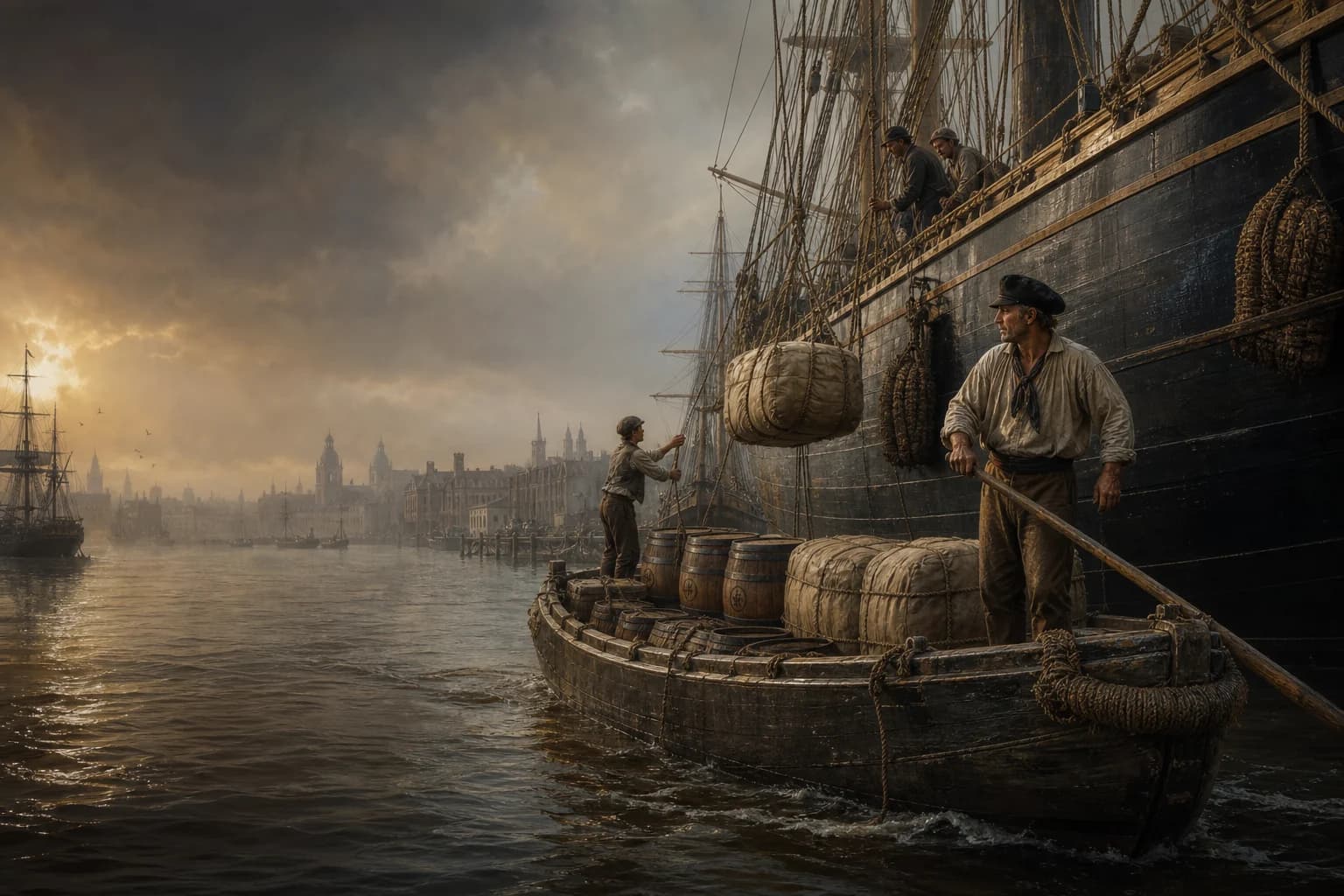
A lighterman handled a lighter on short cargo transfers among anchored ships, quays, warehouses and other vessels. A lighter was generally a shallow-draft, broad cargo barge. Early craft were often unpowered and moved by long sweeps, poles, warps, tide and sometimes sail or tow. The lighterman did more than carry packages: he selected a tidal window, brought the barge safely alongside, controlled load and freeboard, recognized cargo marks and preserved tally and custody evidence at every ship-vessel-shore handoff. Thames lightermen entered the Watermen's Company in 1700 and trained by long apprenticeship, but that was a local London regime rather than a global licence.
Information arrives, judgment forms, and work passes on through a complete watch.
Confirm cargo, draft, ship, wharf, customs state and turn of tide.
Rig fenders and lines and hold the receiving area beneath ship's tackle.
Land for freeboard, list and discharge order, then use the tide window to clear.
Reach the named quay, tally condition, obtain signature and report wet or missing cargo.
Worked after 1700 through a local Company, long apprenticeship and Thames knowledge.
Used a local shallow craft where no deep quay connected ocean ship to shore.
Owned the craft, bore repair and credit exposure and contracted by trip or tonnage.
Read turn, eddy, bridge, shoal and windage and alter position with sweep and warp.
Use fender, breast line and spring to control a work face between moving hulls.
Watch draft, freeboard, list, contamination and multi-stop discharge sequence.
Reconcile marks, tally, seal, condition, destination and signed responsibility.
Institutions, experience, patronage, and opportunity shaped each person’s route.
Tend line, pole and cover and memorize each reach beside a master.
Drive one lighter and answer for one ship-shore cargo handoff.
Train apprentices, allocate craft and take valuable or difficult tidal work.
Finance a fleet and contracts and carry loss, repair and default.
A lighter transferred cargo between a larger vessel and shallow shore, river wharf or another ship. It divided the load of an oceangoing vessel that drew too much water, lacked a berth or waited in a crowded anchorage and let the goods continue into port. The Smithsonian model description likewise identifies a lighter as a small flat-bottomed barge for loading and unloading ships in port.
Barge is a wider class of shallow-water cargo craft, while hoy, keel, wherry and shallop were local forms and names. A barge could perform lighterage without making every bargeman a lighterman. This page uses lighterman to hold the deep-ship-to-shallow-water chain constant; elsewhere, a documented boatman, bargeman or local vessel title may be better.
Many early ports had no continuous deep quay, forcing oceangoing ships to lie in roadstead, channel or outer harbour. Even with a quay, berth supply, tide height, bridge, bar and vessel draft could keep a loaded ship away. A lighter removed small lots, reduced draft and delivered to several river warehouses.
At Yerba Buena Cove in 1849–1854, lighters were effectively the only means of getting people and goods ashore before piers reached deep water. London Museum describes anchored ships depending on lighters between London Bridge and Wapping before enclosed docks. Across different coasts and dates, the same mechanism appears: missing fixed infrastructure creates a floating logistics fleet.
London evidence makes the distinction particularly clear. Watermen carried passengers and baggage in wherries and related boats; lightermen moved coal, timber, grain, food and merchandise in broader, heavier craft. Both required local water knowledge and entered one Company after 1700, but their hulls, customers, risks and earnings differed.
The boundary could still shift by port. A lighter might carry stores, water, coal and people in an emergency, while a waterman accepted baggage or papers. Primary contract and arrangement are better evidence: open cargo space, low freeboard, heavy load and a ship-to-shore bill indicate lighterage; fare-paying passage indicates waterman service.
Traditional Thames lighters were unpowered flat-bottomed craft. A lighterman used one or two long sweeps to alter heading, a pole to fend from shallow bank and warps, breast lines and springs to control a berth while tide supplied most translation. Royal Museums Greenwich records sweeps first and steam-tug towage later; an eighteenth-century scene should not import the tug.
The specialist read shear, eddy, bridge opening, bend, shoal, moored hull, wake and windage. He waited for the useful tide, allowed the loaded barge to ride it into the right reach and reserved stopping water ahead. Brute-force rowing against stream was slow and dangerous. Skill changed the craft's relationship to moving water with the fewest actions.
The lighterman judged approach from wind, stream and working side, rigged fenders, set lines that could be adjusted for motion and put the receiving area below the ship's tackle. Too little separation created crush points; too much let the load swing. Anchor cable, scupper and surrounding boat traffic further constrained the position.
The ship's crew or stevedore controlled tackle and lift while the lighterman controlled barge position and acceptance. Both needed one stop signal, and nobody belonged beneath a suspended load. A wake, surge or parted line justified rejecting the draft and opening away. Dispatch never overruled survival of craft and crew.
Cask, timber, coal, grain sack and valuable case required different arrangements. Heavy goods stayed low without concentrating to one side; loading watched draft and freeboard continuously. An open craft needed dunnage, cover, lashing and drainage. A later account that corn lighters seldom carried sugar reflects specialization caused by cleanliness, smell and residue.
The lighterman did not replace the stevedore planning an ocean hold, but could reject an unsafe lift and tell the gang where the next package could land. Multiple destinations also reversed into discharge sequence. One bad layer could require restowing afloat or immerse the low side first.
At receipt the lighterman checked marks, count, condition, seal and destination with ship clerk, tally clerk or customs officer and obtained a record. Wharf or warehouse receiver repeated the check. Without a defined handoff, wet damage, shortage, torn package and wrong delivery became disputes without proof.
Cargo loss was serious in eighteenth-century London, and later docks, river police and gates all responded to it. Sources record plunderage from lighters and at the ship-lighter interface, but an entire occupation cannot be turned into thieves. A credible system separates customary perquisite, theft, outside robbery, official corruption and tally error and assigns liability from evidence rather than label.
The London Archives records the Watermen's Company founded in 1514 and extended to lightermen in 1700. Until late in the nineteenth century, entry generally required a seven-year apprenticeship with age restrictions. Rules printed in 1701 governed watermen and lightermen on the Thames between Gravesend and Windsor.
Training transmitted tide, wharf, dock, reach, bridge, boat handling and occupational relationships as local knowledge, while controlling who could earn by it. Other British, colonial and Asian ports and temporary anchorages might rely on family boat operators, hired crews, port contractors or another guild. The London Company should be a specific institution, not the world's default skill tree.
A hired lighterman might begin as apprentice, boy or deck hand and take charge after mastering one river. Capital and connections could support ownership, employment of others and charges by trip, tonnage, waiting time or contract. London Museum notes that craft owners could be prosperous beside poorer watermen, but no universal wage crossed centuries.
From the 1790s London enclosed docks promised direct secure discharge and lightermen feared exclusion. The free water clause preserved Company access to the new docks. This was a political bargain over access, warehouse price and labour, not mere technical progress. Lightermen also moved goods of empire, slavery and war; their labour rights, cargo origin and trade victims belong in the same account.
career.lighterman
A skilled river or harbour boatman who handled a shallow-draft lighter carrying cargo among anchored ships, quays, warehouses and other vessels.
Barge is a broad shallow-water cargo category. Lighter emphasizes the function of reducing a larger ship's load and making a ship-to-shore or ship-to-ship short transfer. Local hull forms varied.
In the London regime a lighterman chiefly moved goods while a waterman chiefly carried passengers in smaller boats. Both relied on tide and local knowledge but had different craft, contracts and risks.
Long sweeps, poles, warps and capstan or windlass work adjusted position while tide made much of the passage. Some ports used sail or tow; steam tug assistance was a later change.
For much of the regulated London trade, entry normally required a multi-year and commonly seven-year Company apprenticeship. That rule should not be projected onto every port or century.
They checked marks, count, condition and seals at the ship, lighter, quay or warehouse handoff, obtained tally or receipt and recorded damage before cargo was mixed.