INPUT
→Observe and correct
Record transit and angle; correct clock, instrument and refraction; update reference data.
A real Age of Sail career dossier · 35
Nautical Astronomer · Astronomer Royal · Almanac Editor
The specialist who prearranged the future sky by date, time and meridian so a distant ship could use it to correct position.
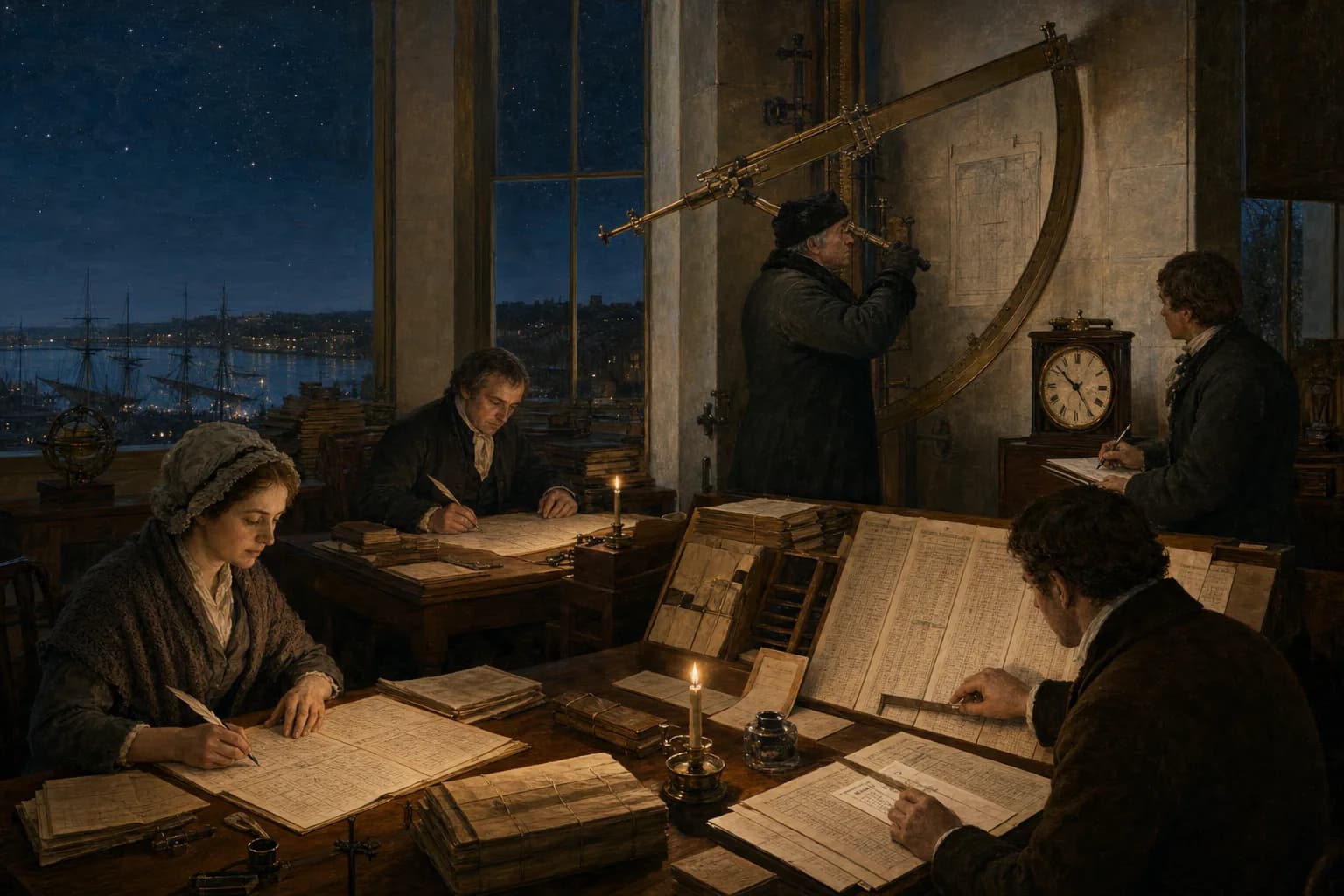
A nautical astronomer repeatedly determined star positions, solar, lunar and planetary motion, meridian transit times and instrument error at an observatory, then combined observations with theory and tables to predict ephemerides for future dates. The first British Nautical Almanac and Astronomical Ephemeris, for 1767, precomputed the Moon's angular distance from the Sun and selected bright stars at three-hour intervals of Greenwich time. A shipboard navigator measured a lunar distance with an octant or sextant, corrected parallax and refraction, recovered Greenwich time from the almanac and compared it with local time for longitude. The Astronomer Royal did not calculate every cell alone. Under Maskelyne, human computers divided the arithmetic; two independently calculated the same material and a comparer reconciled differences. Assistants reduced observations, while printer and proof corrector guarded dense numerical type. 'Computer' was a human occupation requiring literacy, tables, neatness and attention, not necessarily full astronomical training. Mary Edwards and other family workers performed paid calculations and trained another generation. The nautical astronomer was not the sailing master, instrument maker or chronometer maker. The occupation produced dated, timed, meridian-specific and auditable sky data; navigators combined that infrastructure with observations on a moving deck.
Information arrives, judgment forms, and work passes on through a complete watch.
Record transit and angle; correct clock, instrument and refraction; update reference data.
Set dates, times, bodies, source tables, precision, formats and instructions.
Two computers independently finish one parcel; the comparer investigates every mismatch.
Check dense numerical type, publish errata and deliver the volume before ships sail.
Centered meridian observations, reference stars, clocks, instrument correction and catalogues.
Sent parcels and source tables to home computers, then centrally compared duplicate work.
Centered future ephemeris, deadline, dense type, proof, errata and ship distribution.
Control meridian instrument, clock, refraction, zero, level and repeated reading.
Understand star catalogue, solar and lunar theory, time system and future ephemerides.
Parcel work, freeze source versions and specify precision, duplication and comparison.
Check approved copy, metal type, proof, signs, date, unit and erratum by column.
Institutions, experience, patronage, and opportunity shaped each person’s route.
Begin with neat copying, basic tables, clock reading and nightly record.
Own a calculation parcel or instrument set and pass independent checking.
Resolve mismatch, reduce observation, maintain method and train recruits.
Direct science, staff, budget, publication, patronage and fleet liability.
An astronomer or Astronomer Royal set observing programmes, maintained reference stars, solar, lunar and planetary observations, clocks and instrument corrections, and chose source tables. Assistants observed and reduced; computers projected future entries; a comparer reconciled duplicate work; editor and printer produced the annual book. At sea, a master measured altitude or lunar distance, kept ship time, cleared and interpolated, then checked the result against reckoning, lead and chart.
Individuals crossed stages: Maskelyne trialled lunars at sea and later supervised the almanac. Liability nevertheless remained divisible. An observatory error replicated into a batch, a computer shifted one digit, a printer mis-set type, or a navigator chose a wrong limb or date. 'An astronomer invented longitude' hides the production system and its strongest game decisions.
Charles II's warrant charged John Flamsteed with rectifying the tables of celestial motions and fixed-star positions in order to find longitude and improve navigation. The Royal Observatory was therefore Britain's first state-funded scientific research institution with a maritime purpose, not a pure observatory later borrowed by the navy. Flamsteed accumulated more than fifty thousand Moon and star observations over forty years; family and assistants helped reduce and compile them into a catalogue.
The lunar-distance method treated the Moon against the stars as a fast celestial clock hand. If an observatory predicted that angle for a Greenwich time, a distant observer could infer the reference time. It worked only if star catalogue, lunar theory, observatory time and instruments were adequate. A star or lunar-table error became longitude error, not a harmless academic discrepancy.
Eighteenth-century observers used mural quadrant, transit instrument, zenith sector, telescope, micrometer and precision pendulum clock for different tasks. Timing a star over the meridian constrained right ascension; measuring height against horizon or zenith constrained declination. An assistant might call clock seconds while another recorded immediately, leaving the observer at the eyepiece. Instrument suites changed, so a nineteenth-century transit circle does not belong in the 1760s.
Readings required collimation, level, zero, refraction, clock-rate and repeat corrections. Cloud, haze, vibration, temperature, lamp, divisions and human reaction altered results. Astronomers observed reference stars, compared nights, logged adjustment and rejected anomalies. The output was an observatory ledger still awaiting reduction, not a finished ephemeris.
Raw readings were corrected from apparent instrument values into a consistent time and coordinate frame. A star catalogue supplied references, while complex solar and lunar motions required mathematical tables and theory. Early British Almanacs used Tobias Mayer's lunar tables, and the Board of Longitude rewarded Mayer's widow. The production was transnational and intergenerational, not created from nothing by Maskelyne.
The editor specified dates, Greenwich times, bodies, precision, interpolation and supplementary tables, then issued source books and instructions in parcels. Prediction had to reach the press far in advance: an office observed the present while manufacturing one or more future years. A new table or systematic correction required a controlled switch so workers did not mix algorithms.
The volume exceeded an Astronomer Royal and one assistant. Maskelyne typically supervised four to nine Board-paid computers. Literacy, numeracy, command of mathematical and astronomical tables, neatness and attention were core; full astronomy was not essential. Many lived beyond London and worked from home on assigned packets.
Two computers independently calculated the same lunar positions or distances, and a comparer checked them cell by cell. Agreement could still preserve a shared bad source, but disagreement exposed arithmetic, copying and interpolation. The comparer chose where to recalculate, what query to return and how to treat rounding. Malachy Hitchins's long tenure shows checking as a distinct skilled post, not junior tidying.
The first volume supplied lunar distances alongside positions and phenomena of Sun, Moon, planets and selected stars. Its key table gave the Moon's centre from the Sun or a suitable star every three hours of Greenwich time for interpolation. Maskelyne's accompanying Tables Requisite provided parallax, refraction, instructions and worked examples, sparing each navigator from rebuilding the theory.
Calendar date, meridian, time convention, angular unit, sign and rounding had to agree. Midnight, leap year, phase, star name or hemisphere could create gross error. Editors coordinated paper, type, table rules, signatures and delivery. Dense metal type could reverse digits, change columns or omit rows, so proofs were compared again to approved copy. An erratum helped only ships that received it.
A navigator measured apparent Moon-to-Sun or Moon-to-star distance and both altitudes with an octant or sextant. Index error, dip, refraction, semi-diameter and especially lunar parallax were cleared to a geocentric distance. Interpolation in the three-hour table yielded Greenwich time. Local apparent time came from Sun or stars, and the time difference converted at fifteen degrees per hour to longitude.
A deck moved, the horizon hazed, the lunar limb blurred and calculation was long. Maskelyne's trial showed useful improvement over reckoning but not instant universal adoption. As marine timekeepers became reliable and cheaper, they carried reference time, yet still required solar and stellar data, observation and rate checks. Ships combined lunars, timekeeper, dead reckoning and landfall rather than replacing every old method at once.
Error could enter at observation, theory, source table, arithmetic, copying, comparison, layout or press. The dangerous value was plausible, not absurd. Instructions, worksheets, paired results, queries, approved copy, proofs, accounts and errata allowed tracing through production.
Institutional continuity mattered too. After Maskelyne's death in 1811, weak supervision and poor handover contributed to an early-nineteenth-century decline in Almanac reputation. Accuracy could not live only in one editor's memory. The game system is a budget for duplicate computation, disagreement handling, source-version freeze, deadline and public correction—not an intelligence score that removes error.
Astronomers often trained in mathematics, natural philosophy and observation and entered through university, church, patronage, Royal Society or assistantship. Advancement demanded dependable observation, published tables, instrument judgment and administration. A computer might begin as teacher, clergyman, surveyor, mathematical practitioner or family trainee, build trust through neat punctual packets, and move toward comparer, assistant or table maker.
Mary Edwards computed for the Almanac over many years and trained or worked with daughters. Some of her labour first appeared under her husband's name before direct Board recognition. Home piecework widened recruitment while hiding paper, heat, illness, household collaboration and unequal credit. Pay included office salary, Board calculation payments, parcel piecework, publication and teaching, with a gulf in status and security between Astronomer Royal and the many calculators.
career.nautical-astronomer
The astronomer observed and corrected star, Sun, Moon and planet data, chose theoretical tables and organized future ephemerides so shipboard observations could be tied to reference time and position.
A person who performed large calculations with pen and tables. Almanac work was parcelled out, independently duplicated and checked by a comparer.
The first issue supplied data for 1767 and bore that year; printing was underway in 1766, while research indicates finished copies reached the office in early 1767.
A navigator cleared a measured Moon-to-Sun or star angle, used the table to infer Greenwich time, compared it with local astronomical time, and converted the difference at fifteen degrees per hour.
No. A chronometer carried reference time, while celestial data still supported local time, latitude, rate checks and sight reduction.
Yes. Mary Edwards was a long-serving paid computer and her daughters assisted or continued work, though household practice and imprints obscured credit.