INPUT
→Accumulate track
Record course, speed, time, current and handling changes.
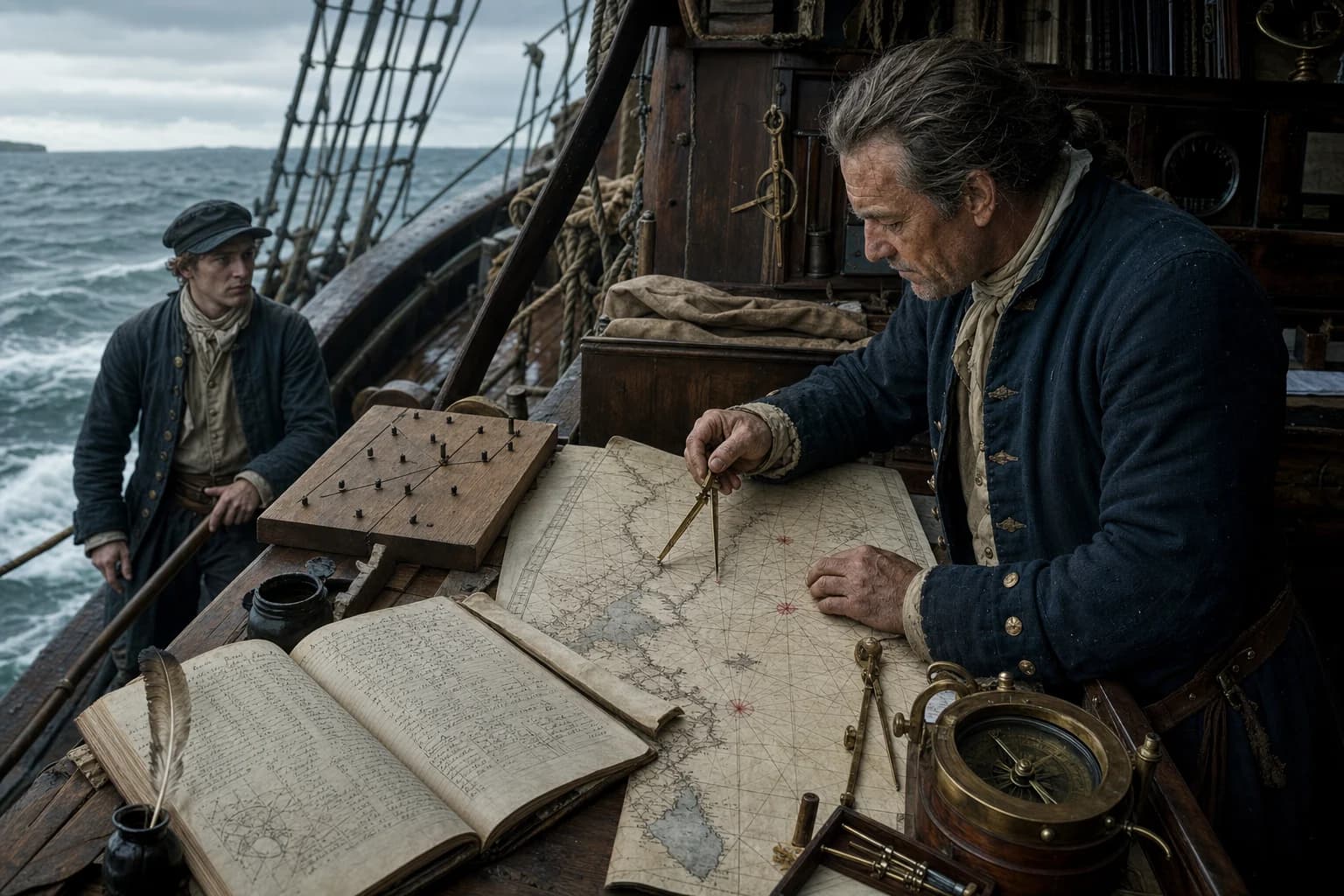
A real Age of Sail career dossier · 02
Sailing Master · Master Mariner
The specialist who manages error in incomplete observations and reports position into command.
A sailing master was a senior professional seaman aboard a large sailing warship, responsible for navigation, charts and logs, navigational observations, and advice on handling, loading and sailing condition. He advised the captain but did not normally hold supreme military command. A helmsman executed a course, while a local pilot supplied knowledge of a particular harbour or waterway. Merchant commanders were also called masters, so master cannot always be translated as sailing master.
Information arrives, judgment forms, and work passes on through a complete watch.
Record course, speed, time, current and handling changes.
Use celestial body, land mark or depth to constrain position.
Explain disagreement and set a margin around the estimate.
Recommend course, reduced sail, soundings or waiting to the captain.
Professional navigator below supreme command, responsible for charts, logs, stowage and sailing condition.
Offices could merge and professional navigation sat closer to watch execution.
A merchant master was often the commander; master does not always mean sailing master.
Compare dead reckoning, celestial observation, soundings and terrestrial bearings.
Maintain track and correction records another watch can audit.
Bring wind, sea, canvas, ballast and trim into the route model.
Separate known position, estimated position and unresolved danger for command.
Institutions, experience, patronage, and opportunity shaped each person’s route.
First acquire real sail, helm and heavy-weather experience.
Work speed, log, cables, headsails and stowage.
Carry whole-ship navigation by service, recommendation, examination or warrant.
The office did not always sit on the normal commissioned path to captain.
In late eighteenth- and early nineteenth-century British and American naval settings, the sailing master was an experienced technical officer charged with bringing the vessel safely and effectively to the ordered place. United States regulations of 1814 gave the office its own duties, while USS Constitution's complement classified the master among warrant officers.
A merchant master was commonly the vessel's overall commander and should not automatically be recast as a subordinate navigator. Seventeenth-century records also use skipper, pilot, stuurman and patron differently. This dossier concerns the specialist below supreme command, not every historical person whose title contained master.
The sailing master combined chart, compass course, speed, elapsed time, soundings, wind, current and astronomical observations to estimate position and anticipate the next danger. A fix was not guaranteed each day: cloud could prevent observation, charts could omit shoals, and dead reckoning accumulated error from compass, speed, current and leeway.
Professional value lay in managing uncertainty. Near land, soundings, bearings and tides gained weight; offshore, dead reckoning could be compared with astronomical observation. In formation or battle, navigation also had to serve the captain's mission. Judgment finally became courses and shiphandling advice that watch officers and helmsmen could execute.
USS Constitution Museum assigns charts, the logbook and a journal of uncharted dangers to the sailing master. The log preserved course, speed, weather, position and important events so one watch could continue another's reasoning and later inquiry had written evidence.
Tools varied with date but could include compass, log line and glass, lead line, chart, dividers and parallel rules, cross-staff or backstaff, quadrant, octant or sextant. No instrument navigated by itself. The master needed magnetic variation, leeway, current, observation error and practical knowledge of the ship under sail.
In early United States naval practice the sailing master did more than draw tracks. He supervised the stowage of ballast, provisions and cargo so the vessel retained workable trim and sailing qualities, inspected supplies coming aboard and reported deficiencies to the captain. Bad stowage could degrade steering, stability and draught together.
Master's mates assisted with speed measurement, logs, headsails and anchor cables. In the USS Constitution establishment the boatswain and carpenter also reported through the sailing master on relevant technical matters. That reporting line was not universal, but it shows navigation joining data, hull condition, rigging and the hold.
The captain selected the mission and acceptable risk; the sailing master proposed safe routes and shiphandling. They could disagree in storm, shoal water or combat, but final command remained with the captain. Technical office required a clear account of danger and accurate records, not replacement of military authority.
A helmsman kept the rudder and vessel on an ordered course. A pilot contributed intimate knowledge of a harbour, river, shoal, tide and local practice for a limited stretch. A master who had crossed an ocean could still need a pilot, because general navigation did not replace changing local knowledge.
A sailing master first needed to be a dependable seaman who understood sail, manoeuvre, reefing, anchoring and heavy weather. Arithmetic, reading, charts, observation and logs were added to that foundation. Work as a master's mate offered experience in speed, recording, stowage and handling, although services did not share one examination ladder.
Around the War of 1812, a United States sailing master held a Navy Department warrant rather than a commission and occupied a nonpromotion-track position in that establishment. The office combined high technical standing and broad responsibility without automatically leading to captain.
USS Constitution's 1812 pay evidence gives the sailing master $40 per month and two rations per day, twice the cited monthly pay of a master's mate. A sixteenth-century account of a Portuguese India voyage also places master and pilot among highly rewarded specialists, but its currency, freight privileges and appointment system cannot be merged with American naval pay.
Occupational risks included grounding, collision, missed watering places, bad stowage and responsibility for a false log as well as ordinary injury and disease. Unknown coasts and severe weather left probability even after sound work. The rarest skill was not memorizing formulae but detecting uncertainty, preserving a margin and warning command in time.
career.sailing-master
Usually not on a large warship. The captain held supreme command while the sailing master directed professional navigation. A merchant master, however, was often the overall commander.
He understood and could take part in shiphandling, especially at critical moments, but helmsmen and watchkeepers normally operated the wheel or tiller.
By combining course, speed, time, soundings, bearings, wind, current and astronomical observations, then correcting dead reckoning when new evidence appeared.
The master managed navigation across the voyage; a pilot contributed detailed local knowledge of a harbour, river, shoal and tide for a particular waterway.
No. Instrument observation was one part of seamanship, charts and logs, error analysis, stowage, watch coordination and responsibility to command.
It depended on the service. Transfer was possible in some careers, but the early U.S. sailing master held a warrant and did not share the normal commissioned-officer promotion track.