INPUT
→Specify and allocate
Set use, range, accuracy, price, material, specialists and deadline.
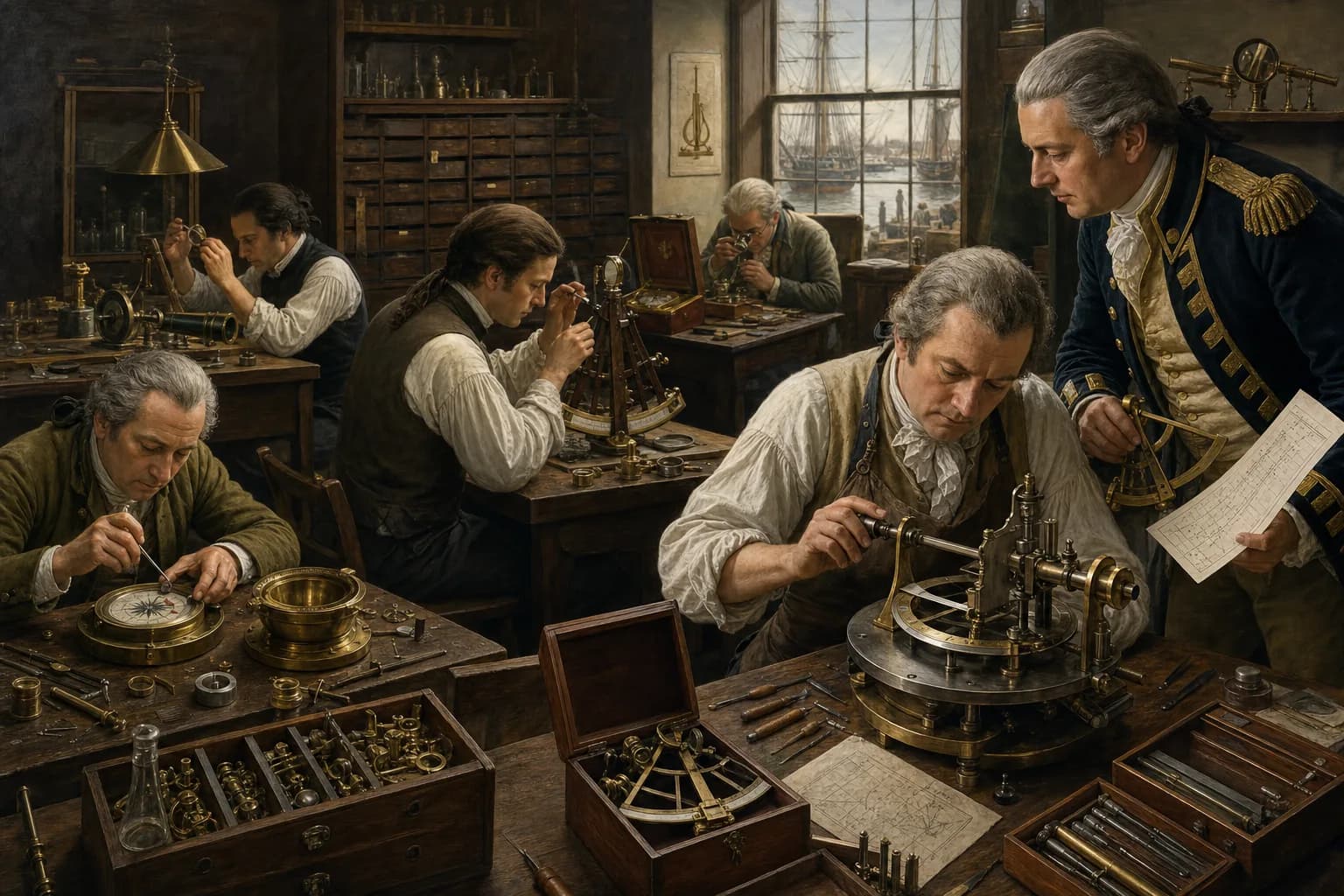
A real Age of Sail career dossier · 36
Navigation Instrument Maker · Mathematical Instrument Maker
The craftsperson who enclosed angle, direction or time in wood, brass, steel and glass fit for a rolling deck—and answered for every mark.
No single universal 'navigation instrument maker' normally made everything from a compass needle or mariner's astrolabe to a marine chronometer. A navigation or mathematical instrument maker designed or assembled angular, surveying and drawing devices and coordinated brass founders, frame makers, scale dividers or engravers, opticians, case makers and retailers. A compass maker magnetized the needle, prepared the card, tuned pivot and balance and mounted bowl, glass and gimbals. Clock or watchmakers alone specialized in escapement, balance, spring, jewel, wheel train and long-term rate for marine timekeepers. A large house could integrate these trades or buy components, apply its name and assume sale, repair and warranty. Around 1750–1800, a reflecting octant or sextant required stable frame, accurate index arm, index and horizon mirrors, shades, sight or telescope and, critically, a divided arc. Jesse Ramsden's circular dividing engine partly mechanized small angular scales and improved capacity and consistency, without replacing material control, assembly, adjustment or independent test. A compass was not a needle in a bowl: retained magnetism, balanced card, pivot friction, gimbal axes, lubber line and shipboard iron all affected reading. The maker delivered stated range, least count, index error, maker or serial identity, accessories, case and repair condition, backed by workshop, observatory, Board, Admiralty or user trials on a moving vessel.
Information arrives, judgment forms, and work passes on through a complete watch.
Set use, range, accuracy, price, material, specialists and deadline.
Produce frame, arc, card, pivot, mirrors, optics, case and specialist parts.
Control play, alignment, friction, magnetism, divisions, index error and repeatability.
Pass comparison or sea trial, deliver accessories and preserve correction and repair record.
Sold ordinary compass, octant, telescope, case, instruction and repair to merchant navigators.
Centered divided brass arcs, verniers, optics and survey or lunar instruments.
Centered batch consistency, certification, trial, training, cost and delivery.
Turn range, radius, double reflection and least count into accurate arc, vernier and correction.
Control frame stress, pivots, mirrors, telescope, gimbals, fasteners and play.
Magnetize and balance compasses; select and align glass, lens, shade and sight.
Number, compare standards, record error, case, certify and maintain repair history.
Institutions, experience, patronage, and opportunity shaped each person’s route.
Begin with filing, turning, grinding, cards, cleaning, cases and shop ledger.
Own one component or adjustment and pass master inspection.
Join bought and made parts into a complete instrument with stated error.
Control standards, machines, brand, credit, patronage, workforce and failure liability.
A mathematical instrument maker produced sectors, rules, quadrants, octants, sextants, survey instruments and drawing tools, mastering geometry, brass or wooden frames, pivots, scales and fine adjustment. Opticians supplied lenses, telescopes and sometimes mirrors; compass makers controlled magnet, card, pivot, bowl and gimbal; watch and clockmakers handled wheel train, escapement, balance, spring, jewelling and case. Founders, turners, engravers, cabinetmakers and printers supplied further parts.
A London, Paris, Amsterdam or port shop could sell all under one master and sign, while outside journeymen and specialist firms made components. Museum records call Ramsden both mathematical instrument maker and optician, while the Adams business sold compasses and octants. Commercial integration does not prove one master made each part. Distinguish inventor, maker, retailer, agent, certifier and repairer.
A customer specified Sun altitude, lunar distance, bearing, magnetic variation, coastal angle, reference time or plotting. The maker chose range, radius, material, graduation, telescope, shades, case, weather protection and readable precision. A cheap wooden octant served routine latitude; lunars and survey favoured stable brass, tangent adjustment, vernier, optics and fine division.
Cost exceeded brass weight. Ebony, mahogany, boxwood, ivory, silver scales, plate and optical glass, steel magnet, jewel and spring came from different supplies. War, import limits, internal stress and bad blanks disrupted delivery. The master prepared material lists, allocated work, reserved inspection margin and decided if an experimental improvement justified price and delay.
A circa-1750 compass might carry a paper card on one iron needle, its brass cap resting on a central spike. The card received points and degrees, then tiny sealing-wax weights for balance. Lead lowered the bowl's centre of mass, brass gimbals kept it nearer level, glass excluded wind and dirt, and a lubber line connected card direction to the ship's axis. Every element introduced friction, lag, tilt or reading error.
After 1745 Gowin Knight developed strongly magnetized steel bars and longer-lasting needles, with the Adams firm acting as agent. This reduced continuous remagnetization at sea, though instruments still returned to firms for the work. Makers selected steel, magnetized and checked poles, tuned pivot and card, then compared known bearing or azimuth. Nearby guns, ship iron and magnetic variation remained installation and use problems.
Earlier ocean navigators used mariner's astrolabe, quadrant, cross-staff and later backstaff for Sun or star altitude. A cast brass astrolabe needed weight and perforation against wind, a free alidade and reliable limb; wooden staffs required straight scales, edges and vanes. Instruments faced observer toward or away from Sun, used horizon differently and behaved differently in roll.
Makers copied established patterns because regions, navigator habits, price and repair networks persisted. Wooden octants remained useful on merchantmen after reflecting instruments appeared, and a simple compass did not vanish with a sophisticated azimuth attachment. Adoption and service matter more than an invention date.
John Hadley showed a reflecting octant to the Royal Society in 1731. Double reflection made an index rotation register twice the angle and let an observer bring the reflected body onto the direct horizon from a moving deck. George Adams's 1753 octant combines mahogany frame, boxwood limb, brass, index and horizon glass, coloured shades and sight vanes—a joined product of wood, metal, glass and division.
The sextant's nominal one-sixth arc measured a larger angle through double reflection and suited lunars. The maker kept frame unwarped, index pivot free of play, mirrors perpendicular, horizon glass adjustable, shades optically tolerable and telescope aligned. Adjusting screws permitted correction but also damage, and the user still established index error.
Before dividing engines, a specialist built arc divisions with master circle, geometrical subdivision, beam compass and graver, a slow process whose errors propagated. Ramsden's 1767 circular engine used a precision screw and ratchet to rotate a mounted instrument through known increments. The Board of Longitude later required him to share the design to expand reliable supply.
The machine still needed accurate master circle, uniform screw, low backlash, stable mounting and temperature. Number, vernier or transversal followed, with eccentricity and local-error tests. Known angles, collimating telescopes, celestial observations or comparison standards created corrections. Repeat positioning did not align mirrors or stabilize frames by itself.
A sea timekeeper held reference time against temperature, motion, humidity, spring torque and lubrication. H4 joined brass, steel, silver, diamond, ruby, enamel, copper and glass with a special balance, escapement, remontoir, temperature compensation, jewelling and anti-friction practice. John Jefferys made a key pocket watch to Harrison's design, showing invention resting on a watchmaking network.
The Board commissioned Larcum Kendall to copy H4 part for part. K1 took until 1769 and months of adjustment, then excelled on Cook's second voyage. Cheaper simplified K2 and K3 performed worse, separating manufacture, cost and rate. Arnold, Earnshaw and others later advanced detent escapement and compensation balance, making chronometers a scalable specialist product—still within the clock and watch trade.
Finished work was checked for range, least division, zero or index error, repeatability, mirror or telescope alignment, compass freedom, clock rate and complete case. Maker or certifier cut name, place and number and supplied key, shades, telescope, instructions and correction. A Board, observatory, naval officer or respected navigator might compare it, while one demonstration could not substitute temperature, roll and voyage trial.
Port shops repaired salt corrosion, warped frame, scratched glass, broken shades, dull pivots, weak magnets, damaged case and poor timekeeper rate. Unauthorized repair altered corrections; false marks and retailer relabelling obscured provenance. Ralph Walker's compass was praised in 1794 trial and adopted in 1795 yet remained costly and difficult, eventually limiting issue. Design, training, cost and fleet adoption had to align.
Entry came through mathematical instruments, optics, clockmaking or adjacent metal trades. Apprentices flattened brass, filed frame, turned pivot, ground glass, filled wax, drew cards, made cases and cleaned before geometry, division, mirror adjustment, magnetization and inspection. Guild and company records organized master and apprenticeship, while freedom and subcontracting varied by city and time.
Journeymen specialized in division, engraving, cards, optics or escapements. The master designed jigs, maintained shop standards, controlled stock and credit, sought Admiralty or Board contracts and chose repair, refund or reputational loss after failure. Piecework, retail margin, commission, patent or prize, repair and instruction supplied income. A prestigious sign charged more and made every falsely signed inferior piece a threat.
career.navigation-instrument-maker
No. Mathematical instrument makers, compass makers, opticians, dividers and clockmakers had different training. A large shop could integrate or outsource work, but one person rarely mastered needle through chronometer.
A maker magnetized an iron or steel needle, attached and balanced its paper card, tuned a low-friction pivot and mounted it in a weighted bowl, glass and gimbals before directional tests.
The index and horizon glasses used double reflection to place a celestial image against the directly seen horizon; an index-arm rotation represented twice that measured angle.
A precision screw and ratchet partly mechanized equal angular divisions on octant and sextant arcs, increasing output and consistency while leaving assembly and calibration to skilled hands.
Normally specialist clock and watchmakers made its escapement, balance, spring, jewels and train. A general shop might retail, case or broker repairs.
Transport, temperature, frame stress, mirror angle, pivot friction and local magnetism changed readings. Arc division was only one part of total error.