INPUT
→Reconcile pattern and metal
Set calibre, weight, allowances, charge, heats and labour.
A real Age of Sail career dossier · 32
Gun Founder · Cannon Founder · Master Founder
The specialist who turned one melt, one mould and one irreversible pour into a pressure-bearing gun barrel.
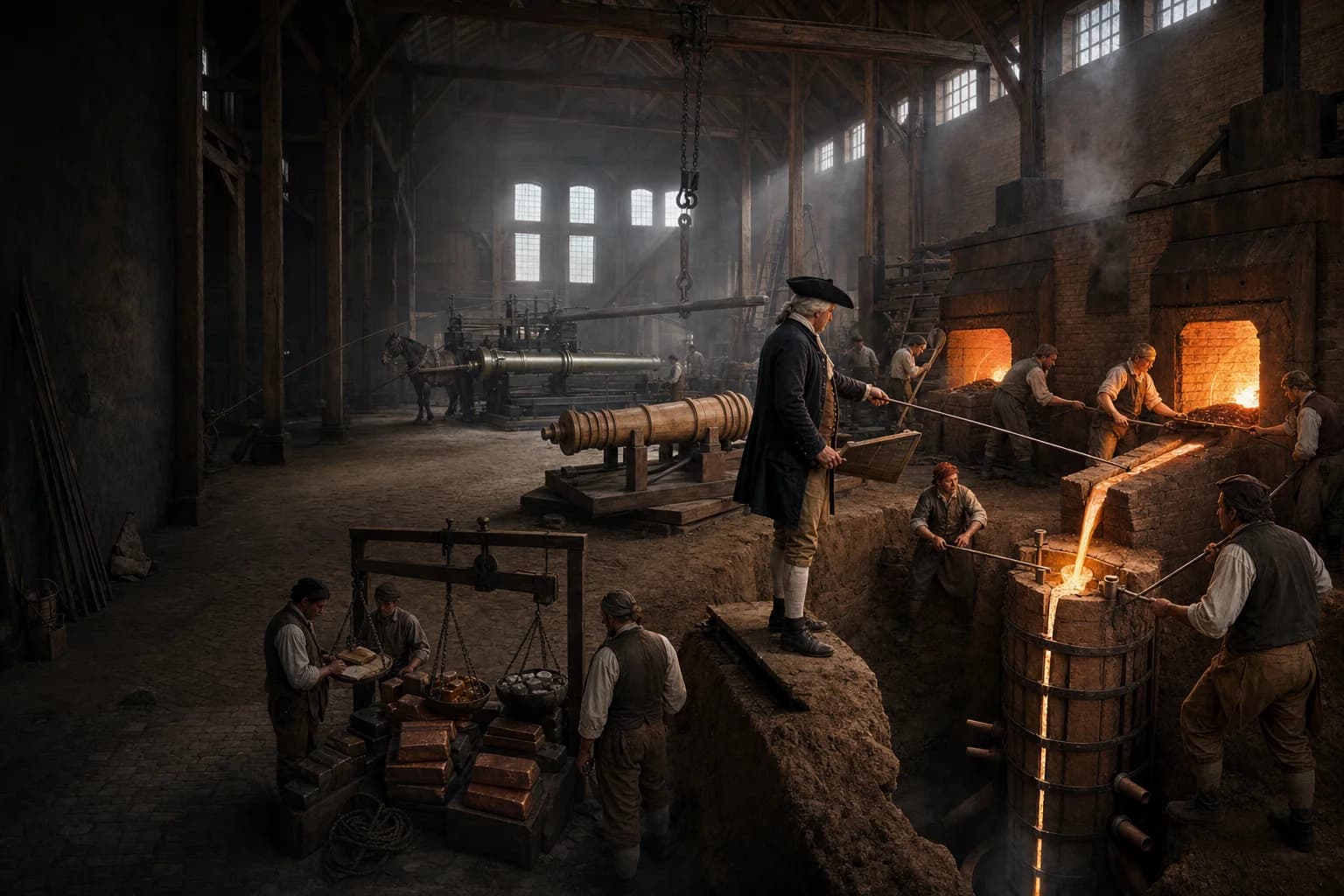
A naval cannon founder translated an ordnance pattern, calibre and target weight into a pressure-bearing gun barrel. The Master Founder organized pattern makers, moulders, furnace men, casters and labourers. A full gun model on a turning frame received trunnion, cascabel and ornament patterns; layers of loam were applied, reinforced with hemp or wooden slats, baked, opened and fitted with vents and runners. Copper, tin, old-gun metal or iron charge was weighed, melted and poured into a dry mould buried in a casting pit. After cooling and breakout, the casting was cleaned, weighed and examined for blowholes and shrinkage before a boring mill machined bore, vent and reference surfaces. Ordnance personnel then gauged, inspected internally and proof-fired it. The founder was not the shipboard Master Gunner, carriage maker, powder worker or independent accepting officer. Bronze and cast iron involved different materials and supply systems, while hollow casting and solid boring varied by time and place. This dossier centres sixteenth- to early-nineteenth-century evidence, especially eighteenth-century Woolwich.
Information arrives, judgment forms, and work passes on through a complete watch.
Set calibre, weight, allowances, charge, heats and labour.
Complete model, loam mould, reinforcement, vents, feeding and drying.
Weigh, melt and control slag, then complete one coordinated pit pour.
Cool, clean, weigh and inspect before boring and independent proof.
Centered standard patterns, costly copper and tin, maker marks, boring and formal proof.
Used blast-furnace iron for large orders with high rejection and batch-failure exposure.
Co-located casting, boring, carriages, ammunition, storage and proof under distinct gangs and liabilities.
Control allowance, loam layers, reinforcement, vents, feeding and drying.
Weigh and manage alloy or iron charge, furnace temperature, slag, fluidity and tapping window.
Synchronize mould lift, ramming, channels, pour, retreat and controlled cooling.
Connect blowhole, shrinkage, cold shut, core shift and proof failure to a casting batch.
Institutions, experience, patronage, and opportunity shaped each person’s route.
Begin with loam, fuel, handling, drying, cleaning and escape discipline.
Own a mould stage, a metal charge or small ordnance.
Connect pattern, mould, melt, pit and casting book into an accountable batch.
Control process, contract, plant, people, acceptance relationship and casualty liability.
An ordnance authority or designer fixed pattern, calibre, length, reinforces, trunnions and target weight. The Master Founder interpreted these into mould, charge, heats and pour; borers machined the casting; proof officers and gunners inspected and fired it; carriage makers built the wooden mounting; the shipboard Master Gunner controlled inventory, powder, training and combat use.
One arsenal might place all stages under common management and a private ironworks might contract several steps, but 'gun maker' should not erase liability. Ask who owned melt and mould failure, bore geometry, acceptance authority and shipboard operation.
Smoothbore guns were commonly classified by nominal round-shot weight, while the barrel could weigh thousands of pounds. Pattern governed bore, chase, reinforces, breech, muzzle, cascabel and trunnions. Naval service further required the gun to pass ports, recoil, run in and balance on a carriage. The founder turned a drawing or standard piece into a full-size model with shrink and machining allowances.
Woolwich images of about 1776–78 show wooden trunnion patterns, dolphins, royal cipher and ornament applied to a complete 24-pounder pattern. Decoration expressed authority and could carry maker, year, weight or ownership, but every projection complicated mould release and venting. Coaxial bore, sound breech and correctly placed trunnions remained primary.
So-called brass ordnance was commonly copper-tin bronze. A large beam scale controlled copper, tin and reusable old-gun metal, while the founder managed segregation, oxidation and slag. Bronze was costly but readily remelted, took surface detail and was less prone than brittle cast iron to sudden fragmentation; elaborate royal guns made use of those qualities.
Cast-iron ordnance depended on blast furnace, ore, fuel and foundry iron. Lower unit cost armed fleets with more heavy guns, but graphite, slag, sand holes, cold shuts, shrinkage and brittle failure made process control critical. Local ore and charcoal or coke practice changed results. No universal alloy recipe or bronze-good/iron-bad hierarchy fits the entire period.
Moulders shaped a gun model on a spindle or turning frame, brushing repeated layers of finely ground refractory clay and sand as loam. Woolwich images record hemp winding, clay bats, outer wooden slats and iron hoops. The mould was baked, spindle and pattern removed, and trunnion cavities, cascabel plug and inner details finished.
Sprues, runners, feeding head and air vents controlled filling. Trapped gas made blowholes, interrupted or chilled flow made cold shuts, and inadequate feeding left shrinkage cavities. Graphite improved the cast surface but could not repair bad structure. Residual moisture flashed into steam against molten metal and could throw metal and mould across the foundry.
The finished mould was lifted into a casting pit and rammed with earth in layers against the pressure of tons of metal. Cascabel mould, barrel, feeding head and channels were aligned with the casting direction. Pits near groundwater needed drainage and pumping. Lifting, sealing, ramming and channel baking had to finish before the furnace was ready.
At tapping, the master synchronized metal release, ladles or channels, slag control, flow order and escape lanes. A cold melt failed to fill; excess heat encouraged erosion, gas or segregation; violent flow entrained slag and air, slow flow froze early. Thick breech and thinner chase then cooled under control, because premature breakout or local quenching locked thermal stress into the gun.
A clay-covered core or newel could cast an approximate hollow for later reaming. Core eccentricity left one wall thin, while supports and near-bore impurities created weaknesses. In the later eighteenth century the Verbruggens at Woolwich and other makers expanded solid casting followed by horizontal boring: the casting rotated around a fixed-axis boring bar for a straighter, more repeatable bore.
Solid casting reduced direct core disturbance at the bore but demanded more power, secure mounting, time and removed metal; it did not eliminate internal shrinkage or segregation. Boring hands also addressed muzzle, vent, trunnions or references and determined centre of gravity. Historic England identifies Woolwich's boring tower and the RMG drawings show the mill, joining two distinct specialist stages.
After removing mould, sprues, feed head and flash, workers examined surface, trunnions, cascabel and visible cavities. Boring was followed by gauges for calibre, straightness, wall and position. The Woolwich record shows candle examination of a bore; British eighteenth-century evidence names Desaguliers' instrument for straightness and internal defects. The beam scale served charge, finished weight and centre of gravity.
Final proof firing normally belonged to ordnance acceptance, not self-certification by the founder. The piece was re-examined for crack, distortion, bore and vent before acceptance. David Tanner's records include burst pieces, bad trunnions, interior defects and alleged concealed plugs, showing why mark and surface could not replace independent proof. Charge and sampling rules changed, so no fixed proof multiple belongs to the whole era.
Furnace crews faced radiant heat, spatter, carbon monoxide, fumes and breakout; pit hands faced steam explosions, unstable ramming and blocked exits; riggers moved multi-ton moulds and guns; borers worked beside rotating masses, chips and drives. The lethal Moorfields gunfoundry explosion of 1716 helped prompt the state-built Royal Brass Foundry at Woolwich.
Gunfounding was also wartime contracting. Sudden demand strained metal supply, rejected proof destroyed batch value and reputation, and shortage tempted doubtful scrap. The master separated returns, recorded heats and castings, guarded patterns, scheduled long furnace cycles and prevented schedule repairs from becoming hidden defects.
Entry could come through bell founding, bronze or iron casting, moulding, furnace work or the pattern shop. Apprentices learned loam, reinforcement, drying, charge and cleaning before small gun or mortar moulds and a furnace. Master responsibility integrated model, mould, pit, melt, pour, cooling, boring handoff and proof record.
Jan and Pieter Verbruggen became joint Master Founders at Woolwich in 1770, and Pieter later served alone. Their careers show the force of machine design, transnational recruitment and state patronage. A founder could become works owner, ordnance contractor or superintendent but did not thereby enter a warship's command succession.
career.naval-cannon-founder
The founder organized barrel patterns and moulds, metal charge, furnaces, casting-pit pour and casting quality, directing moulders, furnace men and casting labour.
No. The founder made barrels ashore; the Master Gunner kept guns and powder and trained crews aboard. Boring, carriage work and independent proof could be separate again.
Both. Their mix changed with state, date, gun type, resources and cost. Bronze was costly and recyclable; cast iron was cheaper but demanded strict control of internal defects.
Solid boring avoided a displaced core directly creating uneven walls and could produce a straighter, more regular bore, at the cost of power, time and removed metal.
Water contacting molten bronze or iron flashed into high-pressure steam, causing violent spatter or a mould explosion. Drying also reduced gas defects.
It was cleaned, weighed, gauged and internally examined, then subjected to ordnance proof firing and another inspection. Charge, sampling and marks varied by authority and date.