In one minute
What did this event actually change?
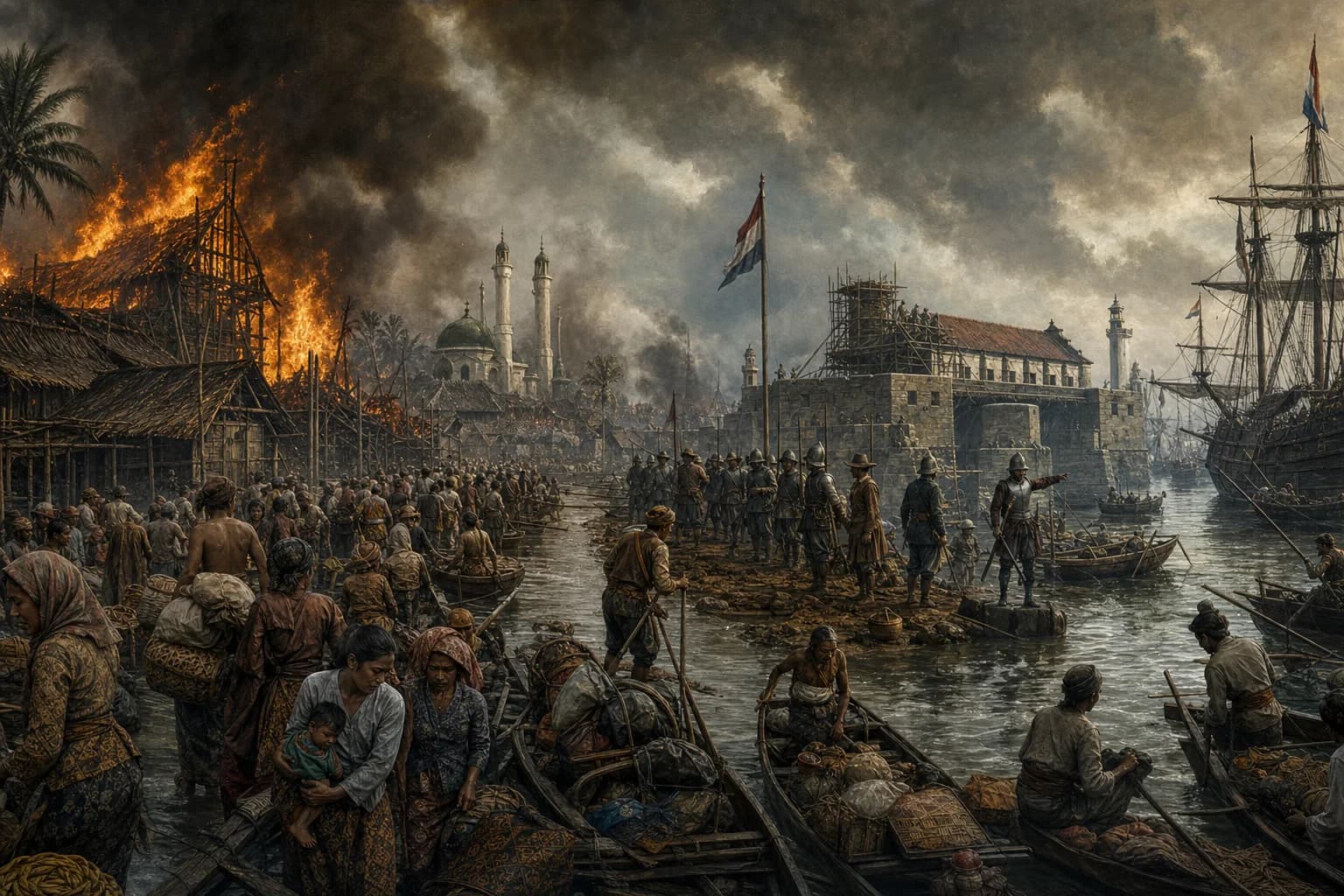
In 1619, VOC governor-general Jan Pieterszoon Coen returned to Java amid conflict with Banten, Jayakarta's ruler and the English East India Company. His forces destroyed Jayakarta and expanded a fortified company city on its site. Batavia became the VOC's Asian administrative and shipping centre, but never a simply Dutch city: Chinese merchants, migrants from across Asia, enslaved people and regional supply networks sustained it.
- Predecessor
- The Javanese port of Jayakarta
- VOC leader
- Jan Pieterszoon Coen
- Competing powers
- Banten, Jayakarta's ruler and the English East India Company
- New function
- VOC Asian headquarters, fortress and entrepôt
- Urban foundation
- Asian migration, Chinese commerce, enslaved labour and company military rule
Chronology
A process, not a single date
Causes, turning points and aftermath form one process, far larger than a capital’s fall, a signed treaty or a company’s founding date.
- 01
The VOC warehouse at Jayakarta is fortified
The port lies within Banten's political sphere and a competitive trading region; the company's site is not sovereign ground.
- 02
Coen turns the post into a fortress
Conflict with local authorities and English rivals escalates until the VOC compound is besieged.
- 03
Coen sails away for reinforcements
Those left behind preserve the fort through unstable negotiations while the company remains locally outmatched.
- 04
VOC forces destroy Jayakarta
Coen returns, defeats his rivals, burns the old town and displaces residents before expanding the fortified settlement.
- 05
The company confirms the name Batavia
The governor-general and Council of the Indies make it the centre for coordinating a growing network of Asian posts.
- 06
Migration, slavery and disease shape the city
Europeans remain a minority as Chinese, Malay, South Asian and archipelagic peoples supply labour, commerce and population.
Why did the VOC insist on a headquarters of its own?
Company factories were scattered, and fleet commanders changed with voyages. To direct warehouses, repairs, courts, shipping and war, the VOC created a governor-general and council and sought a fixed centre beyond the daily control of a strong local ruler.
Jayakarta offered access to the Sunda Strait and Javanese markets, but it stood amid the power of Banten, a local prince and English competition. The VOC no longer wanted permission for a warehouse. It wanted land on which it alone could fortify, garrison and legislate.
Batavia rose on a destroyed port
Coen armed the existing compound until conflict made his position untenable. After leaving to obtain forces, he returned in May 1619. VOC troops defeated their opponents, destroyed much of Jayakarta and drove residents from the core area.
Calling this the founding of Batavia can hide the action inside the word 'founding.' The company city was built through conquest and spatial replacement: a headquarters on the site of a port its army had deliberately cleared.
Who made Batavia work?
The VOC imagined a Dutch ordered town but attracted too few European settlers. Chinese traders, artisans and sugar producers became indispensable. People from Java, the Malay world, India and other islands joined a population in which enslaved people performed domestic, dockside, craft and construction labour.
The company sorted residents through legal status, religion, origin and designated quarters, backed by prison and forced work. Batavia was institutionally Dutch and demographically Asian—a colonial city produced by migration, commerce and coercion together.
How did one city give a company territorial power?
Fort, warehouses, ship facilities, archives and government offices let the VOC schedule intra-Asian trade, dispatch soldiers, try cases and negotiate treaties from one base. Information and violence could now accumulate between sailing seasons.
Yet Batavia never made the company omnipotent. It depended on Asian creditors, brokers, sailors, troops and food suppliers, and controlled the archipelago only unevenly. Headquarters was a machine for producing power, not evidence that all Indonesia had been conquered in 1619.
Evidence boundary
Fact, interpretation and uncertainty
The evidence reveals where imperial claims diverged from reality and where heroic stories compressed complex wars.
Batavia followed the violent destruction of Jayakarta
Dutch archival and museum records explicitly describe Coen's 1619 attack, the old town's destruction and the new headquarters.
Dutch migrants did not build Batavia alone
Europeans remained a minority. Asian merchants and migrants, enslaved labourers and local suppliers maintained its economy and daily life.
A headquarters was not control of all Indonesia
VOC authority first concentrated in selected ports, routes and commodity regions, then expanded through long wars and alliances.
Questions
Common questions
Is Batavia the same place as Jakarta?
They occupy the same urban core. The VOC destroyed Jayakarta and built Batavia there; the name Jakarta returned during the Second World War and Indonesian independence.
From whom did the VOC take Jayakarta?
The conflict involved Jayakarta's ruler, the Sultanate of Banten and the English company. It cannot be reduced to the Dutch fighting one isolated opponent.
Were most residents Dutch?
No. Europeans were a minority. Chinese, Malay, South Asian and other Asian communities, including many enslaved people, formed most of the population.
Why is Coen so controversial?
He strengthened VOC monopoly and administration through destruction, forced movement and mass violence, most notoriously at the Banda Islands. Commercial institution-building cannot be separated from that record.
Sources
Sources and further verification
Archives, museums, international organizations and academic publications support the facts and interpretive limits in this account.
- Coen bouwt fort Batavia (1619)Nationaal Archief
- VOC archive: historical contextNationaal Archief
- The Dutch East India Company (VOC)Rijksmuseum
- VOC (1602–1800)Nationaal Archief
Age of Seas editorial research distinguishes verifiable facts, historical interpretation and potentially misleading simplifications.Editorial standards and corrections ↗