In one minute
What did this event actually change?
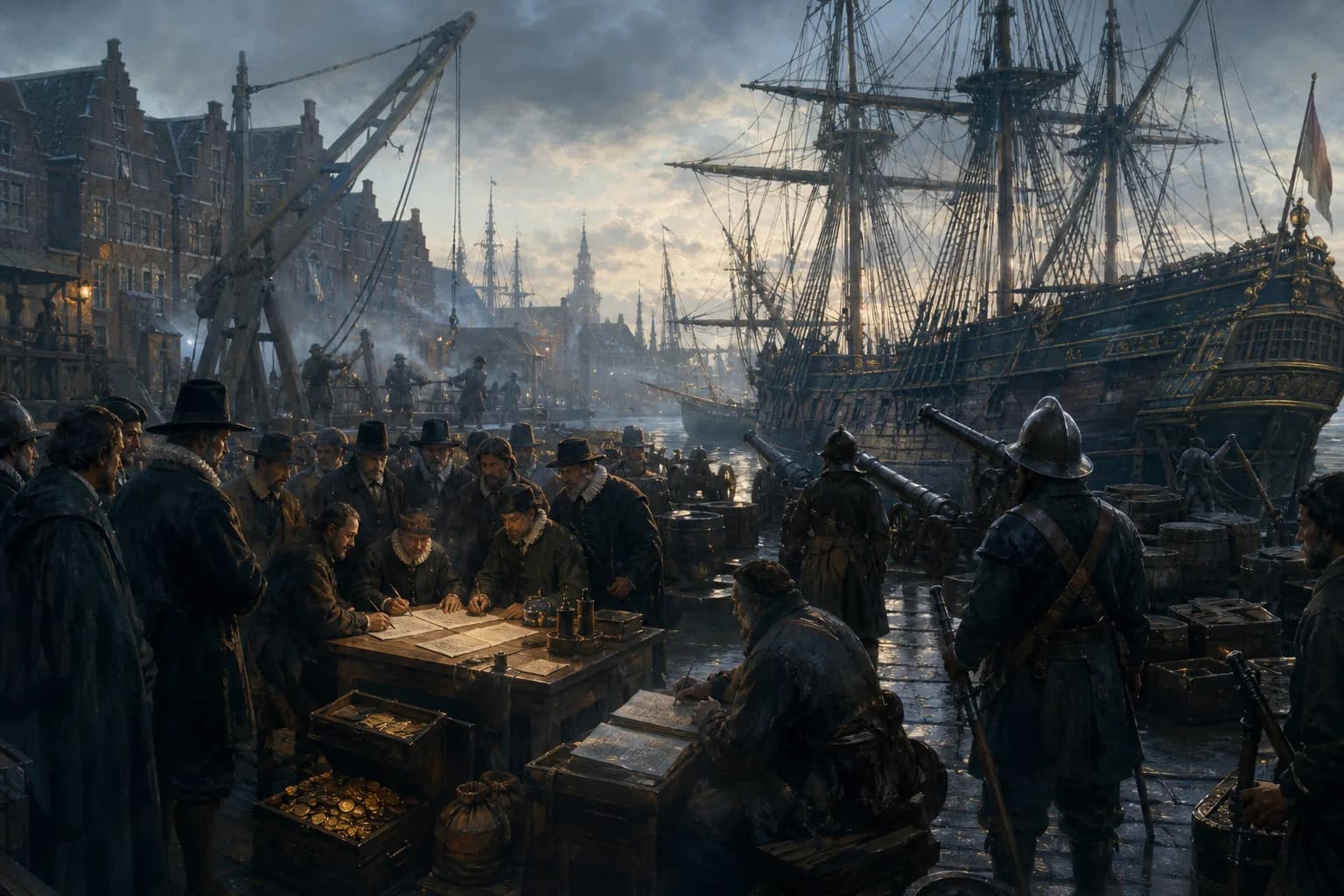
The English East India Company received a royal charter in 1600. In 1602, the Dutch Republic merged competing voorcompagnieën into the VOC. Both used monopoly privileges and pooled investment to organize risky Asian trade, but they were not the same institution and did not instantly rule Asian territory. The VOC's charter granted treaty-making, fort-building and military powers early; the English company's major territorial transformation came much later.
- English charter
- 31 December 1600
- VOC charter
- 20 March 1602
- Shared structure
- State charter, trade monopoly and pooled long-distance risk
- VOC powers
- Treaties, forts, courts, troops and war in its chartered sphere
- Important difference
- Financing, governance and territorial power developed at different speeds
Chronology
A process, not a single date
Causes, turning points and aftermath form one process, far larger than a capital’s fall, a signed treaty or a company’s founding date.
- 01
The first Dutch fleet completes an Asian voyage
Risk and potential profit bring several Dutch companies into competition with one another.
- 02
The English East India Company is chartered
London merchants receive an exclusive right to English trade east of the Cape of Good Hope.
- 03
The VOC is founded
The Dutch Republic unites regional companies in six chambers and grants broad monopoly and quasi-sovereign powers.
- 04
The VOC seizes positions and establishes Batavia
The company enters the Moluccan contest and destroys Jayakarta in 1619 to build its Asian headquarters.
- 05
Corporate war accompanies monopoly
Both companies negotiate and fight alongside Asian rulers and intermediaries; the VOC imposes especially violent controls in parts of the spice islands.
- 06
The EIC acquires territorial and fiscal power
Plassey and the 1765 grant of revenue rights in Bengal mark a transformation from merchant corporation toward territorial regime.
Why did oceanic trade need a new organization?
A round trip to Asia could consume years and enormous capital. Ships, weapons, goods and crews were expensive; wreck, war and changing markets could ruin one investor. Companies pooled money and spread risk across a larger body of merchants.
This 'private' capital was never separate from government. Charters drew monopoly boundaries, diplomacy and navies supported merchants, and corporations absorbed some costs of forts and war. Profit and sovereignty were entangled from the beginning.
1600 and 1602 created related but different companies
Elizabeth I's 1600 charter gave London merchants exclusive English trade east of the Cape. Early English finance often centred on individual or limited groups of voyages. Military and territorial power grew later over more than a century.
The Dutch Republic formed the VOC in 1602 by merging rival regional ventures. More permanent capital and explicit authority to make treaties, build forts, administer justice, recruit forces and wage war let it perform state-like functions earlier.
Asian states and merchants were participants, not a blank background
Both corporations arrived amid powerful courts, port states and commercial networks. They needed permissions, customs arrangements, brokers, interpreters, credit and Asian shipping. A European charter carried no automatic authority in an Asian harbour.
When trade did not deliver the monopoly sought, companies used blockade, bombardment, fortification and coerced treaties. VOC violence in the Moluccas and its destruction of Jayakarta reveal the war, slavery and displacement behind entries in commercial ledgers.
A chartered company did not become a territorial empire overnight
VOC power long concentrated on maritime nodes and selected commodity regions. The EIC initially depended on Mughal and local permission for its factories in India. Their geographies and timetables remained distinct.
In the eighteenth century, political crisis and Anglo-French rivalry helped the EIC obtain Bengali revenue that could finance larger armies. The VOC, meanwhile, accumulated debt and administrative burdens before its dissolution in 1799. Their shared legacy was to place military, judicial and colonial capacity inside organizations formally pursuing shareholder return.
Evidence boundary
Fact, interpretation and uncertainty
The evidence reveals where imperial claims diverged from reality and where heroic stories compressed complex wars.
The VOC charter granted quasi-sovereign powers
Dutch archival descriptions explicitly include treaty-making, fortification, justice, recruitment and warfare within the chartered sphere.
The EIC and VOC did not share one capital or governing model
Both were chartered monopolies, but their founding finance, organization and pace of expansion differed.
Founding dates are not dates of instant territorial empire
The early companies relied heavily on Asian rulers and commercial networks; broad EIC fiscal power came only in the mid-eighteenth century.
Questions
Common questions
Was the VOC the world's first joint-stock company?
It is often described as the first major company with transferable shares and relatively permanent capital, but any 'first' depends on definitions. Its durable capital joined to overseas sovereign powers is the more important distinction.
Were East India companies private businesses or governments?
They were investor-run corporations created by states and empowered to perform public acts abroad, including diplomacy, war, justice and later taxation. The categories overlap.
Did they immediately conquer India and Indonesia?
No. Early operations centred on voyages, factories and selected forts within Asian political systems. Territorial rule developed unevenly over decades and centuries.
Which company was stronger?
The answer changes with time and region. The VOC dominated much seventeenth-century intra-Asian shipping and parts of the spice trade; the EIC's eighteenth-century fiscal base in India later altered the balance.
Sources
Sources and further verification
Archives, museums, international organizations and academic publications support the facts and interpretive limits in this account.
- VOC (1602–1800)Nationaal Archief
- The Dutch East India Company (VOC)Rijksmuseum
- Traders: The East India Company and AsiaRoyal Museums Greenwich
- East India CompanyThe British Museum
Age of Seas editorial research distinguishes verifiable facts, historical interpretation and potentially misleading simplifications.Editorial standards and corrections ↗