In one minute
What did this event actually change?
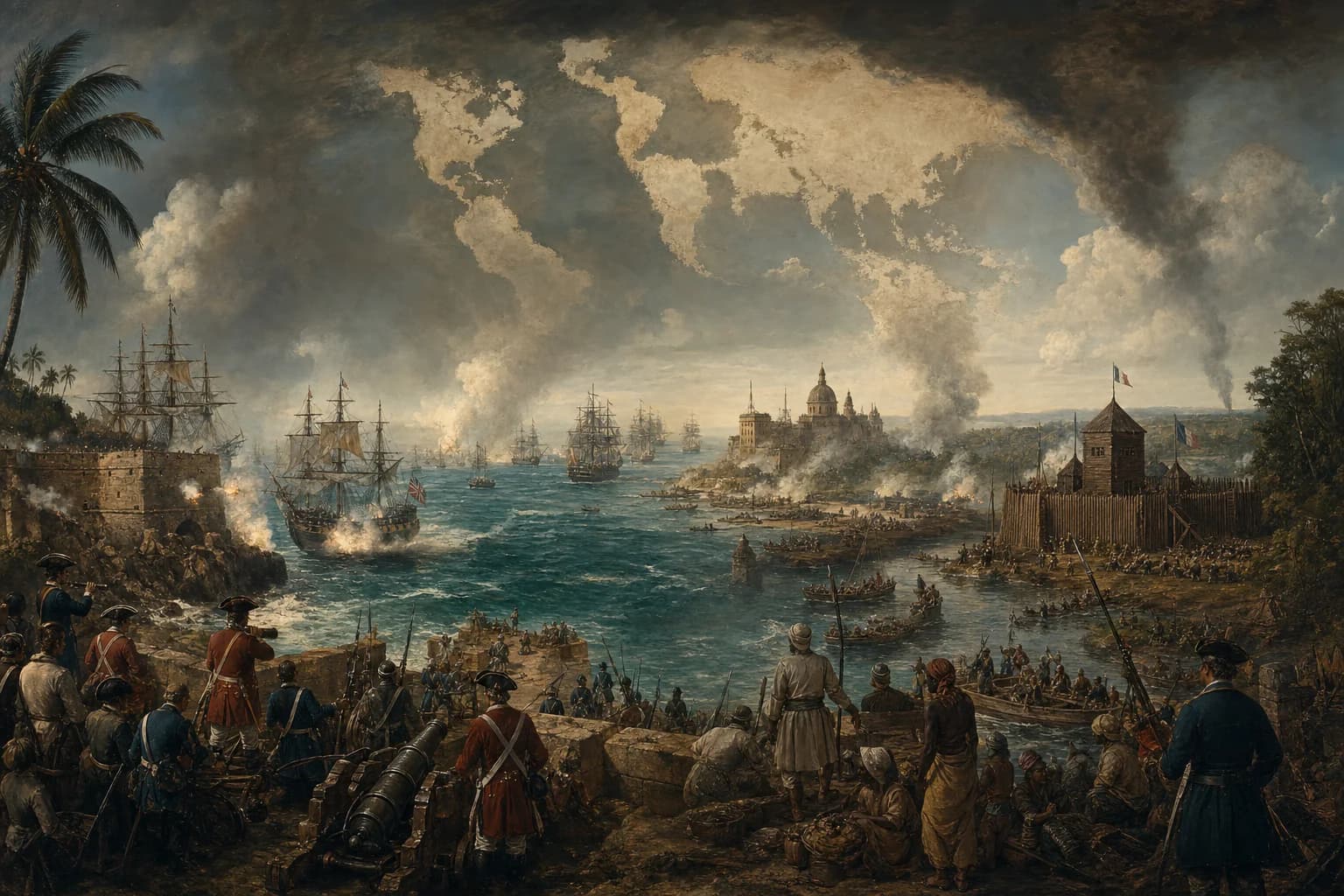
The Seven Years' War usually means the 1756–1763 European conflict, although fighting in North America began in 1754. War spread through the Caribbean, West Africa, India and the Philippines. Britain gained Canada and strengthened its position in India in 1763, which is why historians often call this one of the earliest global wars. It was not a simple British–French duel: Indigenous nations and Asian powers pursued their own aims.
- Formal war
- 1756—1763
- North American prelude
- The French and Indian War began in 1754
- Major theatres
- Europe, North America, Caribbean, West Africa, India and the Philippines
- Peace settlements
- The treaties of Paris and Hubertusburg
- Overall shift
- Greater British colonial power alongside deeper debt and local conflict
Chronology
A process, not a single date
Causes, turning points and aftermath form one process, far larger than a capital’s fall, a signed treaty or a company’s founding date.
- 01
Conflict opens in the Ohio Valley
British and French colonial forces compete while Indigenous nations make choices around land, defence and trade.
- 02
Formal war begins in Europe
British–Prussian and French–Austrian alliances link the European balance of power to overseas competition.
- 03
Plassey changes the balance in Bengal
The EIC works with opponents of Siraj ud-Daulah and begins expanding political and fiscal influence.
- 04
Britain gains major advantages
Victories around Quebec, Canada and India weaken French positions while depending on colonial forces and local allies.
- 05
British expeditions occupy Havana and Manila
Spain's entry brings important Atlantic and Pacific ports into the conflict.
- 06
Two treaties redraw claims
Paris addresses overseas exchanges and Hubertusburg ends the central European war; Indigenous peoples are absent from the transfer of their lands.
Why is it sometimes called a first world war?
British and French colonial forces were already fighting in North America in 1754. Once European alliances entered war, fleets, credit, garrisons and colonies joined the theatres: Atlantic shipping affected Quebec, European war reshaped company conflict in India, and Spain's entry drew Havana and Manila into battle.
'First world war' is a later and disputed label, since earlier wars also crossed continents. 'One of the earliest global wars' better captures the exceptional intensity, naval scale and wide colonial settlement without confusing it with the twentieth century.
Who was fighting?
Britain and Prussia faced a coalition including France, Austria and Russia in Europe, but each overseas theatre had its own actors. Haudenosaunee, Cherokee, Abenaki and other Indigenous peoples chose alliance, neutrality or resistance according to their own territorial and commercial aims.
South Asia was not an empty board for Britain and France. Companies relied on Indian soldiers, bankers, merchants and political alliances. The 1757 victory at Plassey was inseparable from opposition and conspiracy within Bengal; describing it as Britain simply conquering India erases both local agency and the long wars still ahead.
What did Britain win—and what did it not win?
Naval strength, credit and alliances helped Britain acquire Canada and strengthen its position in India under the 1763 settlement. Havana and Manila, occupied during the war, were returned through negotiated exchanges that included Florida.
Britain did not thereby gain uncontested world control. France retained valuable Caribbean interests, powerful Indian states remained, and Indigenous nations in North America had not ceded sovereignty. The balance shifted sharply; imperial rivalry did not end.
Why was 1763 an ending and the opening of new crises?
War produced heavy public debt. British attempts to make North American colonists share imperial costs contributed to the conflict that became the American Revolution. In Bengal, EIC military advantage and later revenue rights let local taxation support a growing corporate army.
The Treaty of Paris transferred European claims over vast Indigenous lands without Indigenous consent. Pontiac's War and the Royal Proclamation of 1763 immediately showed that a changed colour on a map did not extinguish sovereignty or resistance. The connected oceanic world was now held together as much by debt, corporations and colonial coercion as by routes.
Evidence boundary
Fact, interpretation and uncertainty
The evidence reveals where imperial claims diverged from reality and where heroic stories compressed complex wars.
The theatres spanned several continents and two oceans
Campaigns in Europe, North America, the Caribbean, West Africa, India and the Philippines were linked by diplomacy, fleets and finance.
'First world war' is an explanatory label
The phrase emphasizes reach but remains debatable. 'One of the earliest global wars' acknowledges earlier transcontinental conflicts.
Territorial transfer did not extinguish Indigenous sovereignty
European negotiators transferred claims without the participation or consent of the Indigenous nations whose lands were discussed.
Questions
Common questions
Did the Seven Years' War begin in 1754 or 1756?
Formal European war began in 1756; the connected North American conflict began in 1754. Global accounts often show both dates.
Was it really the first world war?
That is a useful but contested description. Its reach was global, but earlier conflicts also crossed continents; 'one of the earliest global wars' is safer.
Did a British army alone win the Battle of Plassey?
No. EIC troops included Indian soldiers, and the result depended on Bengali elite opposition, bankers and political conspiracy as well as battlefield action.
Why were Havana and Manila returned to Spain?
They were bargaining pieces in the peace settlement. Britain exchanged their return for other advantages, including Florida.
Sources
Sources and further verification
Archives, museums, international organizations and academic publications support the facts and interpretive limits in this account.
- The Seven Years’ WarNational Army Museum
- Teaching American Indian History with Primary SourcesNational Park Service
- Fort Stanwix in the French and Indian / Seven Years’ WarNational Park Service
- The British PeriodNational Park Service
Age of Seas editorial research distinguishes verifiable facts, historical interpretation and potentially misleading simplifications.Editorial standards and corrections ↗