In one minute
What did this event actually change?
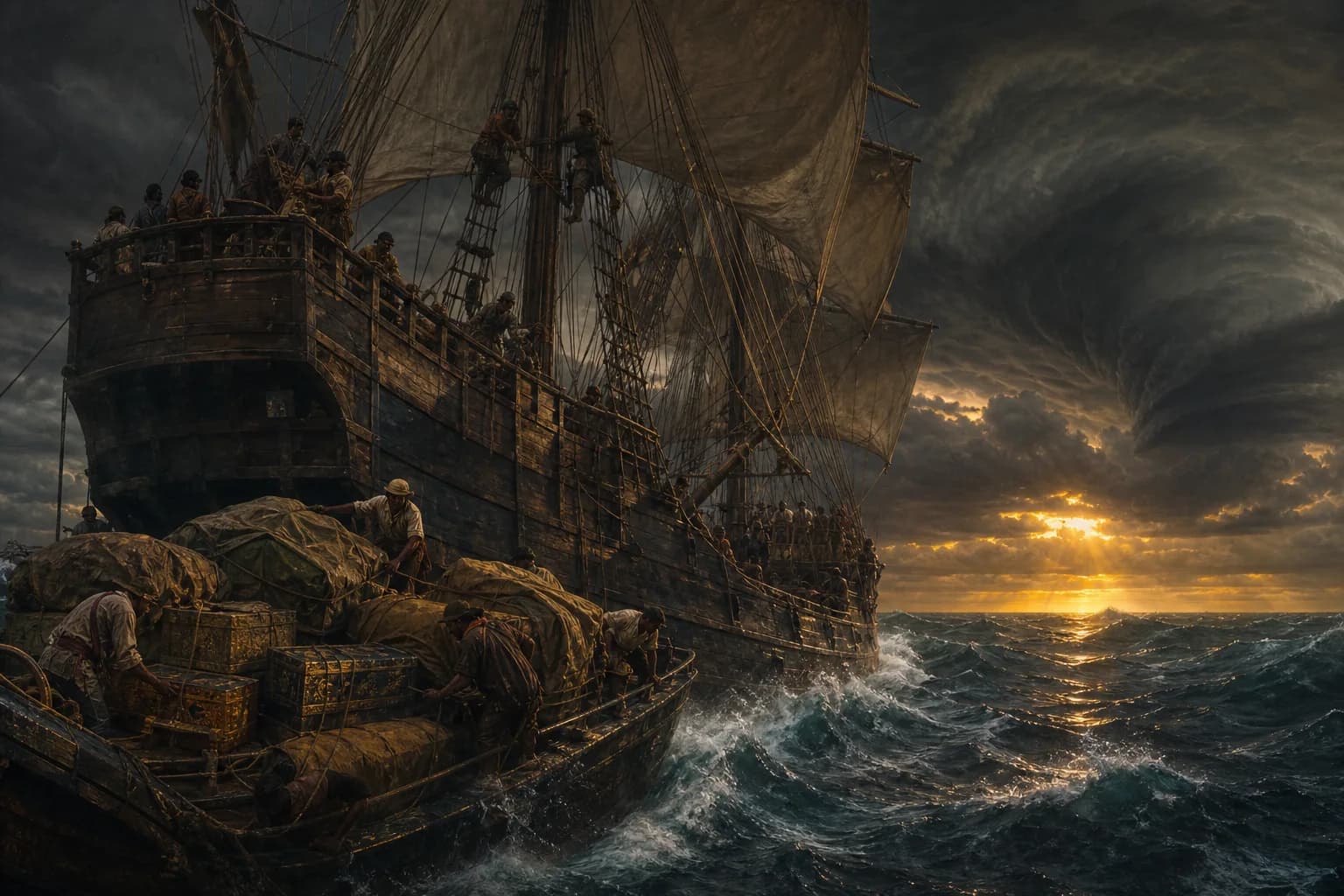
The Manila–Acapulco galleon trade began after Andrés de Urdaneta found a viable eastward return route across the Pacific in 1565 and became institutionalized after Spain established colonial Manila in 1571. Chinese silk, porcelain and other Asian goods travelled to New Spain, while American silver flowed west. The route completed a Pacific link in global trade, but depended on Chinese merchants, Filipino shipbuilding and labour, trans-Pacific crews and colonial power.
- Official span
- 1565—1815
- Navigational breakthrough
- Urdaneta's eastward Pacific return route
- Asian terminus
- Manila, made a Spanish colonial centre in 1571
- American terminus
- Acapulco in New Spain
- Principal exchange
- Asian goods eastward; American silver westward
Chronology
A process, not a single date
Causes, turning points and aftermath form one process, far larger than a capital’s fall, a signed treaty or a company’s founding date.
- 01
Urdaneta completes the eastward return
The ship first sails north to find the westerlies, then crosses to North America and follows the coast south.
- 02
Spain establishes its colonial centre at Manila
The harbour and existing regional commerce make the city a junction for Chinese traders, Southeast Asian goods and American silver.
- 03
The crossing becomes a regulated system
A small number of large vessels carry high-value cargo under colonial controls on schedules, volume and participation.
- 04
Silver and Asian goods continue across the Pacific
Cargo enters New Spain through Acapulco while Manila relies heavily on Chinese commerce and Filipino labour.
- 05
British occupation exposes Manila's vulnerability
The Seven Years' War draws the distant colonial port into the same imperial conflict.
- 06
The final official galleon arrives
Mexican independence and changes in imperial trade end the route after roughly two and a half centuries.
The hardest part was not sailing west, but returning east
Low-latitude trade winds could carry vessels from the Americas toward the Philippines. Sailing directly back against them did not work. In 1565 Urdaneta went northeast from the Philippines, found westerly winds at higher latitude, crossed toward North America and then sailed south to Acapulco.
A line on a map hides months of exposure to hunger, disease, storm and navigational error. The route became durable only when climate knowledge, ports, shipbuilding and labour were organized around repeated crossings.
Manila's commerce rested on networks older than Spanish rule
Spain occupied Manila in 1571 and built a colonial administrative centre, but it did not create the port's Asian connections from nothing. Chinese merchants, especially those arriving from Fujian, supplied silk, porcelain and many other goods through regional trade.
Those merchants, interpreters and craftspeople were indispensable while facing segregation, taxes, expulsion and periodic violence. People across the Philippines felled timber, built ships, moved stores and served aboard. The route was maintained by many communities, not by Spanish merchants alone.
Silver moved west while goods moved east
At Manila, American silver purchased high-value Asian merchandise. Galleons carried it to Acapulco, from where goods entered New Spain and sometimes travelled onward by land and Atlantic shipping. Silver returned across the Pacific and entered Asian markets with strong demand for it.
This was not a balanced exchange between equal shores. Colonial rules restricted participants and concentrated profit, while crews and shipyard workers bore high risks. Smuggling and merchant adaptation continually exceeded the official system.
Global connection was also a colonial structure
The galleon route is often celebrated as the final link in a global trade circuit. It did connect American mines, Asian manufacturing, Pacific navigation and European empires. The same connection depended on conquest, coerced labour, dangerous voyages and unequal legal power.
Seen from the deck, a 'global economy' was not an abstract web. It was timber cut in the Philippines, silver mined in the Americas, goods assembled by Asian merchants, and sailors trying to survive one of the world's longest regular passages.
Evidence boundary
Fact, interpretation and uncertainty
The evidence reveals where imperial claims diverged from reality and where heroic stories compressed complex wars.
The eastward return required a northern route
The 1565 crossing demonstrated a practical use of higher-latitude westerlies rather than a direct reversal of the westbound path.
Manila depended on Chinese commerce and Filipino labour
The colonial port's trans-Pacific role rested on existing Asian trade and on extensive local shipbuilding, transport and service work.
A trade connection was not a neutral bridge
Colonial occupation, labour extraction and unequal regulation were part of the system that moved goods and silver.
Questions
Common questions
Why did the return voyage sail north first?
Ships needed to escape low-latitude easterly trade winds and reach westerlies that could carry them toward North America.
What did the galleons carry?
Eastbound cargo included silk, porcelain and other Asian goods; westbound flows were dominated by American silver, alongside passengers, documents and other cargo.
Did Spain control all the trade through Manila?
No. Colonial authorities regulated the official route, but Chinese and other Asian merchants supplied it, while smuggling and competing ports remained important.
Why did the route end in 1815?
The crisis of Spanish imperial rule and Mexican independence dismantled the political and commercial framework that had sustained the official service.
Sources
Sources and further verification
Archives, museums, international organizations and academic publications support the facts and interpretive limits in this account.
- The Manila Galleon Trade (1565–1815)The Metropolitan Museum of Art
- Fortifications of ManilaUNESCO World Heritage Centre
- Negotiating Empire: From Magellan to the Founding of ManilaLibrary of Congress
- The Manila Galleon by William Lytle SchurzSmithsonian Institution
- Empires and EmporiaThe Metropolitan Museum of Art
Age of Seas editorial research distinguishes verifiable facts, historical interpretation and potentially misleading simplifications.Editorial standards and corrections ↗