In one minute
What did this event actually change?
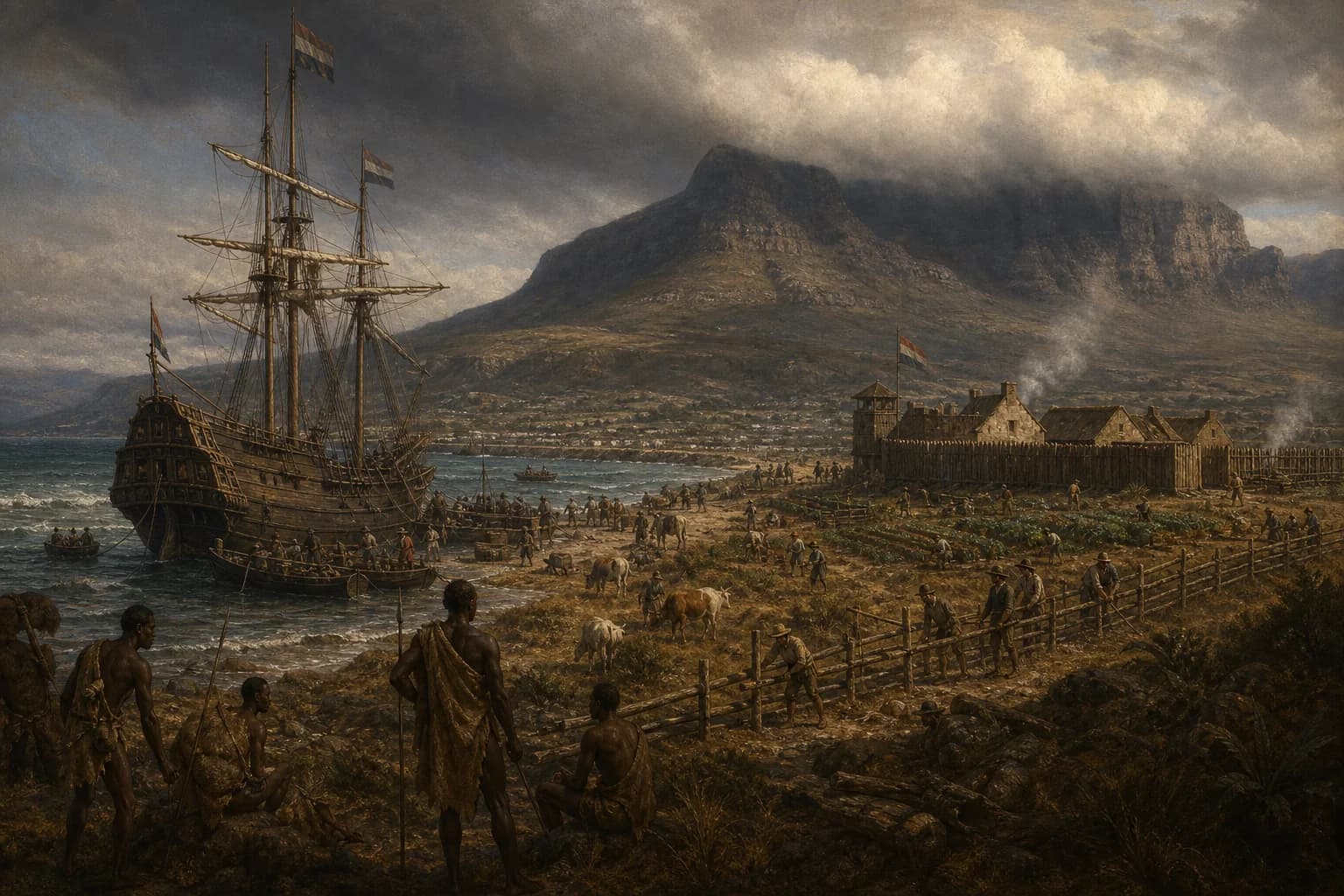
Jan van Riebeeck and a VOC party reached Table Bay in April 1652 to supply Asia-bound fleets with water, vegetables, meat, repairs and care for the sick. The company initially described a service station, not a settler colony. Reliable provision nevertheless demanded land and labour. Free-burgher farms from 1657, war with Khoikhoi communities and large-scale importation of enslaved people in 1658 turned the shipping stop into the centre of a colonial society.
- Arrival
- 6 April 1652, Table Bay
- Leadership
- Jan van Riebeeck under VOC instructions
- Initial purpose
- Water, fresh food, repairs and medical recovery for Asian voyages
- Existing inhabitants
- Khoikhoi communities including the Goringhaicona and Goringhaiqua
- Colonial turn
- Free-burgher farms, land seizure, war and imported enslaved labour
Chronology
A process, not a single date
Causes, turning points and aftermath form one process, far larger than a capital’s fall, a signed treaty or a company’s founding date.
- 01
A wreck produces a proposal
Survivors from Haerlem live at the Cape and their experience supports a memorandum urging a permanent provisioning station.
- 02
Van Riebeeck reaches Table Bay
The party builds a fort, garden and sick facilities and seeks cattle through trade and Khoikhoi intermediaries.
- 03
Former employees become free burghers
Private farms receive land to increase supply, pushing settlement beyond the company's original garden.
- 04
Large groups of enslaved people arrive
Captives from Angola and Indian Ocean regions are brought to the Cape, making slave labour structural to farms and the town.
- 05
The first Khoikhoi–Dutch war
Land occupation and cattle disputes provoke armed resistance; the VOC answers with fortification, mounted patrols and boundaries.
- 06
The station expands into a colony
Settler farms move inland as Khoikhoi land and livestock are lost and the enslaved population grows.
Why did the VOC need a stop at the Cape?
The voyage between the Netherlands and Batavia was long enough for scurvy, bad water and ship damage to kill crews. Table Bay offered fresh water, cultivable ground and anchorage near the route around southern Africa. Vegetables and recovery time could save both lives and cargo.
The Cape was already a place of Khoikhoi habitation, herding and exchange, and European ships had traded there before. 'Establishing a station' describes a new VOC installation, not the discovery or first use of an empty shore.
Why did a garden keep taking more land?
The company garden and salaried workers could not reliably meet demand from growing fleets. In 1657, the VOC released some employees as free burghers and granted farms. Food production spread outward over Khoikhoi grazing and movement corridors.
Company deeds allocated land under European law without equivalent consent from pastoral communities. Fences, fields and cattle disputes restricted seasonal mobility. A logistical requirement for ships therefore became a territorial conflict on land.
Where did the labour come from?
The VOC traded cattle with Khoikhoi groups and hired some workers, but local pastoralists had no reason to become a permanent agricultural labour force. Company rules also discouraged their formal enslavement. The settlement instead imported enslaved people from Angola, Madagascar, South Asia and Southeast Asia.
Two large arrivals in 1658 marked a turning point. Enslaved people worked farms, building sites and households and formed new creole communities. European settlement, Indigenous dispossession and coerced Indian Ocean migration made the Cape together.
Did a station naturally grow into a colony?
Nothing about the transition was automatic or peaceful. Khoikhoi groups resisted the loss of land and cattle; the war of 1659–1660 was an early phase of prolonged conflict. Disease, military frontiers and economic pressure further damaged local societies.
The VOC wanted a cheap, reliable link in a global route. Its low shipping costs were produced locally through seized land and enslaved labour. That is the importance of 1652: maritime infrastructure became colonial power when it touched the ground.
Evidence boundary
Fact, interpretation and uncertainty
The evidence reveals where imperial claims diverged from reality and where heroic stories compressed complex wars.
The initial instructions centred on fleet supply
Fresh produce, water, repair and care for sick sailors led the brief; the later free-burgher policy shows how quickly the mission expanded.
Table Bay was not vacant land
Khoikhoi communities maintained pastoral routes, politics and commerce, while intermediaries such as Autshumao actively shaped early dealings.
Slavery was present near the beginning
A few enslaved people arrived earlier, and large-scale importation began in 1658—during the station's first transformation into settlement.
Questions
Common questions
Did van Riebeeck arrive to found the nation of South Africa?
No. He was a VOC employee instructed to build a shipping station. A settler colony emerged through later decisions about farms, land and labour.
Was the Cape inhabited before 1652?
Yes. Khoikhoi pastoralists, San communities and others had long lived in and used the region; European ships had also stopped temporarily to trade.
Why did war break out with Khoikhoi communities?
Farms occupied grazing land, constrained seasonal movement and intensified disputes over cattle and authority. The conflict followed colonial land expansion.
Where did enslaved people at the Cape come from?
Origins included Angola, Madagascar, India, Indonesia and other Indian Ocean regions, with the proportions changing over time.
Sources
Sources and further verification
Archives, museums, international organizations and academic publications support the facts and interpretive limits in this account.
- The Arrival of Jan van Riebeeck in the CapeSouth African History Online
- Establishment of the Cape and its impact on Khoikhoi and DutchSouth African History Online
- Dutch settlement, the Indian Ocean slave trade and slavery at the CapeSouth African History Online
- History: The Early Colonial PeriodSouth African Government
Age of Seas editorial research distinguishes verifiable facts, historical interpretation and potentially misleading simplifications.Editorial standards and corrections ↗