In one minute
What did this event actually change?
Cape Verdean Kriolu probably took shape on Santiago in the late fifteenth and early sixteenth centuries. Ribeira Grande, established in the 1460s between the Upper Guinea coast and Atlantic shipping routes, brought together Portuguese and other European migrants, Africans forcibly transported from the mainland and their locally born descendants. Portuguese supplied most vocabulary, while Mandinka, Wolof, Fula and other West African languages—and communication across generations—helped shape new grammar, sound patterns and expression. Kriolu is not 'broken Portuguese' but a complete language. The creativity it carries must also be understood within slave trading, land control and colonial hierarchy.
 View the complete scene ↗
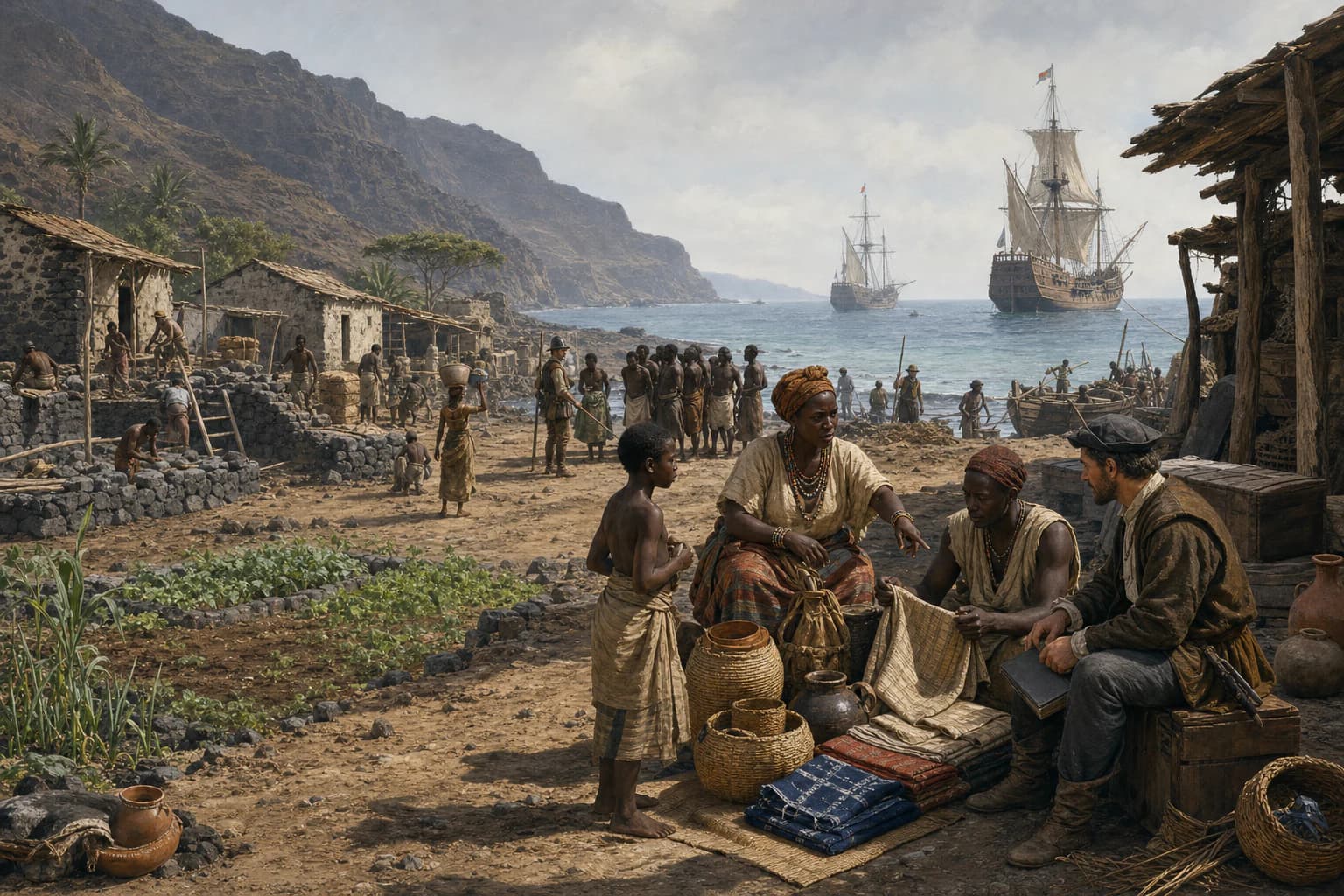
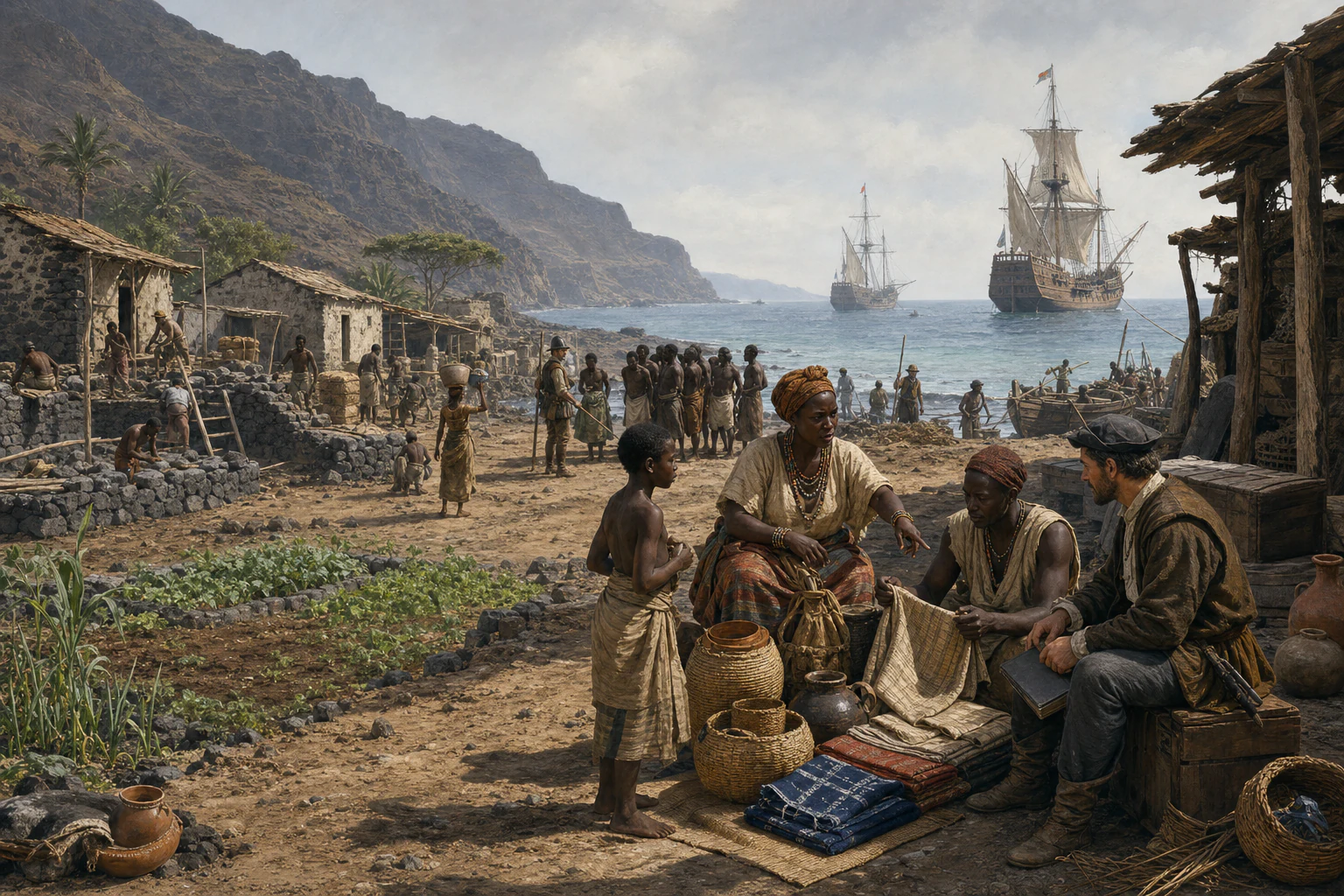
The complete scene places linguistic and cultural formation beside port labour, seaborne exchange and guarded forced arrivals. It is an evidence-led composite, not a site photograph or a record of one day.
- Place
- Ribeira Grande on Santiago, now Cidade Velha
- Formative period
- Late fifteenth–early sixteenth century; the precise sequence remains debated
- Language ecology
- Fifteenth- and sixteenth-century Portuguese alongside several Upper Guinea languages
- Population
- Enslaved West Africans, free Africans, European migrants and locally born generations
- Historical structure
- Slave-trading port, colonial agriculture and island–coast brokerage networks
Chronology
A process, not a single date
Causes, turning points and aftermath form one process, far larger than a capital’s fall, a signed treaty or a company’s founding date.
- 01
Portuguese mariners record and begin settling the Cabo Verde archipelago
Archaeology has found no evidence of permanent pre-European occupation. That does not make the subsequent forced migration and slave-based colonization a harmless development of 'empty' islands.
- 02
Ribeira Grande becomes one of Santiago's first permanent settlements
Fresh water in a volcanic valley, a sheltered coast and proximity to West Africa make the settlement an administrative, agricultural and shipping node.
- 03
A royal charter broadens residents' trading rights on the African coast
The privilege stimulates commodity exchange while embedding the purchase, concentration and onward shipment of enslaved people in the settlement's economy.
- 04
Multigenerational contact produces early Kriolu
Linguists commonly place Santiago near the beginning of Upper Guinea Portuguese Creole development, although no document can provide an exact birthday.
- 05
The islands and Upper Guinea coast form one commercial and cultural zone
Cape Verdean merchants, interpreters, mariners and brokers cross between them. Language and practice travel with people while also serving commerce and enslavement.
- 06
Ribeira Grande becomes a city and episcopal seat
Religious, administrative and port institutions expand, while urban construction and agriculture continue to rely heavily on enslaved labour.
- 07
Cidade Velha enters the World Heritage List
UNESCO recognizes its material testimony to tropical European colonization, slave trading and the development of an early Creole society.
Why did a new society emerge so quickly on islands without an earlier permanent population?
Current archaeology has found no evidence of a permanent Indigenous society in Cabo Verde before Portuguese settlement. After the 1460s, Santiago's population therefore came through migration: a small number of Portuguese and other European settlers controlled land, shipping privileges and colonial administration; many more Africans were forcibly brought from Senegambia, Upper Guinea and elsewhere, alongside free traders, intermediaries and people who later obtained freedom.
Ribeira Grande occupied a freshwater volcanic valley close to West Africa but separated from the mainland by sea, making it useful for calling ships, victualling and controlling movement. The 1466 trading privilege strengthened its role in slave trafficking. This 'new society' did not arise because cultures simply met. People made families, markets, religious practice and everyday cooperation within radically unequal legal status, gender relations and labour regimes.
How did Kriolu form instead of merely 'simplifying Portuguese'?
Most Kriolu vocabulary comes from fifteenth- and sixteenth-century Portuguese, but language is more than a word list. Africans brought Mandinka, Wolof, Fula and other languages. Communication across groups, kinship, children's acquisition and island–coast brokerage allowed a stable new grammar and sound system to emerge over generations. Describing this as faulty Portuguese turns speakers' creativity into deficiency.
The speed and route of formation remain debated. Multiple studies place late-fifteenth- to early-sixteenth-century Santiago near the origin of Cape Verdean and Upper Guinea Portuguese Creoles, tracing older Portuguese features and West African words and structures. Yet there are no recordings and few continuous early texts. We can reconstruct social conditions and linguistic relationships, not name the first speaker of Kriolu or assign the language a single day of birth.
Why was a 'Creole society' not a cheerful melting pot?
UNESCO describes Ribeira Grande as one of the earliest fully developed Creole societies while also identifying it as a place where enslaved people were concentrated and trafficked and slave labour developed colonial territory. African knowledge shaped agriculture, cooking, healing, textiles, religion and seamanship. That contribution did not occur under equal choice. Cultural creation belongs to the people who lived it, not to the institution of slavery.
Legal life also contained more than a simple European-versus-slave divide. Free Africans, freed people, Luso-African families, locally born residents, merchants, sailors, interpreters and clergy occupied shifting but unequal positions. Colour, birth, baptism, gender, property and patronage could all affect opportunity. Complexity does not soften coercion; it shows how colonial society bound intimacy and commerce to violence.
Why does this language history cross between islands and coast?
Early Cabo Verde and the Upper Guinea coast formed an interconnected region. Mariners, canoe men, porters, interpreters, merchants and religious intermediaries moved across the water, carrying Kriolu and related speech into river mouths and trading settlements. Existing African political and commercial networks on the coast also continued to shape island life. Ribeira Grande was not a one-way centre broadcasting European culture into Africa.
Cape Verdean Kriolu later developed identifiable island varieties, while the related Creoles of Guinea-Bissau and Casamance followed their own histories. Calling Santiago an important early centre does not mean every Creole language in the world began in Cabo Verde, nor that every Cape Verde island speaks one unchanged Kriolu. Migration, colonial administration, schooling and community identity continued to reshape the language.
Evidence boundary
Fact, interpretation and uncertainty
The evidence reveals where imperial claims diverged from reality and where heroic stories compressed complex wars.
Ribeira Grande was simultaneously an early colonial town, slave-trading node and centre of Creole society
UNESCO, archaeology and Atlantic history support all three characteristics. None can responsibly be detached from the other two.
Kriolu has no precisely documentable birthday
Language features and population history support a late-fifteenth- to early-sixteenth-century Santiago model, while scarce early texts leave its speed, generations and African contributions open to continued research.
A Creole is not an incomplete or broken colonial language
Kriolu has systematic grammar, sound patterns and community norms. Portuguese-derived vocabulary does not reduce its structure to erroneous Portuguese.
Questions
Common questions
What is Cape Verdean Kriolu?
It is a group of Creole language varieties whose vocabulary is largely Portuguese-derived and whose development reflects West African language contact and Cape Verdean society. It has complete grammar and native-speaking communities.
When did Kriolu emerge?
Most relevant research places the key formative period on Santiago in the late fifteenth and early sixteenth centuries, but surviving texts cannot reduce the process to one year.
Is Ribeira Grande today's Cidade Velha?
Yes. The settlement was originally called Ribeira Grande and became known as Cidade Velha from the late eighteenth century. It lies in southern Santiago and entered the World Heritage List in 2009.
Was Cabo Verde inhabited before Portuguese settlement?
Archaeology currently shows no evidence of permanent earlier occupation. Lack of a resident Indigenous population did not make colonization harmless: settlement depended on mass forced migration, enslaved labour and unequal landholding.
Was Ribeira Grande the world's first Creole society?
UNESCO calls it the first fully fledged Creole society. A cautious reading treats it as one of the earliest clearly documented Creole societies produced by European colonial expansion, not a claim that cultural or linguistic mixture had never occurred anywhere before.
Is Kriolu identical on every Cape Verde island?
No. Islands developed recognizable varieties, often discussed through Sotavento and Barlavento groupings. Shared history did not erase insular difference.
Sources
Sources and further verification
Archives, museums, international organizations and academic publications support the facts and interpretive limits in this account.
- Cidade Velha, Historic Centre of Ribeira GrandeUNESCO World Heritage Centre
- Cidade Velha nomination evaluationICOMOS / UNESCO World Heritage Centre
- The Settlement of Cabo Verde and Early Signs of Creolisation in Western AfricaCambridge University Press
- Brokers on the MoveCambridge University Press
- Upper Guinea Creole: Evidence in favor of a Santiago birthJohn Benjamins Publishing Company
- Historical and sociolinguistic overview of CapeverdeanUniversity of Lisbon Repository
- Excavating Alcatrazes, Santiago Island, Cape VerdeAntiquity / Cambridge University Press
- The Creolizing Turn and Its Archipelagic DirectionsCambridge Journal of Postcolonial Literary Inquiry
Age of Seas editorial research distinguishes verifiable facts, historical interpretation and potentially misleading simplifications.Editorial standards and corrections ↗