In one minute
What did this event actually change?
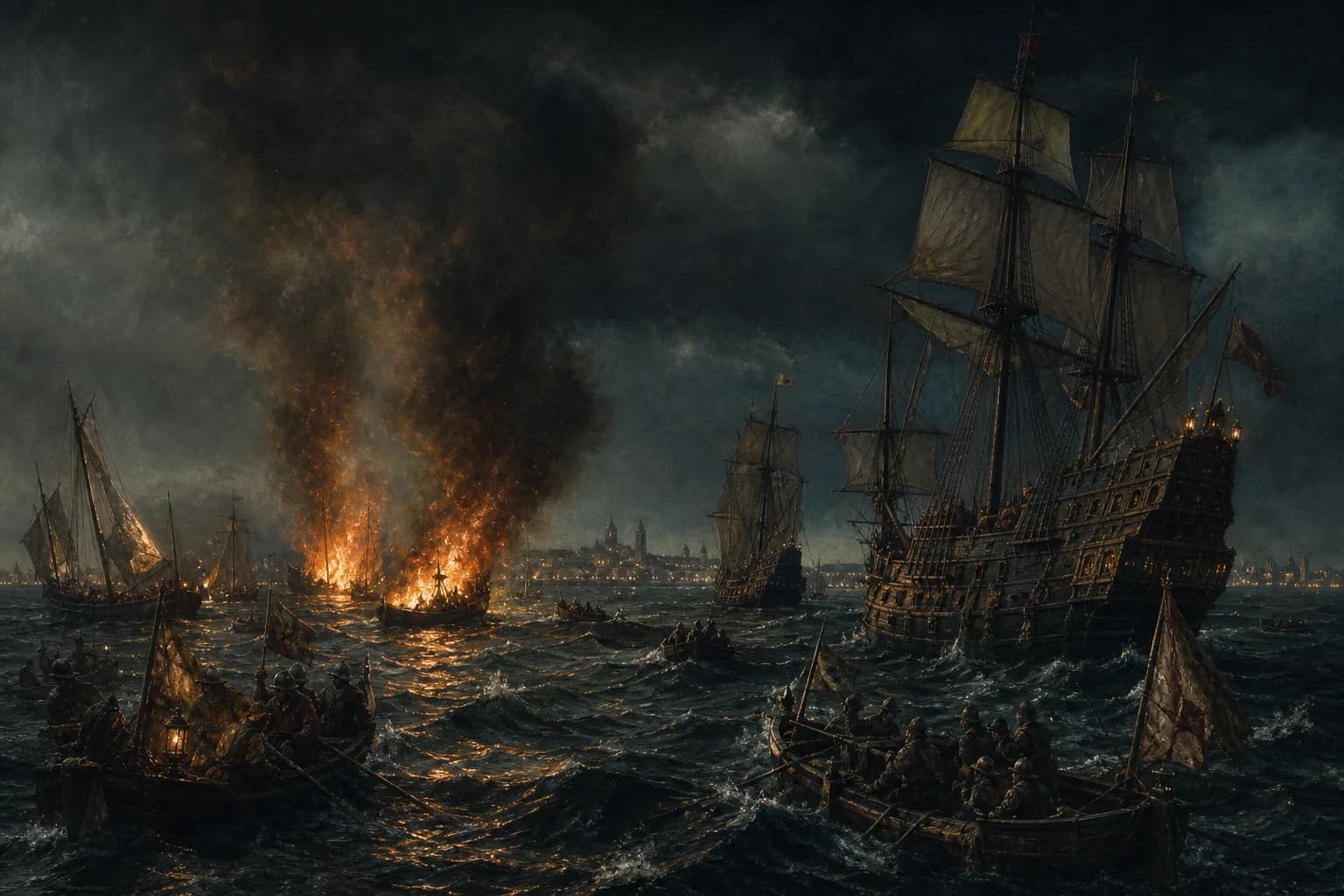
Philip II sent the Armada into the English Channel in 1588 to protect the Duke of Parma's army as it crossed from Flanders. While the fleet waited off Calais, English fireships forced it to cut anchor cables and scatter. Fighting off Gravelines and unfavourable wind then prevented a renewed rendezvous. The Armada sailed home around Scotland and Ireland, where storm, hunger and poor navigation added heavy losses. England escaped invasion, but Spain remained a major naval power and the war continued.
- Strategic objective
- Escort the Army of Flanders across the Channel to invade England
- Armada commander
- The Duke of Medina Sidonia
- English command
- Lord Howard, with Drake and other senior captains
- Principal battle
- Gravelines, 8 August 1588 in the Gregorian calendar
- Failure chain
- Rendezvous design, communications, fireships, combat, wind and a hazardous return
Chronology
A process, not a single date
Causes, turning points and aftermath form one process, far larger than a capital’s fall, a signed treaty or a company’s founding date.
- 01
The Anglo-Spanish war becomes open
English aid to the Dutch revolt and attacks on Spanish commerce meet Philip II's plan to overthrow Elizabeth's regime.
- 02
Drake raids Cádiz
Damage to shipping and supplies delays the Spanish operation without ending its preparation.
- 03
The Armada departs and regroups
Weather and repairs interrupt the first movement from Lisbon before the fleet enters the Channel.
- 04
Channel fighting leads to a wait at Calais
Long-range English attacks do limited damage; the unsolved problem is how to embark and protect Parma's troops.
- 05
Fireships scatter the anchorage
Spanish captains cut cables to escape at night, and the following battle off Gravelines inflicts further damage.
- 06
The Armada returns around Britain
Unable to turn south, ships face dwindling food, disease, poor charts and storms along Scotland and Ireland.
Why was the invasion plan so difficult?
The Armada was not simply looking for a decisive fleet battle. It had to secure the Channel, reach the Calais area and coordinate with Parma's army in Flanders. That army waited in shallow ports without an easy deep-water embarkation, under threat from Dutch vessels.
Messages moved slowly and weather changed faster than orders. The Armada's crescent formation protected it impressively through the Channel, but an intact fleet was useless if it could not collect and carry the invasion force.
What did the fireships and Gravelines actually do?
England sent eight fireships toward the Spanish anchorage at Calais. They did not burn the Armada's capital ships. Their effect was to create a reasonable fear of explosion and force captains to cut anchor cables in darkness, breaking the formation.
English ships pressed closer the next day at Gravelines and inflicted hull and personnel damage. Wind then drove the Armada into the North Sea and denied another attempt to rendezvous. The strategic plan had failed even though much of the fleet still floated.
Was the 'Protestant wind' the whole story?
Once forced north, the Armada had to circle Scotland and Ireland. Lost anchors, short provisions, sickness, uncertain charts and unfamiliar coasts turned bad weather into disaster. Storms wrecked many vessels, especially along Ireland.
English propaganda credited providence; Spanish memory often emphasized weather. Neither alone explains the chain. Ship handling, gunnery, logistics, communication, Dutch pressure, coastal geography and wind acted at different stages.
Why did Spain remain powerful after defeat?
Spain retained its American empire, silver routes and the capacity to rebuild fleets. The war continued to 1604, and England's own counter-Armada in 1589 ended in costly failure.
The lasting result was that England avoided invasion and acquired a durable national victory story. Confidence in northern European naval competition grew. Command of the oceans did not pass permanently to England in 1588; that transformation required more than a century of further war and finance.
Evidence boundary
Fact, interpretation and uncertainty
The evidence reveals where imperial claims diverged from reality and where heroic stories compressed complex wars.
The fireships disrupted rather than incinerated the fleet
Accounts of the campaign show Spanish vessels cutting cables and scattering; most direct destruction came from later combat and the return voyage.
Weather and English guns were parts of a larger system
The plan depended on a difficult junction with Parma. Ports, communication, Dutch blockade, anchors, provisions and wind all mattered.
1588 did not end Spanish naval power
Spain rebuilt, continued defending Atlantic routes and fought England until 1604; England's major counter-expedition also failed.
Questions
Common questions
Did English fireships burn the Armada?
No major Armada ship was directly destroyed by them. They forced ships to cut anchors and lose formation, making the fleet more vulnerable the next day.
Why did the Armada not simply land its own army?
Its central plan was to escort Parma's much larger Army of Flanders. The troops carried aboard the Armada were not an adequate substitute for that force and its equipment.
How many ships were in the Armada?
Counts vary by what is included, but roughly 130 vessels and more than 25,000 sailors and soldiers is a common modern summary.
Did England become ruler of the seas in 1588?
No. It prevented invasion and gained prestige, while Spain remained a formidable maritime empire. Lasting British predominance came much later.
Sources
Sources and further verification
Archives, museums, international organizations and academic publications support the facts and interpretive limits in this account.
- Elizabeth I and the Spanish ArmadaRoyal Museums Greenwich
- Charts of the Spanish Armada by Robert AdamsRoyal Museums Greenwich
- Papers relating to the Spanish Armada, 1588British Library
- Sir Francis Drake to Elizabeth, 8 August 1588The National Archives
Age of Seas editorial research distinguishes verifiable facts, historical interpretation and potentially misleading simplifications.Editorial standards and corrections ↗