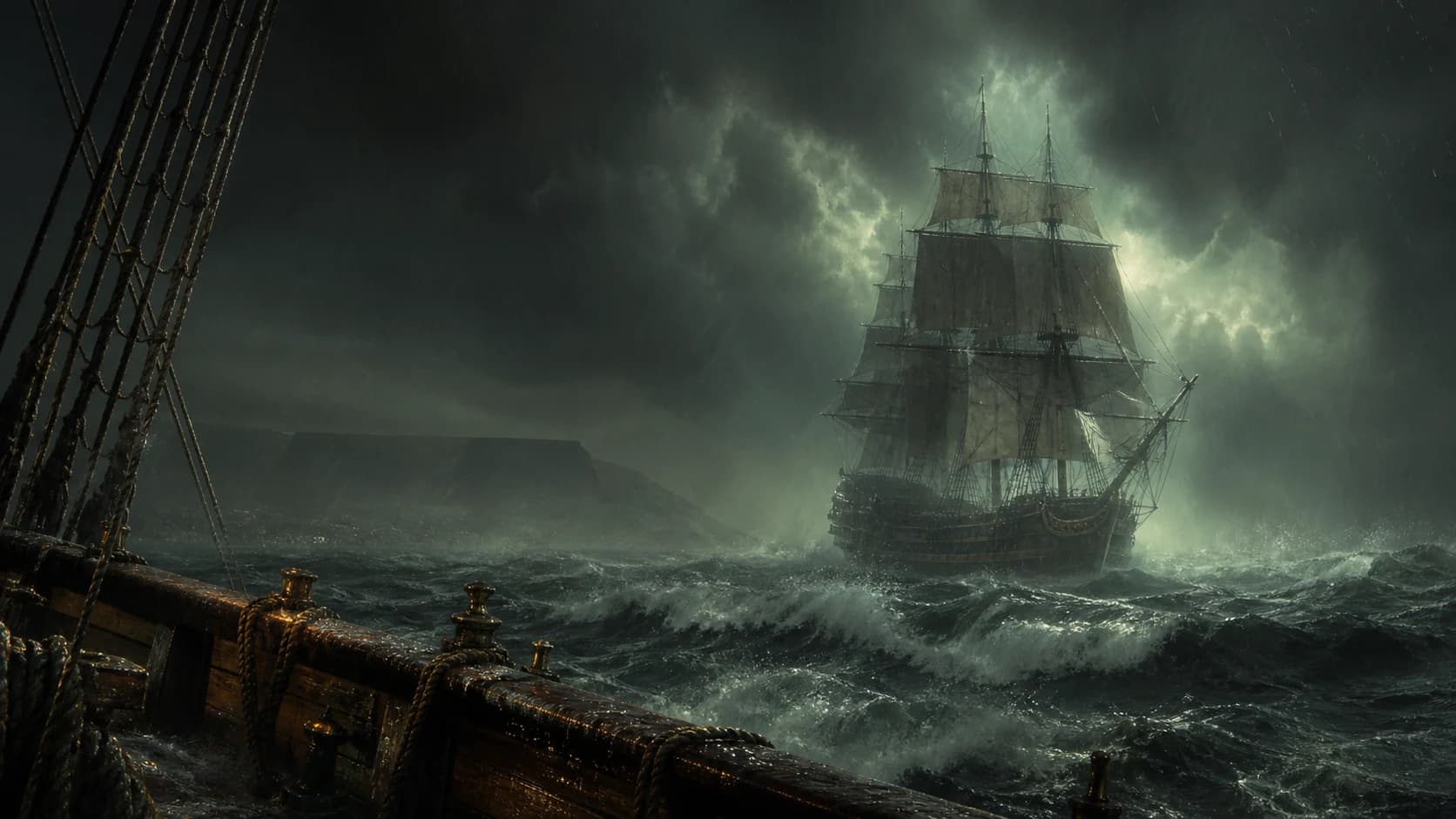
 ghost ship
Blue light has appeared on every mast
No flag
Missing identity makes a real derelict easier to turn into legend.
No reply
Distance, weather and optical uncertainty amplify the unknown.
Under way
An abandoned vessel can continue drifting under wind and current.
A sharp masthead can concentrate the electric field until air begins to glow
As a thunderstorm develops, a large electrical potential may form between cloud, sea and ship. Pointed structures such as mastheads and yardarms concentrate the local field.
When the field becomes strong enough, nearby air is ionized and emits blue or violet light. The glow may cling quietly to a point or flicker like a small flame in rain and wind. The name describes its appearance: the air is glowing, not the timber burning.
It belongs to the same charged weather as lightning, but it is not a small lightning strike
Lightning releases great energy suddenly along a channel through cloud, air or ground. St. Elmo’s fire is usually a local corona discharge that persists or flickers around a point. Its path, energy and appearance are different.
The common background still matters. A glowing mast means the vessel is in a strongly electrified environment where lightning, squalls and other storm hazards may remain. The light is neither an ordinary flame nor a promise that danger has passed; it makes one part of the invisible electric field briefly visible.
When blue light settled on the rig, physics entered the crew’s world of belief
A crew could not see an electric field, but it could see the highest mast suddenly shine in the worst weather without catching fire. The phenomenon appeared purposeful enough to be read as a presence.
Sailors connected it with their patron St. Erasmus, whose name became St. Elmo in the tradition. Some received the light as protection or a sign that the storm would soon ease; others read warning in the same glow. Ionization explains how the light formed. The saint’s story explains how people living inside marine uncertainty understood it.
Questions
Continue exploring this subject
Can St. Elmo’s fire set a ship alight?
The glow itself is ionized air, not open flame. It does, however, occur in strongly electrified weather where lightning and severe storm conditions remain dangerous.
Why does it appear at mastheads?
Sharp points concentrate an electric field, making local ionization and corona discharge more likely.
Does it mean a storm is ending?
No. Some historical traditions read it that way, but a single glow is not a reliable meteorological forecast of a storm’s end.
Sources
Continue the research
- Top Five: Weird Ocean PhenomenaNOAA Ocean Service
- Mariners Weather Log: Unusual Ocean Weather PhenomenaNOAA
 03
03