 ghost ship
The sea's longest story begins with a hail that receives no answer.
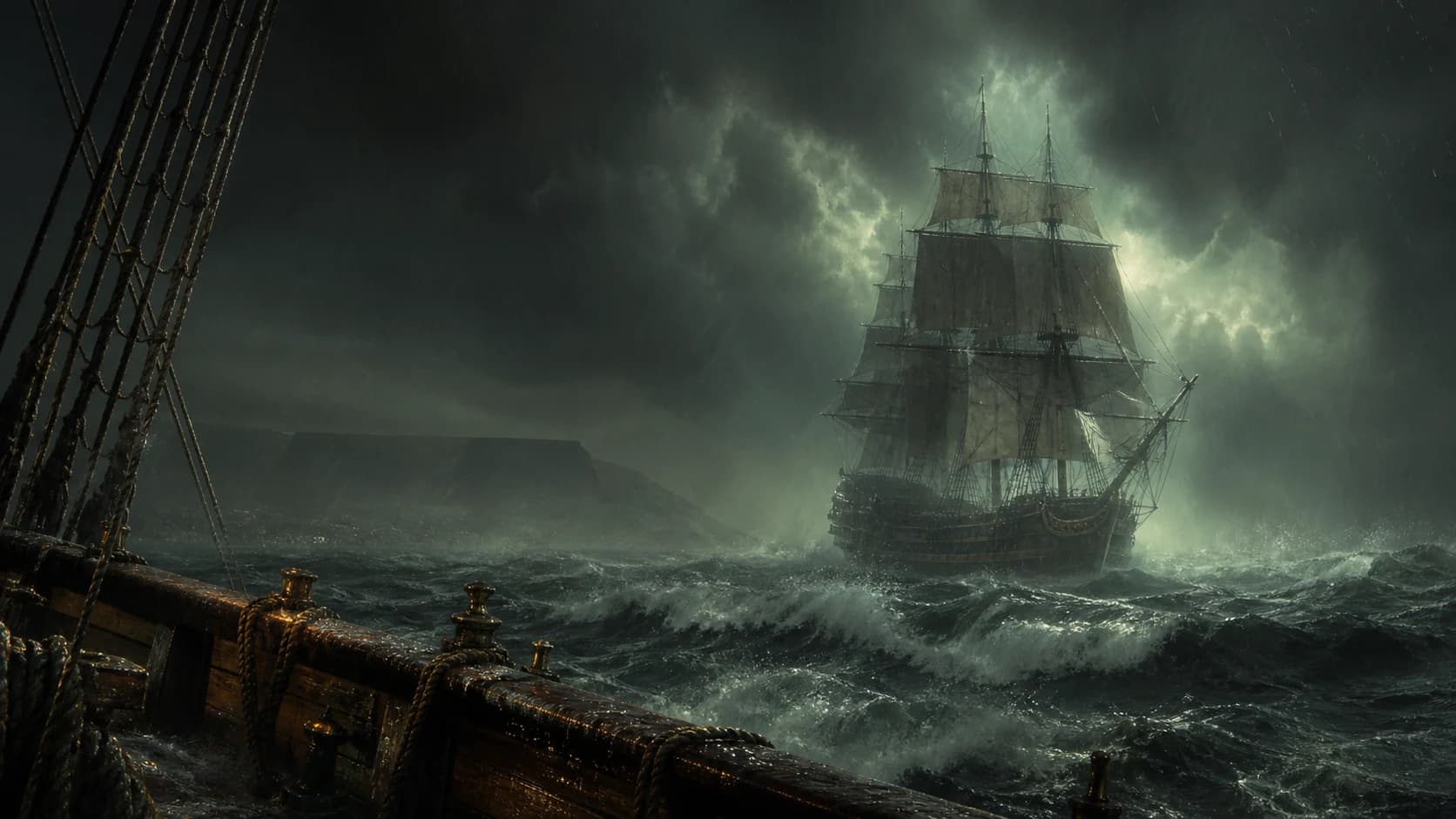
The ghost ship has two overlapping faces. One is the phantom of legend: running under full sail against the wind, carrying the dead and forbidden to make port. The other is the real derelict, its hull still adrift after its people have vanished. Storm, fog, refraction and electrical light give sightings a temporary shape; shipwreck leaves gaps that evidence cannot close; print gives one vessel a name, a crime and an endless voyage. Its deepest terror is not that a ghost stands on deck. It is that everything still appears to be under command, yet no hail is ever answered.
Three different ships drift in the same fog.
The dead still work the sails; the voyage never ends.
The hull remains; the final decision disappears with the crew.
Distance, fog, electrical light and refraction overlap.
The most frightening ship still sails like a ship
When a sea monster rises from below, the eye searches instinctively for scales, teeth and tentacles. The chill of a ghost ship arrives more slowly. First there are masts on the horizon, then canvas; the bow rises with the swell and the rigging appears to carry wind. Every detail belongs to the familiar order of seamanship, except that no one can be seen working the sails and no hand stands at the helm.
A sailing vessel is one of the most visible forms of collective labour. Someone keeps lookout, someone steers, someone hauls the sheets; commands pass from quarterdeck to masthead if the ship is to hold a course. When it comes on under full sail but answers neither flags nor voices, fear need not begin with the word ghost. It begins with a question against experience: if no one answers, who is keeping her under way?
In 1790, the Flying Dutchman was only an apparition that might answer
JOHN MACDONALD · 1790SOURCE ↗ The weather was so stormy that the sailors said they saw the Flying Dutchman.The earliest printed reference commonly cited today: a ship-shaped apparition in bad weather that may answer a hail.
The earliest printed reference commonly cited today appears in John MacDonald's travel narrative of 1790. He remembered three weeks of severe weather between the waters south of Madagascar and the Cape of Good Hope: men were washed away, and everyone aboard expected each day to be buried at sea. It was in that storm that the sailors said they saw the Flying Dutchman.
MacDonald's tale is brief. A distressed Dutch vessel tried to enter the Cape but found no pilot and was lost; ever afterward her apparition returned in bad weather. There is no arrogant captain, blasphemous oath or sentence lasting until judgement day. The uncanny detail is smaller: the sailors believed that if they hailed the image, it would answer like an ordinary ship. The legend first enters print not as a finished plot, but as a possible exchange between two vessels.
In 1821, her letters arrived sixty years too late
BLACKWOOD'S EDINBURGH MAGAZINE · 1821SOURCE ↗ Your letters would be of no use in Amsterdam; their recipients lie beneath ancient green turf in the churchyard.Vanderdecken's Message Home turns the phantom into a ship decades behind the world ashore.
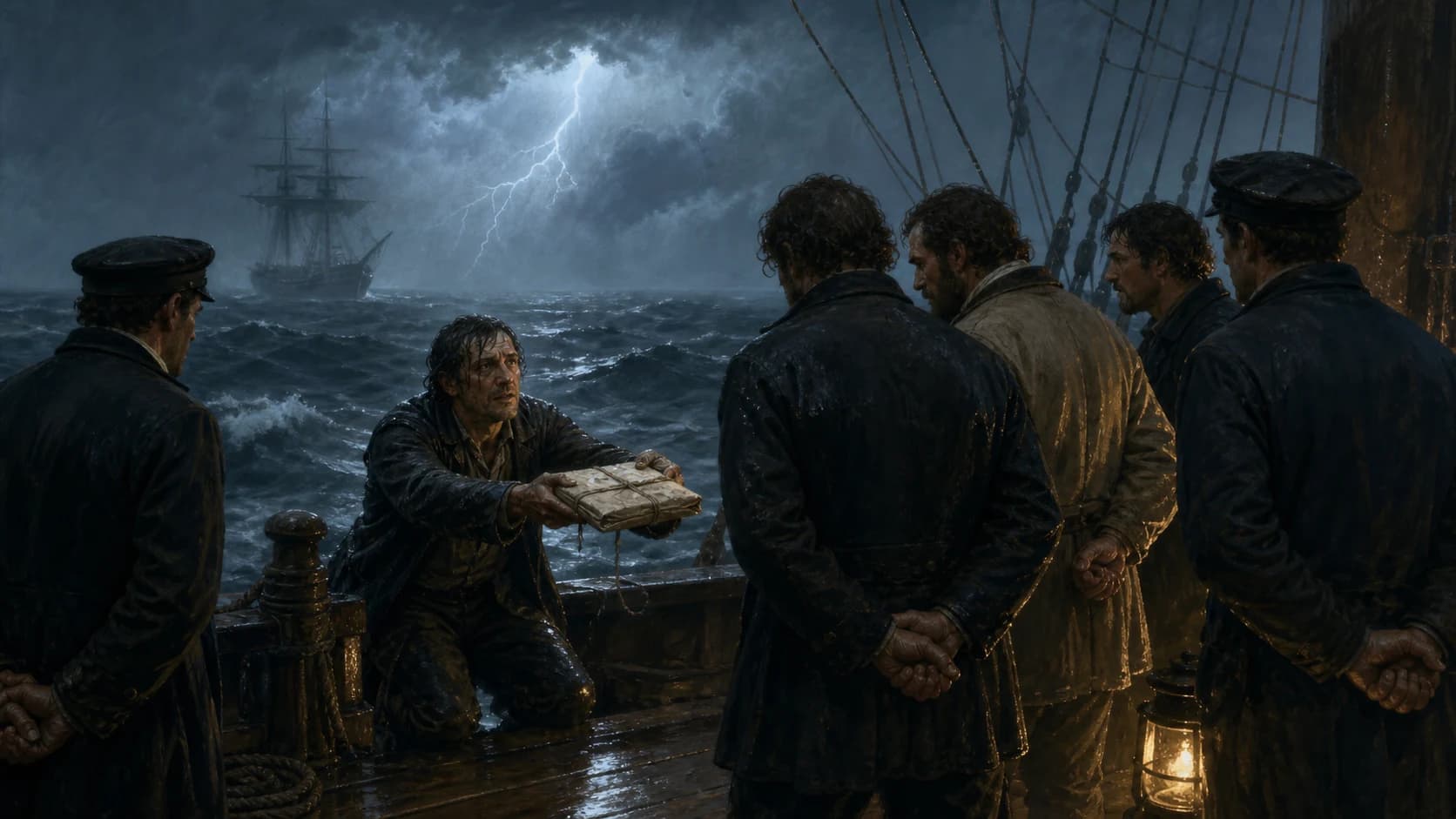
Thirty-one years later, Blackwood's Edinburgh Magazine published ‘Vanderdecken's Message Home.’ A boat leaves the phantom in a gale and its occupants board a passing ship, asking the crew to carry letters to Europe. Their calendar has blown away; unable to reckon how long they have been at sea, they want only to tell their families in Amsterdam that they are alive.
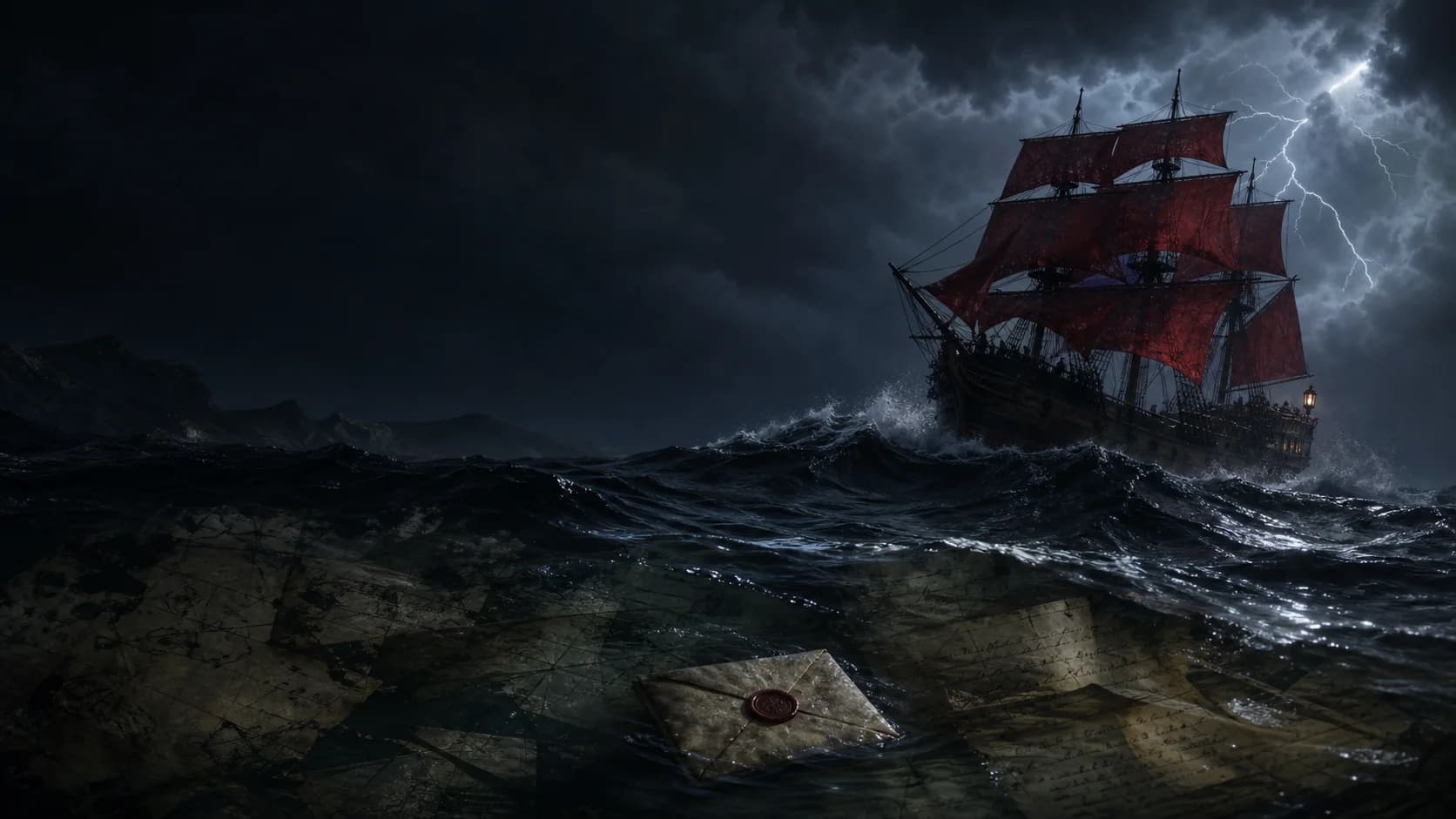
The answer is crueller than the apparition. The street on the address was demolished sixty years ago, the bank has failed, and the intended recipients likely lie beneath churchyard grass. The ghost ship now possesses its own time. Ashore, generations have been born, aged and died; aboard, departure seems as near as yesterday. The curse becomes something that can be held in the hand: a letter that is forever late, and that no one dares accept.
The nineteenth century gave the apparition a crime, a name and a voyage without end
Print kept supplying causes to the compact tale. In 1803 John Leyden wrote of a phantom that sailed into the eye of the wind; its crew had committed an atrocious crime and contracted plague, and every port refused them. Walter Scott later recorded versions involving murder, piracy and disease. The ship's inability to land was becoming a sentence.
Heinrich Heine, the theatre, Wagner's opera and Frederick Marryat's 1839 novel The Phantom Ship continued to alter it. Vanderdecken might be the captain or a father; release might depend on faithful love or on a son crossing the ocean in pursuit. A sailors' rumour from a Cape storm grew into family tragedy, religious parable and operatic myth. The apparently complete ‘standard version’ known today was composed relay-fashion by many authors in different decades.
At four in the morning in 1881, a ship in red light crossed a warship's bows
H.M.S. BACCHANTE · 11 JULY 1881 · 04:00LOG ↗ At four a.m. the Flying Dutchman crossed our bows.The account continues with spars and sails in a red light, seen by thirteen people before the material ship vanished.
On 11 July 1881 the published account of HMS Bacchante recorded a famous sighting. At four in the morning, the spars and sails of a brig appeared in a strange red light and seemed to cross the bows about two hundred yards away. The lookout, officer of the watch and midshipmen saw it. When men reached the forecastle, the clear sea was empty to the horizon. Other ships in company signalled that they too had noticed the light.
Later that morning, the seaman who first reported the apparition fell from aloft and died; he was buried at sea that evening. The account places the two events in sequence on the same day, and the reader's mind stitches them into warning and fulfilment. That is a central power of ghost-ship narrative: the apparition lasts only moments, but a later death shines backward upon it and gives an uncertain sighting the weight of fate.
The Mary Celeste brought the legend aboard a real empty ship
On 7 November 1872, the brigantine Mary Celeste left New York for Genoa carrying about 1,700 barrels of industrial alcohol. Captain Benjamin Briggs was aboard with his wife Sarah, their two-year-old daughter Sophia and seven crewmen. A month later Dei Gratia found her drifting in the Atlantic. No one answered the hail. The boarding party found a vessel abandoned by every person aboard.
The scene was not the later legend's table of warm food and untouched place settings. The boat was missing, some sail and rigging were damaged, cargo hatches were displaced, one pump had been taken apart and the sounding rod lay nearby. Navigation papers and the captain's instruments were gone. Together these traces point toward a deliberate abandonment, but no one left the final explanation. The people were never reliably seen again, and inquiry and newspapers multiplied possible causes.
In 1884 the young Arthur Conan Doyle anonymously published ‘J. Habakuk Jephson's Statement’ as a survivor's account. He wrote the name as Marie Celeste, changed voyage, cargo and condition, and left the boat aboard. The fiction travelled farther than the inquiry, and invented details entered public memory. The real derelict thereby underwent another haunting: not only the crew disappeared, but the boundary between evidence and retelling.
Fog, refraction and electrical light lend the phantom a temporary hull
NOAA · U.S. COAST PILOT 8COAST PILOT ↗ Ships have been seen with an inverted image above and an upright image floating above that.NOAA's description of superior mirage; complex layered systems are known as Fata Morgana.
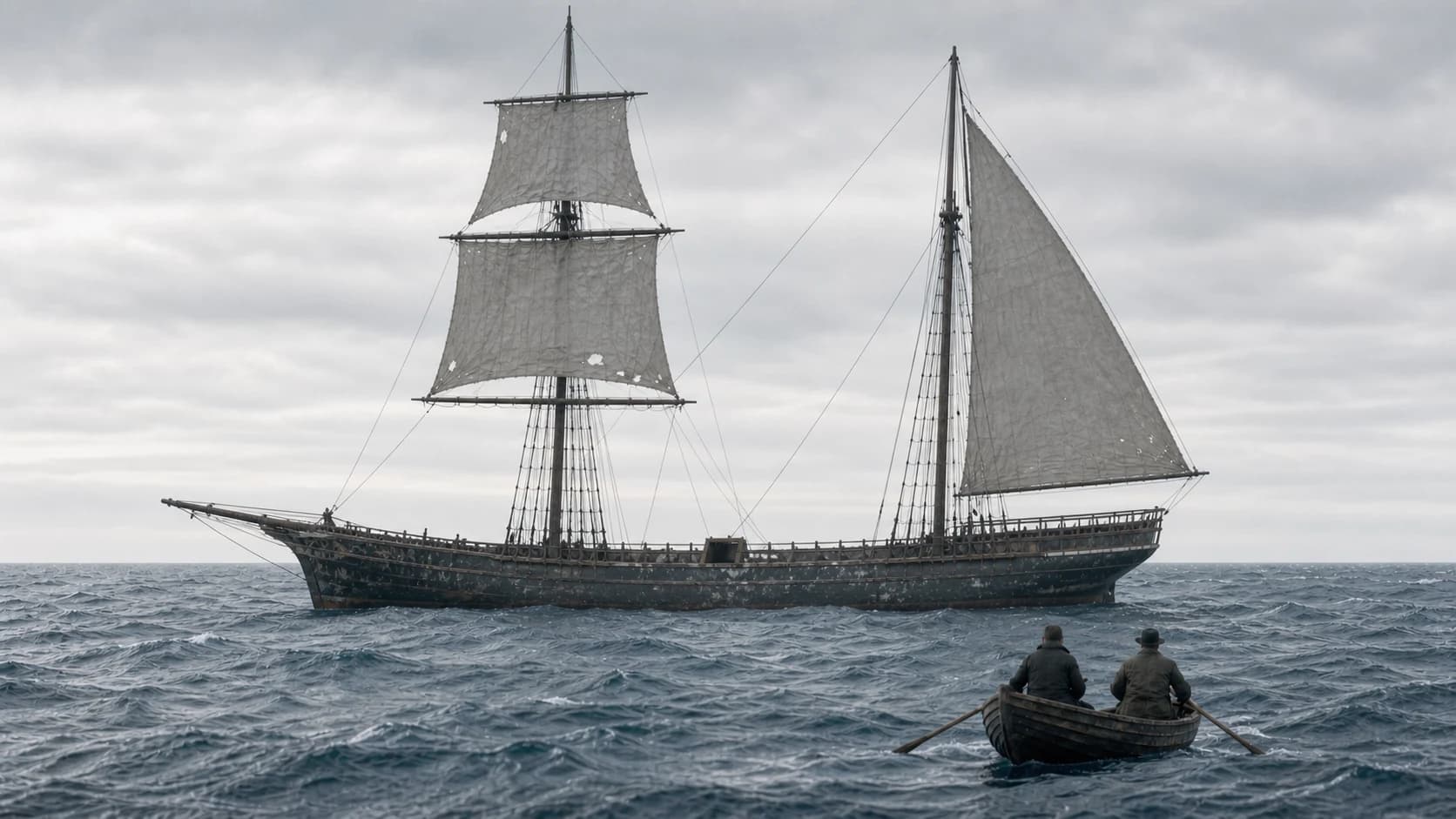
When air density changes sharply near the sea surface, light bends. A superior mirage can lift an object from below the horizon, stretching, inverting or duplicating a distant ship; more complex layered images are called Fata Morgana. The vessel may appear detached from the water, its masts repeated in the air, then vanish as temperature layers or the observer's position changes.
A storm supplies another kind of light. Static charge concentrated near mastheads, yards and other sharp points can ionise the surrounding air and produce St Elmo's fire, sometimes as a ghostly glow and sometimes as sparks along an edge. Refraction, mist, distant ships, lightning and electrical discharge provide physical material for some sightings. The story already carried in a sailor's mind helps decide whether that moment is named an ordinary vessel, a weather phenomenon or the Flying Dutchman.
The ghost ship feels epic because it turns the whole sea into a place beyond contact
An urban ghost story is often enclosed by one doorway, house or burial ground. The ghost ship has no such boundary. It sails from storms off the Cape into North Atlantic fog, then from spoken report into travel narrative, poem, magazine, opera and naval account. As long as an unanswered sail can appear on the horizon, it has another route.
It also preserves the simplest fear of the age of sail. Departure meant leaving the visible world; a letter might arrive later than the ship, the missing had no grave, and people ashore could only wait for a vessel that would never return. The ghost ship gives that loss of contact a visible form. Ship and voyage continue, and those who longed for home seem to continue with them—but the sea has kept them in another time.
Questions that remain after the fog clears
01Are ghost ships and unmanned drifting ships the same thing?+
Popular storytelling often overlaps them. An unmanned derelict is a real maritime condition open to investigation; a phantom, dead crew and an eternal exclusion from port belong to folklore and literature. Real derelicts often become material for the legends.
02Where does the Flying Dutchman first appear in print?+
The earliest printed reference commonly cited is in John MacDonald's 1790 travel narrative. It describes a Dutch apparition in Cape weather that might answer a hail; the familiar captain's crime and eternal curse are not yet fully present.
03Was Vanderdecken a real captain?+
Vanderdecken gradually became a captain or family figure in nineteenth-century texts, and his name, offence and fate vary from work to work. The record supports treating him as a literary character rather than a historical captain with a reliable biography.
04Why must a ship refuse the Flying Dutchman's letters?+
The 1821 ‘Vanderdecken's Message Home’ makes the letters dangerous: their addresses and recipients disappeared long ago, while the phantom crew refuses to recognise elapsed time. Sailors aboard the other vessel fear that accepting them will bring misfortune onto their own deck.
05Was everything aboard the Mary Celeste found in perfect order?+
No. Her boat was gone, sails and rigging were damaged, hatches were displaced, a pump was disassembled and there was water below. She remained navigable, but the immaculate scene of later fiction was never the evidence.
06What happened to the people of the Mary Celeste?+
Captain Briggs, his family and the seven crew members left no reliable trace. Evidence suggests they took papers and navigation instruments into the boat, but surviving records cannot establish why they abandoned ship or what followed.
07Can a mirage really make a ship float in the air?+
Yes. Superior mirage and Fata Morgana can lift, elongate, invert or multiply a distant ship's image so that it appears detached from the sea. Any particular sighting still needs its weather, distance and corroborating observations examined.
08Is St Elmo's fire the light of a ghost ship?+
St Elmo's fire is a glow produced when static electricity ionises air near pointed structures such as masts and yards. It supplies natural visual material for a luminous ship, while the curse, the dead and the endless voyage belong to storytelling tradition.
Return from apparition to archive
- 01Travels in Various Parts of Europe, Asia, and Africa (1790), p. 276University of Michigan · ECCO-TCP
- 02A Voyage to New South Wales (1795), pp. 45–47Google Books
- 03Vanderdecken's Message Home (Blackwood's Edinburgh Magazine, 1821)University of Pittsburgh · Folklore Archive
- 04The Phantom Ship (1839)Project Gutenberg
- 05The Cruise of Her Majesty's Ship Bacchante, 1879–1882, vol. IInternet Archive
- 06The mystery of the Mary CelesteRoyal Museums Greenwich
- 07J. Habakuk Jephson's Statement (The Cornhill Magazine, 1884)HathiTrust Digital Library
- 08Ghost shipsRoyal Museums Greenwich
- 09U.S. Coast Pilot 8, Chapter 3 — Optical PhenomenaNOAA Office of Coast Survey
- 10Abandoned Ship: The Mary CelesteSmithsonian Magazine
Related signals
Along the same route
 01
01The Flying Dutchman: a letter sixty years late, a ship delayed until Judgment Day
From a one-line storm apparition in 1790 to a slave ship, Vanderdecken's late letters, Heine's seven-year reprieve, Marryat's filial quest and Wagner's red-sailed finale: how each retelling made the Flying Dutchman eternal.
Continue along the route ↗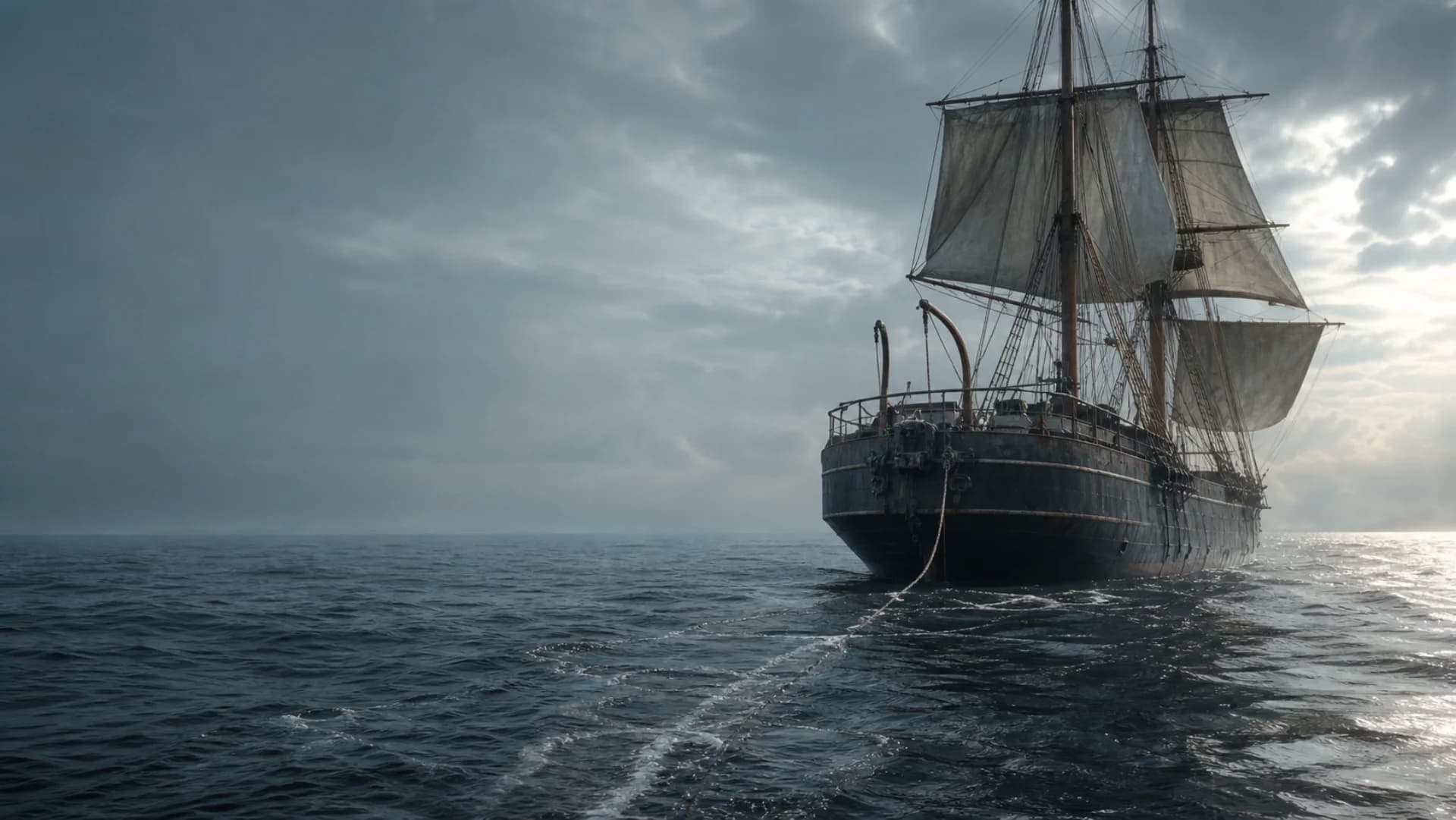 02
02Derelict ships: the vessel sailed on after the last human decision
From Mary Celeste, Carroll A. Deering and Kaz II to Baychimo's thirty-eight-year afterlife: four hulls that kept moving after their human timelines stopped.
Continue along the route ↗ 03
03Curses at sea: when the storm demands a name
From Jonah's lot and the cattle of Helios to the shot fired in 1719 and the albatross hung around a mariner's neck: how omen, transgression, name and disaster became a verdict at sea.
Continue along the route ↗