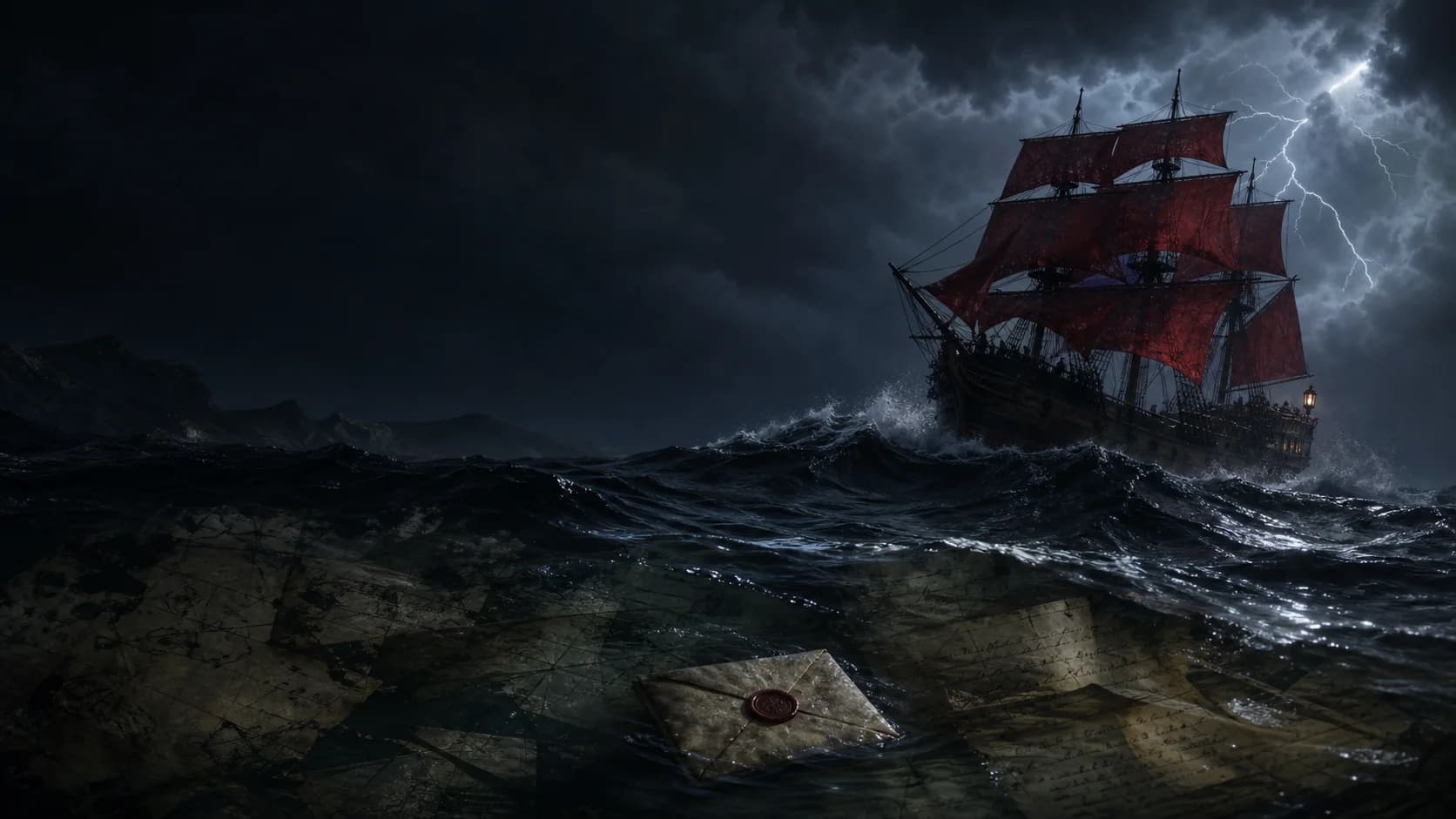
 ghost ship
The letter arrived. The world addressed by it was gone.
No lost seventeenth-century ‘complete original’ survives. In the earliest printed reference commonly cited, from 1790, the Dutchman is only a ship-shadow in bad Cape weather that may answer a hail; Vanderdecken, the blasphemous oath and the seven-year landing have yet to appear. Poets, dramatists, novelists and composers later gave it crimes, letters delayed beyond death and redemption. The legend is a vessel that receives a new master, sentence and destination whenever it is retold.
In forty years, a blank vessel was completed field by field.
The complete legend is a ship's paper covered in amendments
If the Flying Dutchman were a vessel awaiting registration, its earliest paper would be almost blank: ship name, master, departure, offence and sentence unknown. It retains only a Dutch identity, bad weather at the Cape and an apparition. Every later teller takes up this damaged file and fills another empty field.
The famous oath to round the Cape even if it takes until Judgment Day is therefore not the source of every version. Slave trading, piracy, murder, plague, blasphemy, eternal wandering, a landing every seven years and salvation through fidelity came aboard at different dates. Only the voyage remains stable. The shore moves forward; the ship returns to the same storm.
In 1790, the apparition could answer a hail but had no captain
JOHN MACDONALD · 1790SOURCE ↗ The weather was so stormy that the sailors said they saw the Flying Dutchman.
John MacDonald recalled three weeks of violent weather between the seas south of Madagascar and the Cape of Good Hope. Men were washed away and the company expected death each day. In that weather, the sailors said they saw the Flying Dutchman. This is the earliest printed notice commonly cited, while the depth of any earlier oral tradition remains uncertain.
MacDonald's common tale concerned a Dutch vessel lost after seeking a Cape harbour without a pilot. Its image appeared whenever the weather turned bad and might answer another ship's hail. The unease lies at the edge of communication: the distance still contains something that can be addressed, yet whatever answers no longer belongs to the living route.
In 1803, the ghost ship first carried a human crime
JOHN LEYDEN · SCENES OF INFANCY1803 ↗ Stout was the ship from Benin's palmy shore that first bore the weight of traded captives.
John Leyden's Scenes of Infancy made it a ship from Benin's palmy shore, first to bear the weight of ‘bartered captives’; a note added a dreadful crime and pestilence. Slavery and disease gave the wandering a moral cause rather than leaving it as the echo of a wreck.
Thomas Moore moved it to the Gulf of St Lawrence in 1804 and let full sails move in still air. Walter Scott added wealth, murder, piracy and plague in 1812. Each offence explained a part of the curse while revealing the danger its own writer most needed the phantom to carry.
In 1821, Vanderdecken brought a letter sixty years late
VANDERDECKEN'S MESSAGE HOME · 1821SOURCE ↗ Your letters would be of no use in Amsterdam; their recipients lie beneath ancient green turf in the churchyard.
‘Vanderdecken's Message Home’ in Blackwood's Edinburgh Magazine expanded the rumour into an encounter. In a Table Bay storm, the Dutch captain Vanderdecken boarded a British vessel and asked it to carry letters to Amsterdam. His calendar had blown away; the phantom crew no longer knew how long it had been at sea.
The British sailors knew the streets had vanished sixty years earlier, the bank had failed and the recipients lay beneath churchyard turf. Vanderdecken insisted they were alive because departure remained yesterday aboard his ship. The letters blew into the sea and the living vessel believed itself spared. A home letter became the sharpest proof of the curse: the ship had not aged, while everyone ashore had died.
Heine gave it seven years—and one chance of release
HEINRICH HEINE · KAPITEL VIISOURCE ↗ His ship was without anchor, and his heart without hope.
In The Memoirs of Herr von Schnabelewopski, Heinrich Heine presented the material as a play supposedly seen in Amsterdam. The captain swore to round the Cape even until Judgment Day. The devil sentenced him, but allowed him ashore once every seven years to find a faithful woman. Heine jokes about marriage and salvation, yet gives the sufferer his loneliest image: his ship without anchor, his heart without hope.
The omen became a condemned person. The question shifted from what disaster the ship would bring to who might end his pain. Portrait, courtship and fidelity attached the endless sea to a household ashore, while the seven-year reprieve placed one short gangway across boundless time.
In 1839, Marryat sent a son after his father's phantom
Former Royal Navy officer Frederick Marryat turned The Phantom Ship into a full maritime Gothic novel. Philip Vanderdecken learns that his father raged against the Cape wind and swore a blasphemous oath. Carrying a relic of the True Cross, the son goes to sea to deliver redemption to the condemned deck.
Company commissions, ports, crews, wrecks and colonial routes give the apparition a recognisable nautical world. The reader follows not a witness who chances upon the ship, but a son who knows he cannot catch it and must sail nonetheless. Eternal punishment becomes an inherited, intergenerational task.
In 1843, red sails reached the stage and Senta completed the finale
RICHARD WAGNER · ACT III1843 ↗ Here I stand, faithful to you until death!GERMANHier steh' ich, treu dir bis zum Tod!
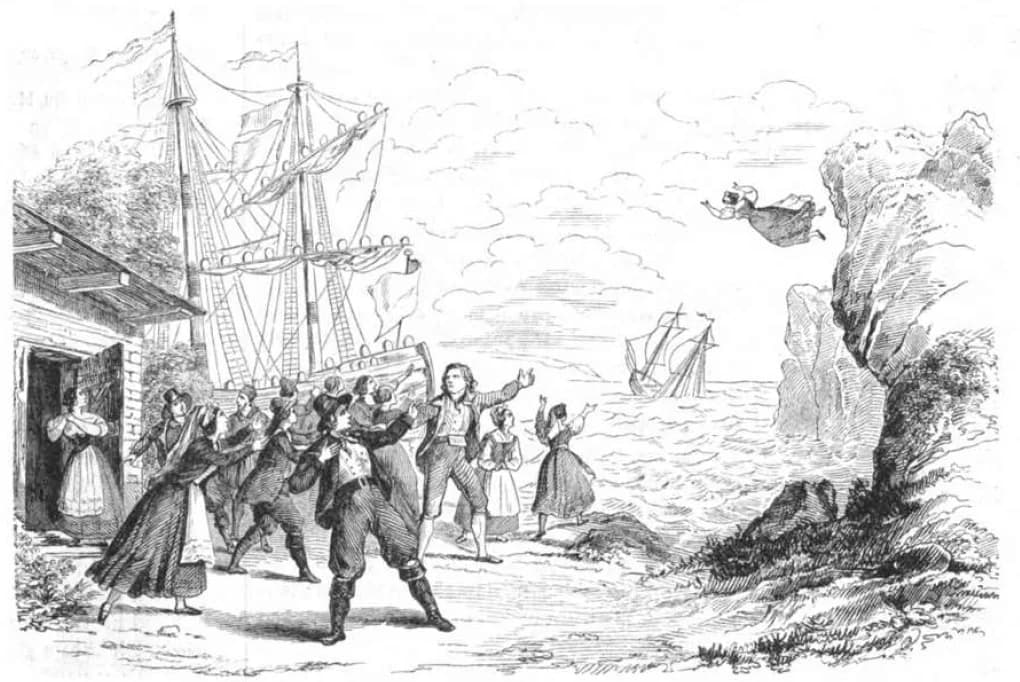
Richard Wagner acknowledged that Heine's treatment gave him his operatic subject, then moved the stage to a Norwegian rock coast. The Dutchman's black mast and blood-red sails arrive as Senta, already transfixed by his portrait, sings of the vessel without aim, rest or peace. She believes fidelity unto death can end the curse.
At the Dresden premiere's climax, the Dutchman thinks Senta unfaithful and departs. She breaks free, cries that she is faithful until death, and leaps into the sea. Ship and crew sink, the water falls back in a whirlpool, and their transfigured figures rise in the red dawn. Only here did the ship that could not make port receive an ending large enough to bring down a theatre curtain.
At four in the morning in 1881, the log sent it back to sea
H.M.S. BACCHANTE · 11 JULY 1881 · 04:00LOG ↗ At four a.m. the Flying Dutchman crossed our bows.
On 11 July 1881, HMS Bacchante recorded a strange red light containing the masts, yards and sails of a brig, passing roughly two hundred yards across the bow. A lookout, officers and midshipmen saw it; when men reached the forecastle, the clear sea held no material ship to the horizon.
The first sailor to report it fell from aloft later that morning and was buried at sea that evening. The log placed both events on one date; readers connected omen and fulfilment. Refraction, distant vessels, haze and electrical light can lend some sightings a temporary body. The prepared name supplied forty years of literary memory.
Its epic moment is when the endless voyage finally acquires a voice, name and home
The legend did not become epic through one fixed plot. First it answered a hail; then it delivered letters to the dead; then it gained a captain's face, an anchorless heart, a landing every seven years, a son's pursuit and Senta's final high cry. Every version claims the same vessel and sends it where it had never sailed before.
Making port would close the log, unload the cargo, deliver the letter and end the tale. The Dutchman survives by arriving late. The letter is sixty years late; the ship is late until Judgment Day; every generation sees its lamp again. Storms do not merely fail to sink it. Centuries replace the world while that light still searches for an addressee who has not disappeared.
After return to sender
01Is there one complete original version?+
No. Texts from 1790 through the 1840s successively added a captain, offence, letters, seven-year term and forms of salvation.
02Does the legend come from seventeenth-century Holland?+
Verifiable print references begin around 1790 and appear mainly in a British cultural setting. No seventeenth-century Dutch source contains the full modern plot.
03Was Vanderdecken a real captain?+
The name becomes the phantom captain in the 1821 story and is repeatedly rewritten afterwards. No reliable biography establishes one historical original.
04Why does the ship carry letters?+
The 1821 tale traps its crew in unchanging time. Addresses and recipients have vanished, and accepting the letters threatens to bring the phantom's misfortune aboard.
05Where does the seven-year landing come from?+
Heine clearly uses the seven-year interval and salvation by a faithful woman in the 1830s; Wagner magnifies that structure.
06Was Senta part of sailor folklore?+
Senta is Wagner's operatic character. Her vow and leap into the sea give the ship its theatrical redemption.
07Are Marryat and Wagner telling the same story?+
No. Marryat sends Philip and a relic after his father; Wagner centres salvation on the Dutchman and Senta's fidelity.
08Can a mirage explain the Flying Dutchman?+
Superior mirage can lift, invert or erase a distant ship. It may explain some visual conditions, not the literary captain, letters, curse and redemption.
Turn back through the printed record
- 01Travels in Various Parts of Europe, Asia, and Africa (1790), p. 276University of Michigan · ECCO-TCP
- 02Manifestations of the Flying Dutchman: on materializing ghosts and (not) remembering the colonial pastCultural History · Utrecht University Repository
- 03Scenes of Infancy: Descriptive of Teviotdale (1803)University of Rochester · Camelot Project
- 04Written on Passing Dead-man's Island, Gulf of St. Lawrence (1804)Project Gutenberg · Thomas Moore
- 05Vanderdecken’s Message Home (Blackwood’s Edinburgh Magazine, 1821)University of Pittsburgh · Folklore Archive
- 06The Memoirs of Herr von Schnabelewopski, chapter VIIWikisource · Heine English translation
- 07Aus den Memoiren des Herren von Schnabelewopski, Kapitel VIIProjekt Gutenberg-DE · Heinrich Heine
- 08The Phantom Ship (1839)Project Gutenberg · Frederick Marryat
- 09Der Fliegende Holländer — German librettoProject Gutenberg · Richard Wagner
- 10Der Fliegende Holländer — performance materials and versionsSchott Music
- 11The Cruise of Her Majesty’s Ship Bacchante, 1879–1882, vol. IInternet Archive
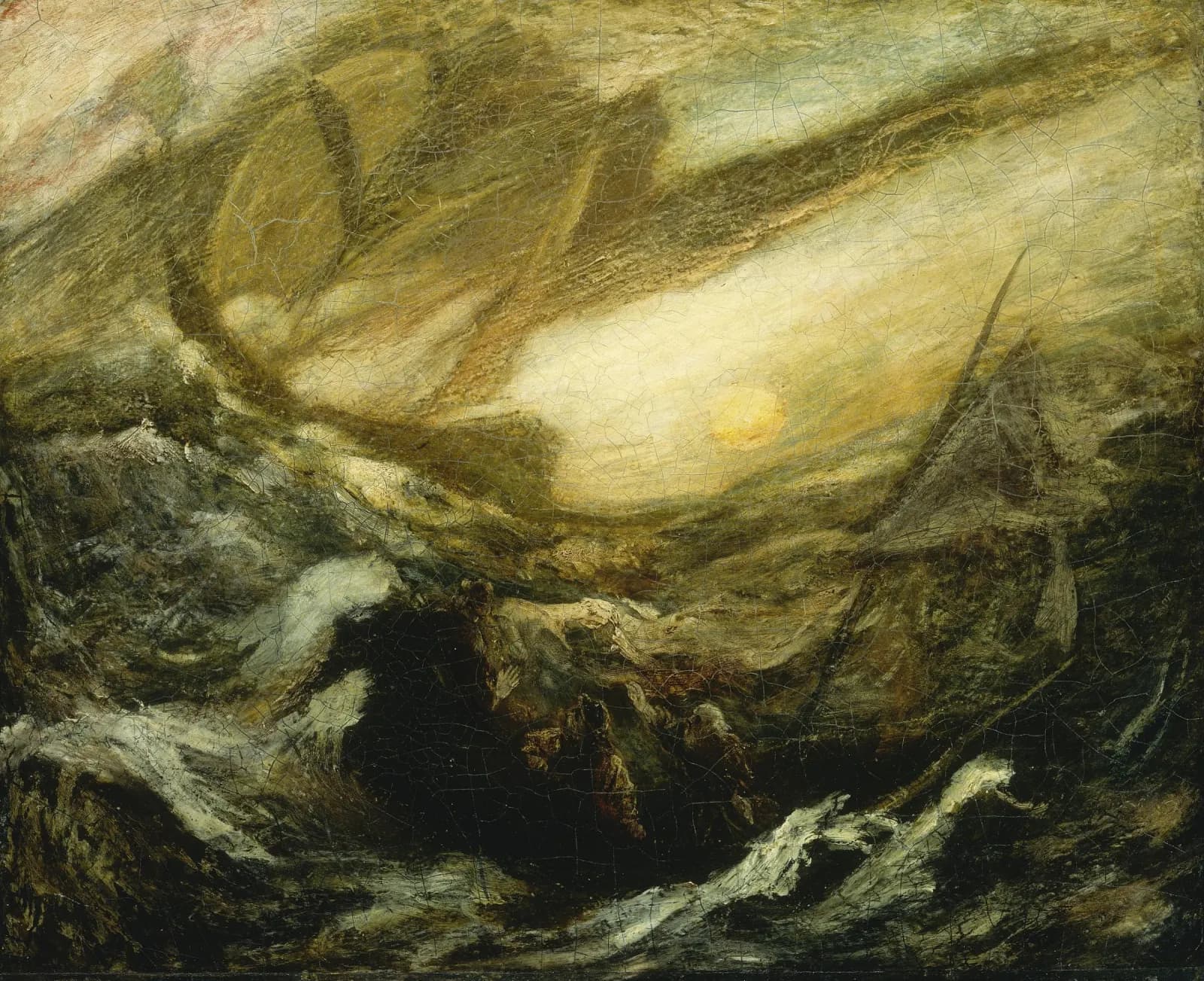
- 12Flying Dutchman, completed by 1887Smithsonian American Art Museum · Albert Pinkham Ryder
- 13Ghost shipsRoyal Museums Greenwich
- 14U.S. Coast Pilot 8, Chapter 3 — Optical PhenomenaNOAA Office of Coast Survey
Related signals
Along the same route
 01
01Ghost ships: the hail that received no answer
From the first printed Flying Dutchman reference in 1790 to the empty Mary Celeste and ships distorted in fog: why does the ghost ship appear when someone hails and no one answers?
Continue along the route ↗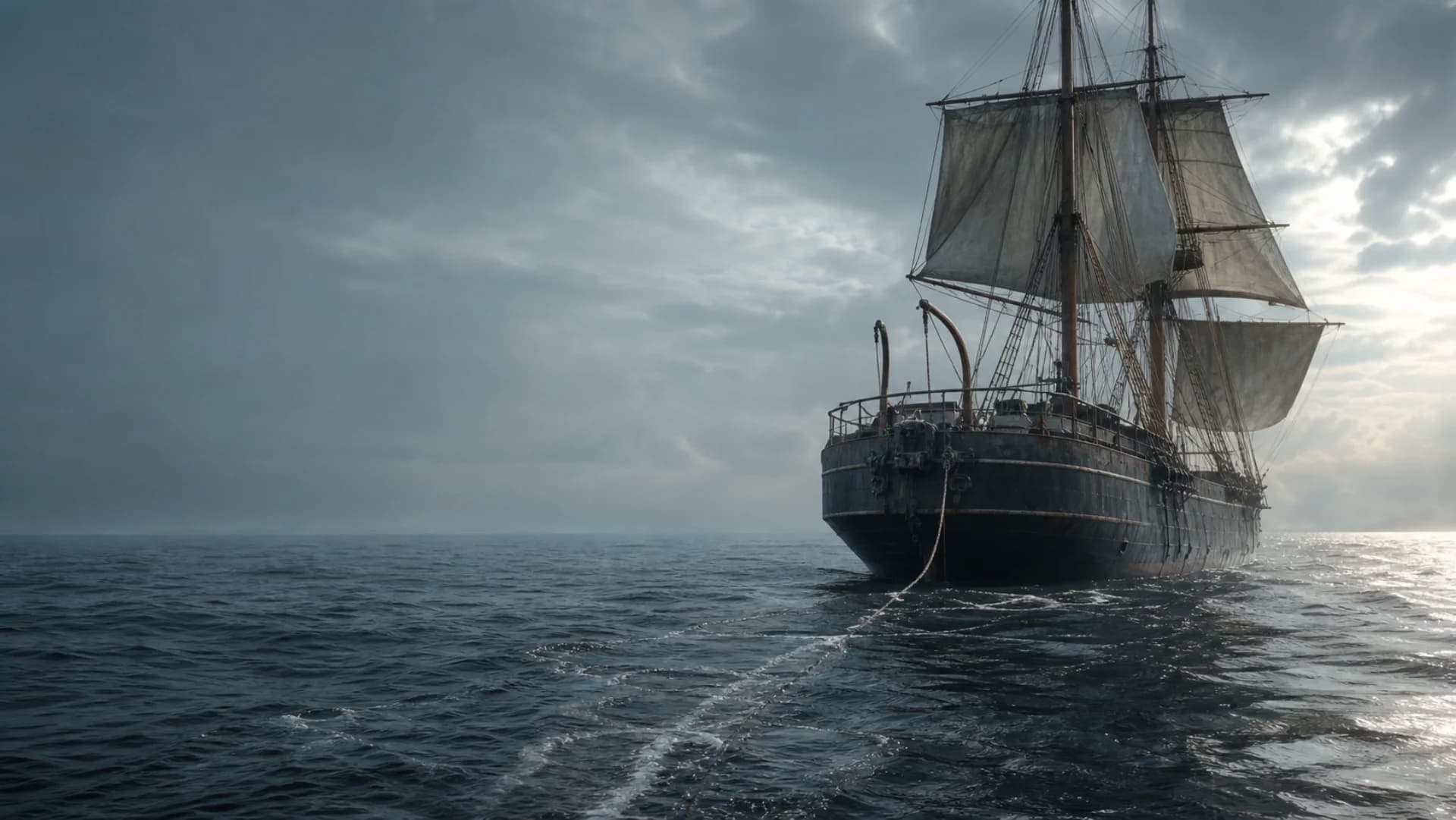 02
02Derelict ships: the vessel sailed on after the last human decision
From Mary Celeste, Carroll A. Deering and Kaz II to Baychimo's thirty-eight-year afterlife: four hulls that kept moving after their human timelines stopped.
Continue along the route ↗ 03
03Curses at sea: when the storm demands a name
From Jonah's lot and the cattle of Helios to the shot fired in 1719 and the albatross hung around a mariner's neck: how omen, transgression, name and disaster became a verdict at sea.
Continue along the route ↗