 ghost ship
THE STORM DEMANDS A NAME.
A sea curse becomes most powerful when a trapped crew asks whose deed caused the storm. Ancient narratives used a cast lot to identify Jonah and a thunderbolt to punish the men who ate Helios's cattle. In 1719, a real sailor shot a black albatross as an evil omen; eighty years later, Coleridge turned that shot into a maritime apocalypse. A curse gives an invisible cause a name—and makes one person, bird or broken prohibition carry the weight of an ocean.
THE STORM GIVES NO TESTIMONY. THE CREW COMPLETES ITS TRIAL.
When the storm rises, chance is the first thing lost aboard ship
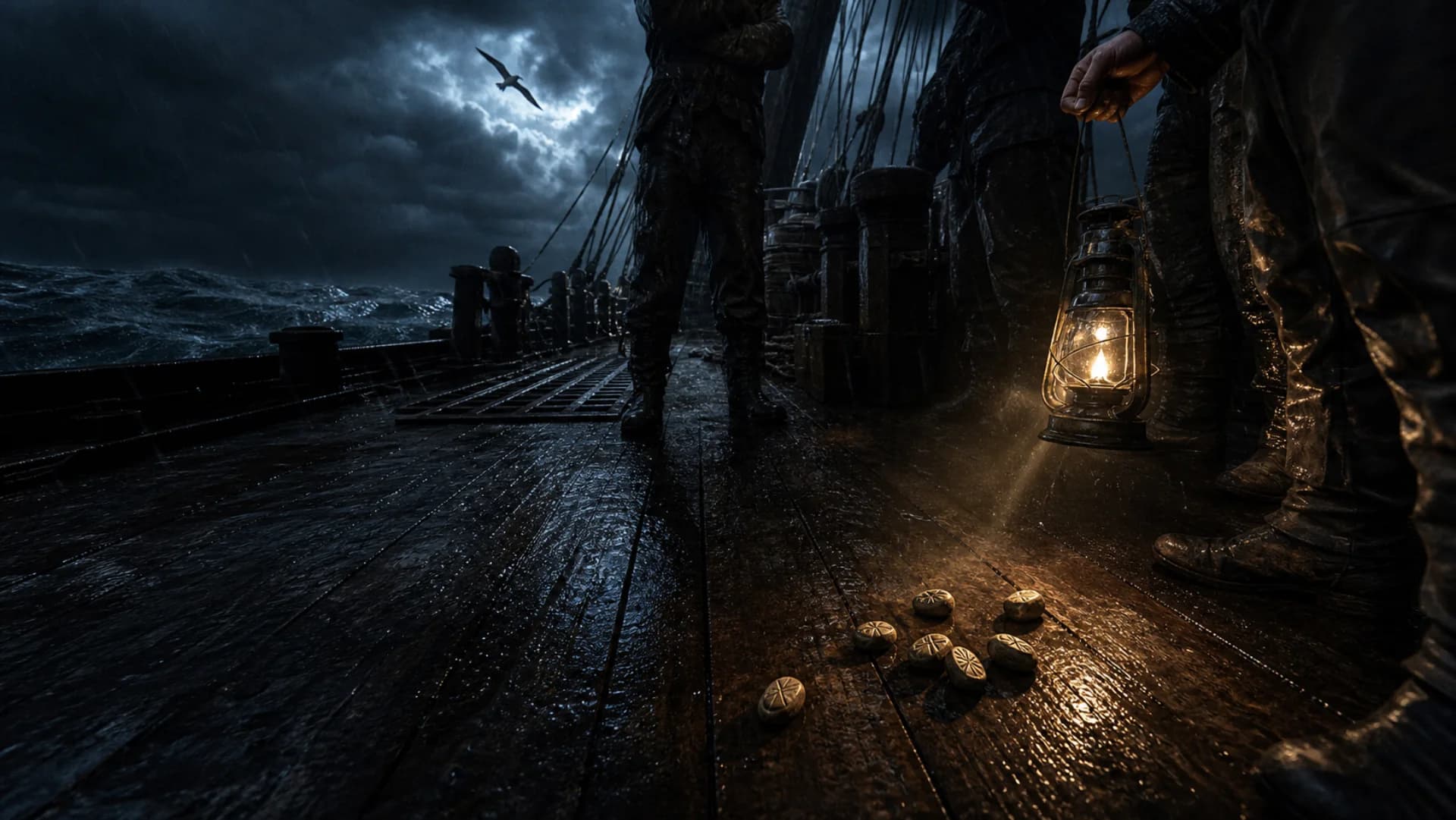
A disaster on land can disperse: people leave the scene and witnesses search in different directions. A ship holds everyone inside the same sinking space. Rigging groans, water enters the hold and the wind changes without warning; every noise draws the crew toward one question. Is this weather—or the consequence of something already done?
The curse begins its work there. It orders invisible force into a procedure: a sign appears, a prohibition has been breached, a name is found and catastrophe begins to resemble a sentence. The sea remains beyond control, but the story no longer allows it to be without cause.
Off Joppa, every life aboard was placed inside a handful of lots
JONAH · 1:7SEFARIA ↗ They said to one another: Come, let us cast lots and learn on whose account this misfortune has come upon us. They cast lots, and the lot fell on Jonah.HEBREW SOURCEוַיֹּאמְרוּ אִישׁ אֶל־רֵעֵהוּ לְכוּ וְנַפִּילָה גוֹרָלוֹת וְנֵדְעָה בְּשֶׁלְּמִי הָרָעָה הַזֹּאת לָנוּ וַיַּפִּלוּ גוֹרָלוֹת וַיִּפֹּל הַגּוֹרָל עַל־יוֹנָה׃
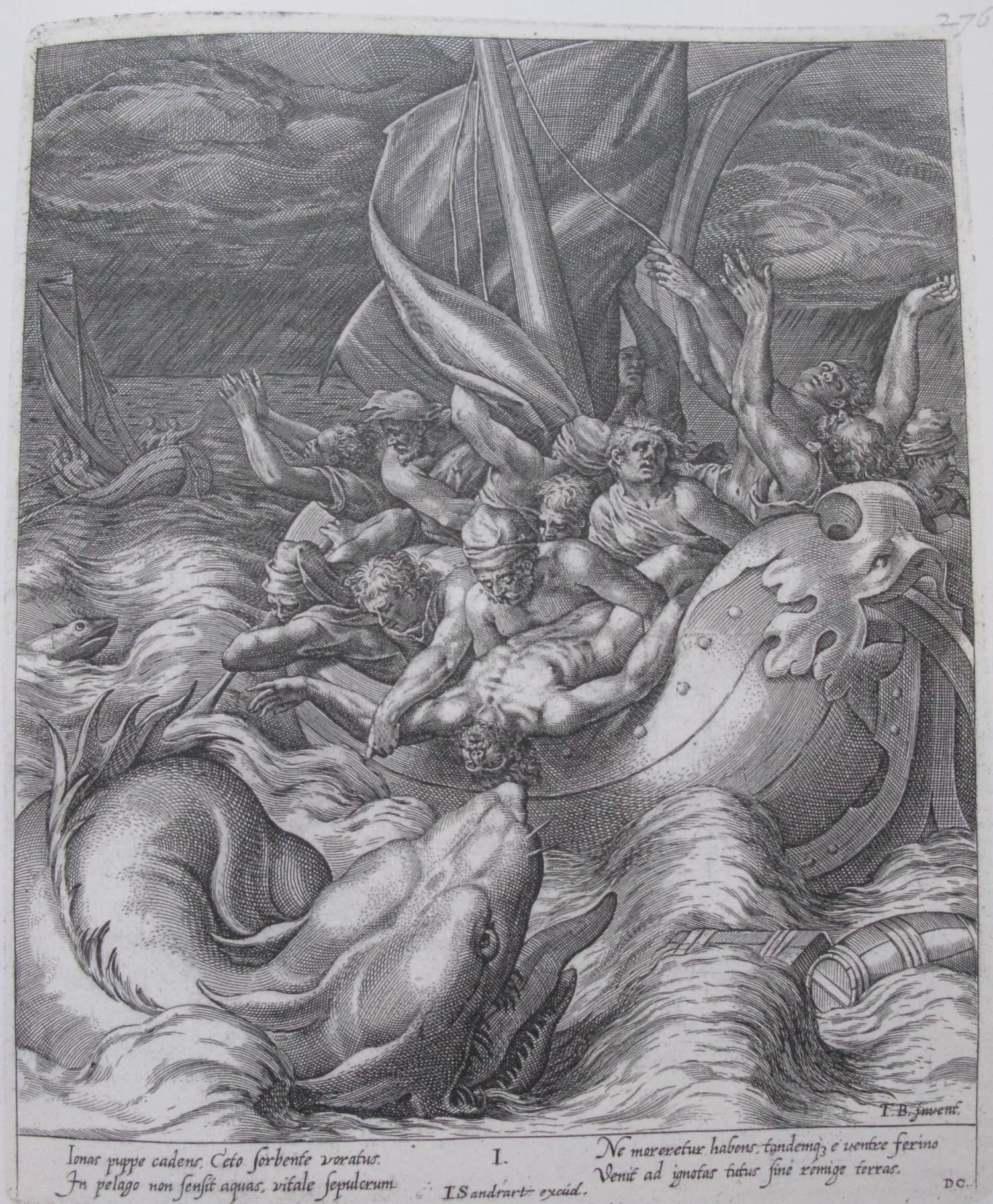
The first chapter of Jonah reads almost like a shipboard casualty record. A vessel leaves Joppa; a great wind threatens to break it; sailors call on their different gods and throw cargo into the sea. The master finds Jonah asleep below. When prayer and lightening ship do not still the weather, the men cast lots to discover on whose account the danger has come.
The lot falls on Jonah and confusion acquires a centre. The sailors ask his work, origin, country and people. Jonah admits that he is fleeing the God who made sea and dry land. One of the oldest and sharpest structures of the maritime curse is now complete: the storm no longer merely surrounds the vessel. It points at one person aboard.
After the chosen man speaks, the sailors still row desperately for shore
JONAH · 1:15SEFARIA ↗ They lifted Jonah and cast him into the sea; and the sea stopped raging.HEBREW SOURCEוַיִּשְׂאוּ אֶת־יוֹנָה וַיְטִלֻהוּ אֶל־הַיָּם וַיַּעֲמֹד הַיָּם מִזַּעְפּוֹ׃
Jonah tells the crew to throw him into the sea, but they do not obey at once. They pull hard for land. Only when the sea grows more violent do they pray not to be charged with innocent blood, lift Jonah over the side and cast him down. The next movement in the text is immediate: the sea stops raging.
That sequence is heavier than a simple tale of superstitious men finding a scapegoat. The lot has spoken, yet the crew tries to resist its sentence. When their oars can no longer move the ship, a body passes across the rail. The calm that follows becomes the most terrible witness of all. Within the story's order, it proves that they named the right man.
 THE LOTTHE SEA
On Helios's island, hunger carried the whole crew across the line
ODYSSEY · XII · 394–396PERSEUS ↗ The hides crawled; the flesh, roast and raw, bellowed around the spits, and there came a sound like cattle.ANCIENT GREEK SOURCEδέρματα μὲν ἕρπον, κρέα δ’ ἀμφ’ ὀβελοῖσι
μεμύκει, ὀπταλέα τε καὶ ὠμά, φωνὴ δ’ ὡς βοῶν γίγνετο.
Book 12 of the Odyssey gives the ship another kind of judgment. Contrary winds hold Odysseus's men on the island of Helios until their food is gone. They have been warned to leave the sun god's cattle untouched. Eurylochus argues that starvation is worse: kill the cattle as a sacrifice, then repay the god with a temple after reaching home. Hunger makes a sacred limit sound like a debt that can be deferred.
Portents follow the slaughter. The hides crawl; raw and roasting meat bellows from the spits. On the seventh day the wind drops and the men sail. Zeus gathers a black cloud and breaks the ship with lightning. No single lot allocates guilt here. The whole company shares the breach—and the sentence that tears mast from keel.
On 1 October 1719, a shot sounded across a real sea
SHELVOCKE · SPEEDWELL · 1726VOYAGE TEXT ↗ Mr Hatley imagined from its colour that it might be some ill omen, and that our contrary winds might be owing to it; after several fruitless attempts, he shot the bird.ORIGINAL ENGLISHMr. Hatley … imagin’d, from his Colour, that it might be some ill Omen … and after some fruitless Attempts, at length, shot the Albitross.
The literary albatross curse can be anchored to a dated voyage. In 1719 George Shelvocke's Speedwell was struggling near Cape Horn, where cold, storms and remoteness had worn down the company. A black albatross followed the vessel. Simon Hatley, the second captain, read its colour as an ill omen and imagined that the bird might be responsible for the contrary weather.
Hatley shot it in the hope of changing the wind. Shelvocke's account preserves another gaze: in so remote a place the albatross might have been a companion, diverting the men from thoughts of their isolation. Before the gun was fired, the same bird already had two identities—cause of misfortune to one man, company to the others. The curse had not yet been written, but its fracture was present.
Coleridge rewrote that single shot as the end of the world
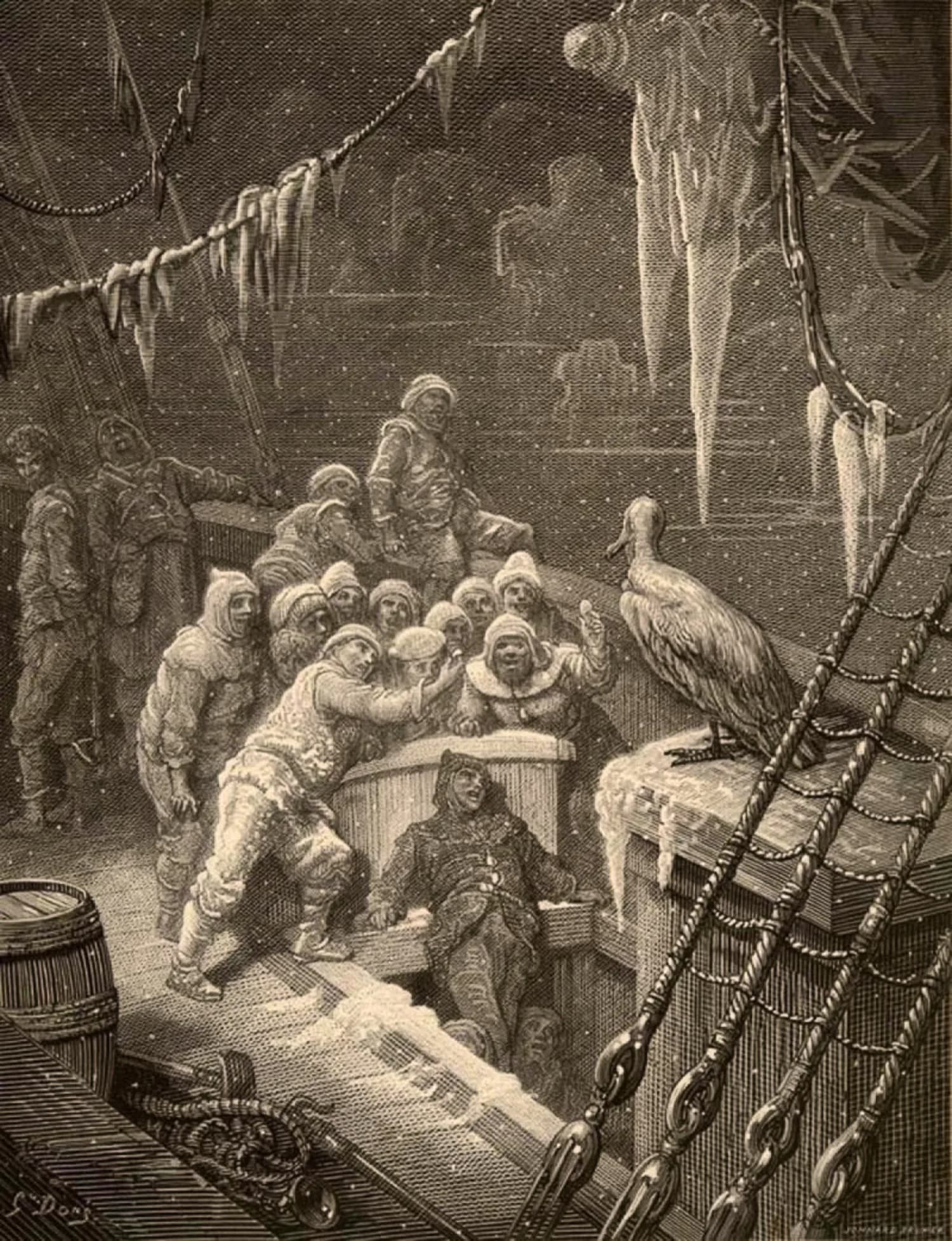
William Wordsworth had read Shelvocke and brought the albatross episode into a story he began devising with Samuel Taylor Coleridge in 1797. The Rime of the Ancient Mariner, published in 1798, reversed the moral direction of the event. The bird comes through the polar ice and is greeted as a Christian soul; the ice splits, a fair wind rises and the albatross follows the ship. Then, without offered cause, the mariner shoots it with his crossbow.
The wind dies. The sea congeals. The sun hangs like copper, and men surrounded by water cannot drink. The crew first condemn the killing, then approve when the weather clears, and finally hang the dead bird around the culprit's neck. A real bullet ended one animal. In the poem, the shot passes through the moral order of an entire ship.
Where a cross should rest, the body of a seabird was hung
COLERIDGE · PART II · 1798POEM ↗ Instead of the cross, the Albatross was hung about my neck.ORIGINAL ENGLISHInstead of the cross, the Albatross
About my neck was hung.
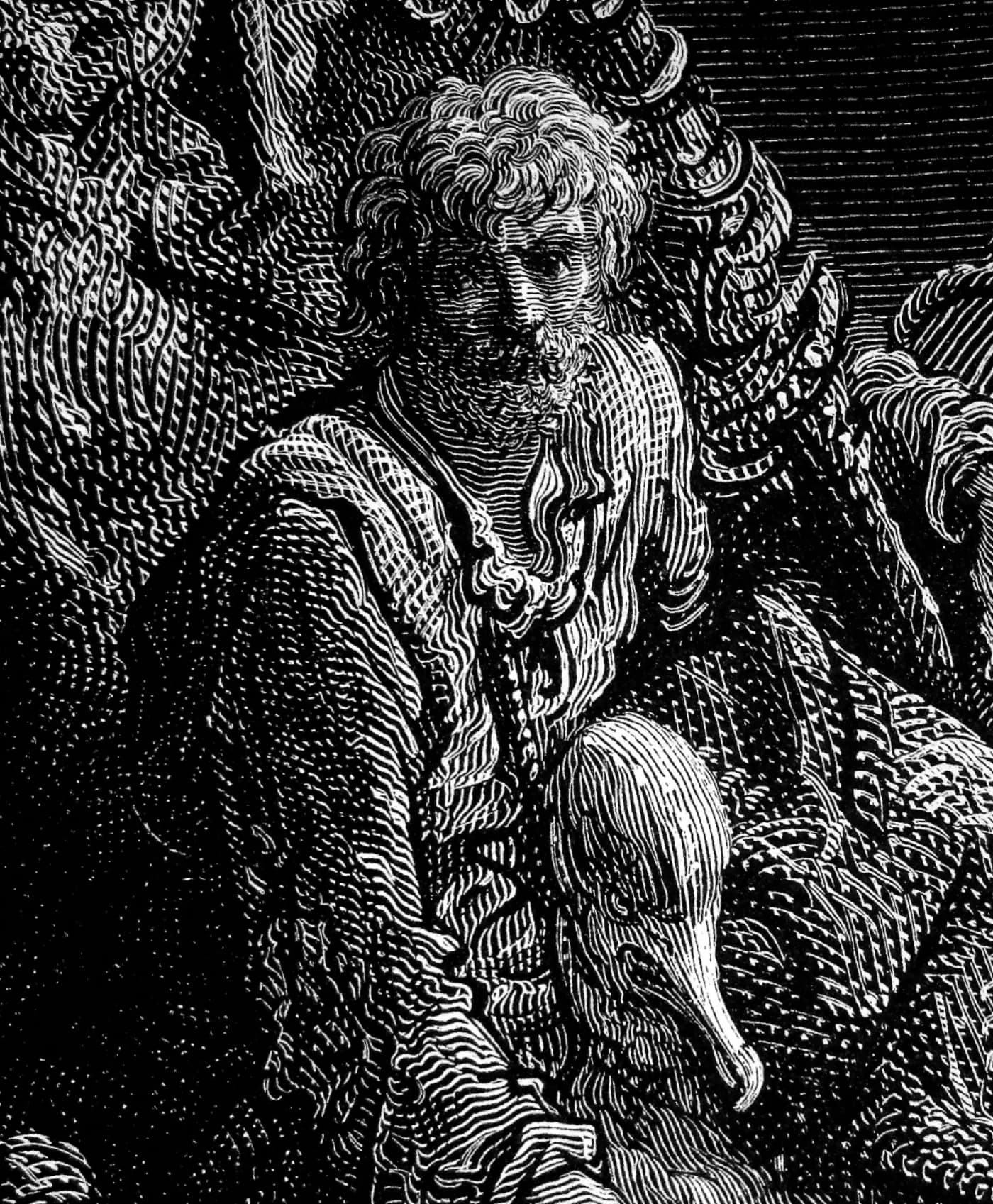
‘Instead of the cross, the Albatross / About my neck was hung.’ The couplet gives a maritime curse a body that cannot be evaded. Guilt is no longer hidden in argument or rumour. It has feathers and weight, touches the mariner's breastbone and swings with each motion of the becalmed hull.
This image helped make the albatross a modern English metaphor for an oppressive burden. Its epic force requires no monster surfacing from the deep. The entire ocean becomes a court: the sun watches, the dead crew remain silent, the ship stops upon windless water, and the one survivor must wear what he has done.
For one bird to become a taboo, history had to flow backward
JOSEPH BANKS · 03 JAN 1770JOURNAL ↗ The albatross was so good that everybody praised it and ate heartily.ORIGINAL ENGLISHso good that everybody commended and eat heartily of it
It is now common to hear that sailors have always refused to harm an albatross. Surviving records show a more unsettled sea. In 1770 Joseph Banks wrote that Endeavour's company shot an albatross and found it good enough for everyone to eat heartily. Hatley fired precisely because he saw the bird as sinister, not as a sacred guide.
Poetry reversed the current. Coleridge gave the killing catastrophic consequences; later readers carried those consequences backward as though they preserved an immemorial law. Legends often grow in this direction. A work of unusual power does not simply record an old taboo—it gives posterity a past that feels as if it had always been there.
Every harbour keeps its own forbidden words and little precedents
FLORIDA SHRIMP FISHERMAN · FIELD RECORDLIBRARY OF CONGRESS ↗ Do not turn the hatch cover all the way upside down … Do not whistle.FIELDWORK TRANSCRIPTYou don't turn the hatch cover all the way upside down … You don't whistle.
The Library of Congress maritime folklife guide records a Florida shrimp fisherman listing bad-luck rules learned among his peers: do not say ‘alligator’, carry shells, turn the hatch cover fully upside down, bring a black suitcase or whistle. These are not articles in a universal maritime code. They are ways one working community recognises its own boundaries.
Some sayings sit near long observation. In the mid-latitude westerlies, ‘red sky at night’ and ‘red sky in morning’ can carry limited meteorological sense. Other rules twist memory, identity and narrative into a single rope. They may not command the wind, but they shape how a crew speaks about it, remembers an accident and warns the next person going to sea.
When the curse descends, the sea finally seems to speak
From Jonah's lot and the cattle of Helios to the dead bird at the mariner's throat, the curse repeatedly turns inhuman force into a verdict that can be read aloud. A sign reveals a breach; the breach reveals a name; the name carries the result. The crew receives a severe explanation—and may force chance, fear and collective failure onto one body.
These stories endure because they understand a deeper shipboard terror than any list of lucky objects. A storm can destroy everyone without giving a reason. Legend therefore makes the water answer, thunder pronounce judgment and a bird become evidence, until the lone survivor returns to human company and tells the tale again and again—as if the ship can reach harbour only when the telling ends.
After the verdict is read
01Why did ‘Jonah’ become a name for an unlucky passenger?+
Jonah 1 binds together a storm, a cast lot, a singled-out passenger and the sudden calm after he enters the sea. Later maritime writing could therefore call a supposed bearer of ill luck a Jonah; Father Mapple retells the shipboard judgment in Moby-Dick.
02Did the sailors throw Jonah overboard immediately?+
No. Jonah volunteers to be cast into the sea, but the sailors first row hard for land. They pray and throw him overboard only after the attempt fails and the storm intensifies.
03Was an albatross really shot in 1719?+
Shelvocke's 1726 voyage account records that Speedwell's second captain, Simon Hatley, shot a black albatross on 1 October 1719 because he associated it with the bad weather.
04Was killing an albatross already an ancient universal taboo?+
The records disagree. Hatley considered the bird an evil omen, while Banks later described Endeavour's company shooting and eating albatross. Coleridge's poem powerfully shaped the later belief that harming the bird brings disaster.
05Why is the albatross hung around the mariner's neck?+
It occupies the place of the cross and makes guilt visible and physically burdensome. The image helped produce the English expression ‘an albatross around one's neck’.
06Did sailors believe that whistling raises a wind?+
Whistling taboos are recorded in some maritime communities, but their meanings and range vary by harbour, occupation and period. A Florida shrimp fisher listed whistling alongside several specifically local prohibitions.
07Does ‘red sky at night’ have a meteorological basis?+
Under some mid-latitude conditions, a red western sunset may indicate clearer air approaching, while a red eastern sunrise may signal weather moving in from the west. The proverb is an observation with limits, not a forecast valid everywhere.
08Could curses help maintain discipline aboard ship?+
Shared taboos can reinforce group identity, make warnings memorable and govern conduct. After a disaster, the same mechanism can also create a scapegoat with alarming speed.
Return each testimony to its own sea
- 01Jonah 1 — Hebrew text and translationsSefaria · JPS Tanakh
- 02The Odyssey, Book 12 — Greek and EnglishPerseus Digital Library · Tufts University
- 03A Voyage Round the World by Way of the Great South SeaGeorge Shelvocke · 1726 · Google Books
- 04Samuel Taylor Coleridge’s ‘The Rime of the Ancient Mariner’The British Library
- 05An introduction to The Rime of the Ancient MarinerThe British Library
- 06The Rime of the Ancient Mariner — 1834 textRepresentative Poetry Online · University of Toronto
- 07The Rime of the Ancient Mariner — public-domain editionProject Gutenberg
- 08Beliefs — Documenting Maritime FolklifeAmerican Folklife Center · Library of Congress
- 09Is ‘Red sky at night, sailor’s delight’ true?Library of Congress · Everyday Mysteries
- 10Documenting Maritime Folklife: An Introductory GuideAmerican Folklife Center · Library of Congress
- 11Journal of the Right Hon. Sir Joseph Banks during Captain Cook’s first voyageState Library of Western Australia · public-domain edition
- 12Moby-Dick; or, The Whale — Father Mapple’s Jonah sermonProject Gutenberg
- 13Legends and Superstitions of the Sea and of SailorsFletcher S. Bassett · 1885 · Internet Archive
- 14Jonah cast into the sea — Iconotheca ValvasorianaWikimedia Commons · public domain
- 15The Albatross — Gustave Doré, 1876Wikimedia Commons · public domain
- 16I watched the Water-Snakes — Gustave Doré detailWikimedia Commons · public domain
Related signals
Along the same route
 01
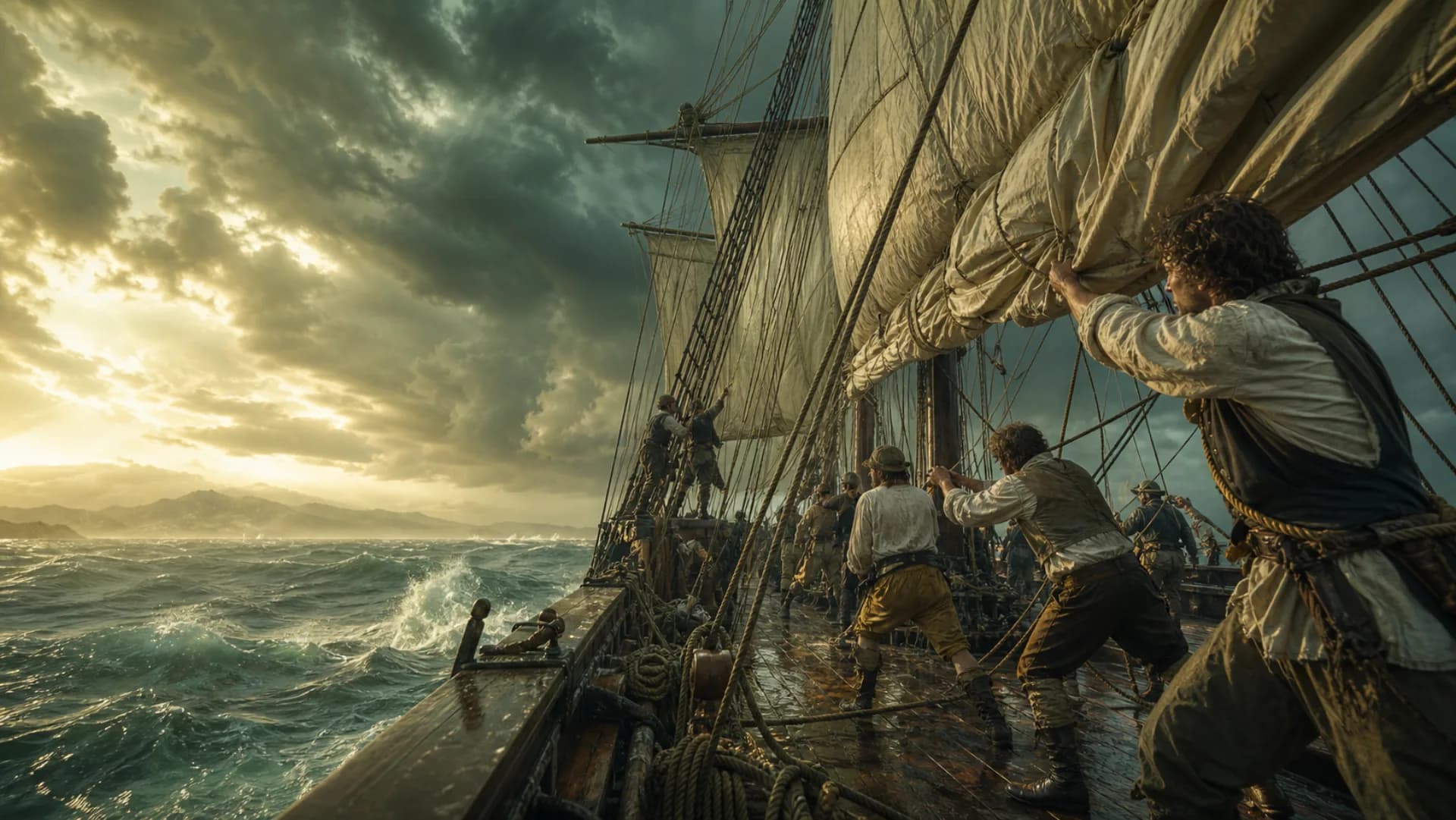
01Superstitions and taboos in sailing history
A whistle, a bird or a day of departure could unsettle a crew because belief helped people give order to shared and unpredictable risk.
Continue along the route ↗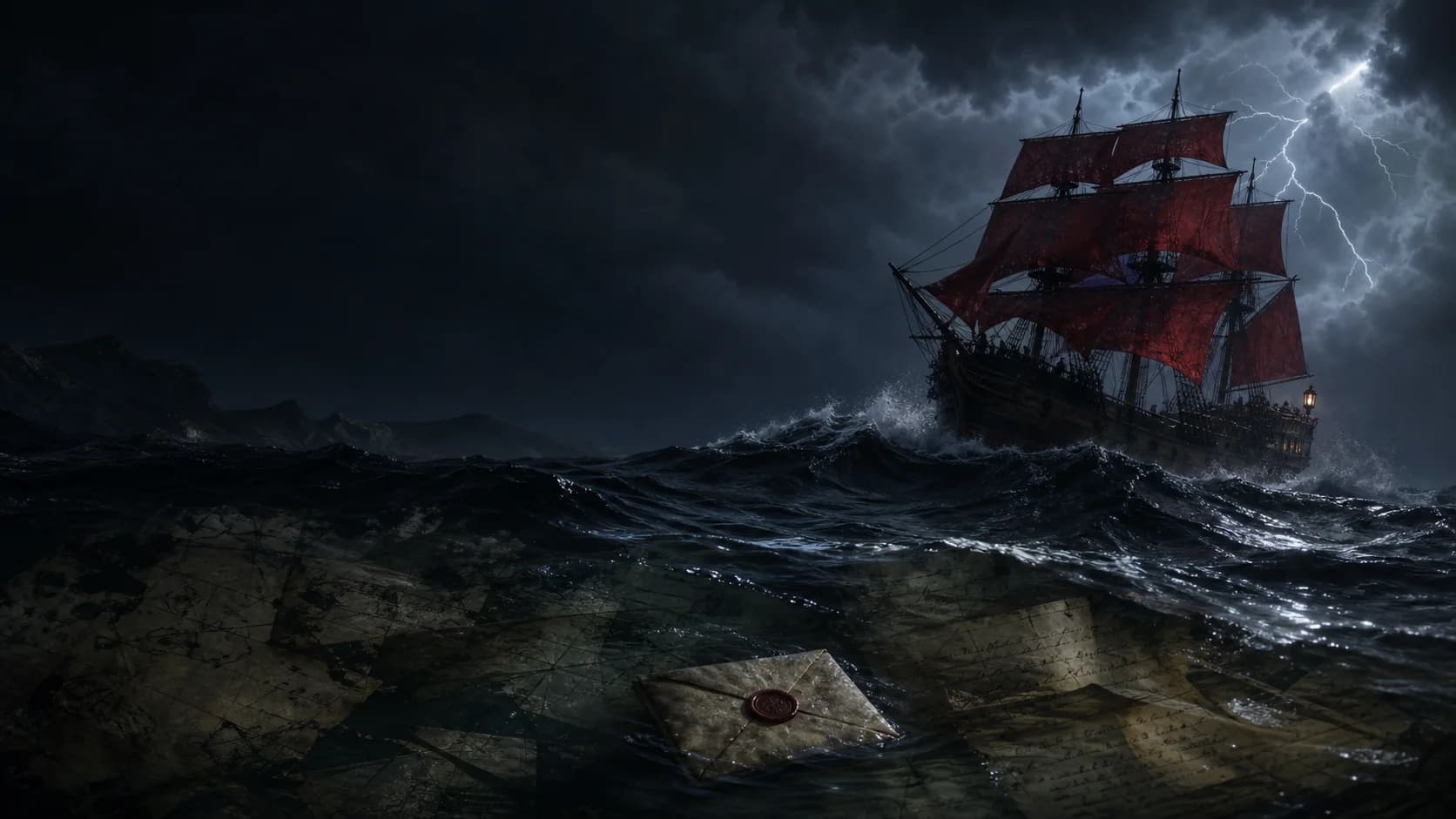 02
02The Flying Dutchman: a letter sixty years late, a ship delayed until Judgment Day
From a one-line storm apparition in 1790 to a slave ship, Vanderdecken's late letters, Heine's seven-year reprieve, Marryat's filial quest and Wagner's red-sailed finale: how each retelling made the Flying Dutchman eternal.
Continue along the route ↗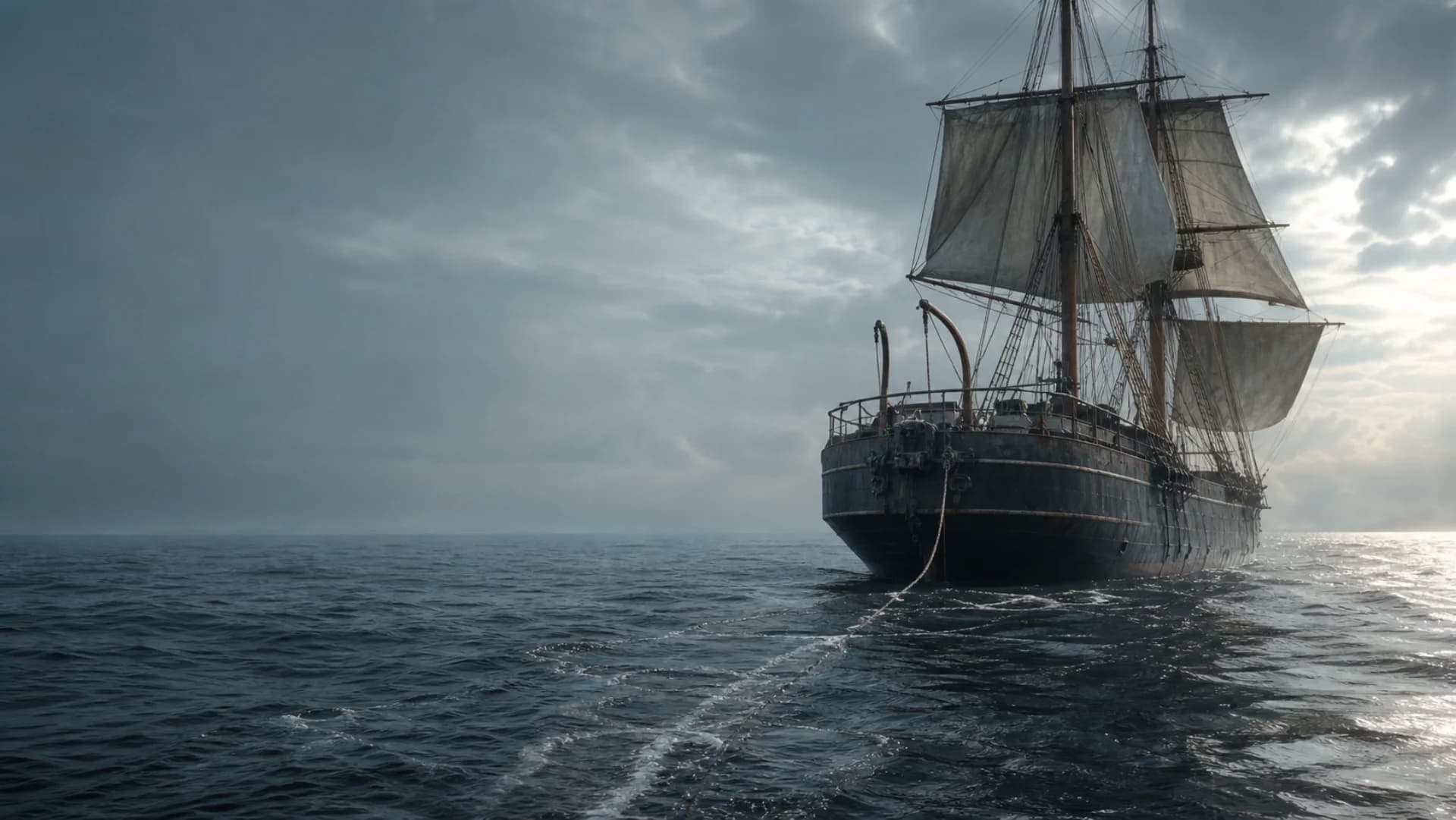 03
03Derelict ships: the vessel sailed on after the last human decision
From Mary Celeste, Carroll A. Deering and Kaz II to Baychimo's thirty-eight-year afterlife: four hulls that kept moving after their human timelines stopped.
Continue along the route ↗