INPUT
→Receive
Take ship, home instruction, capital and outward goods into custody.
A real Age of Sail career dossier · 16
Factor · Company Servant
The resident who preserves capital, market intelligence and relationships between ships so distant trade does not reset at every departure.
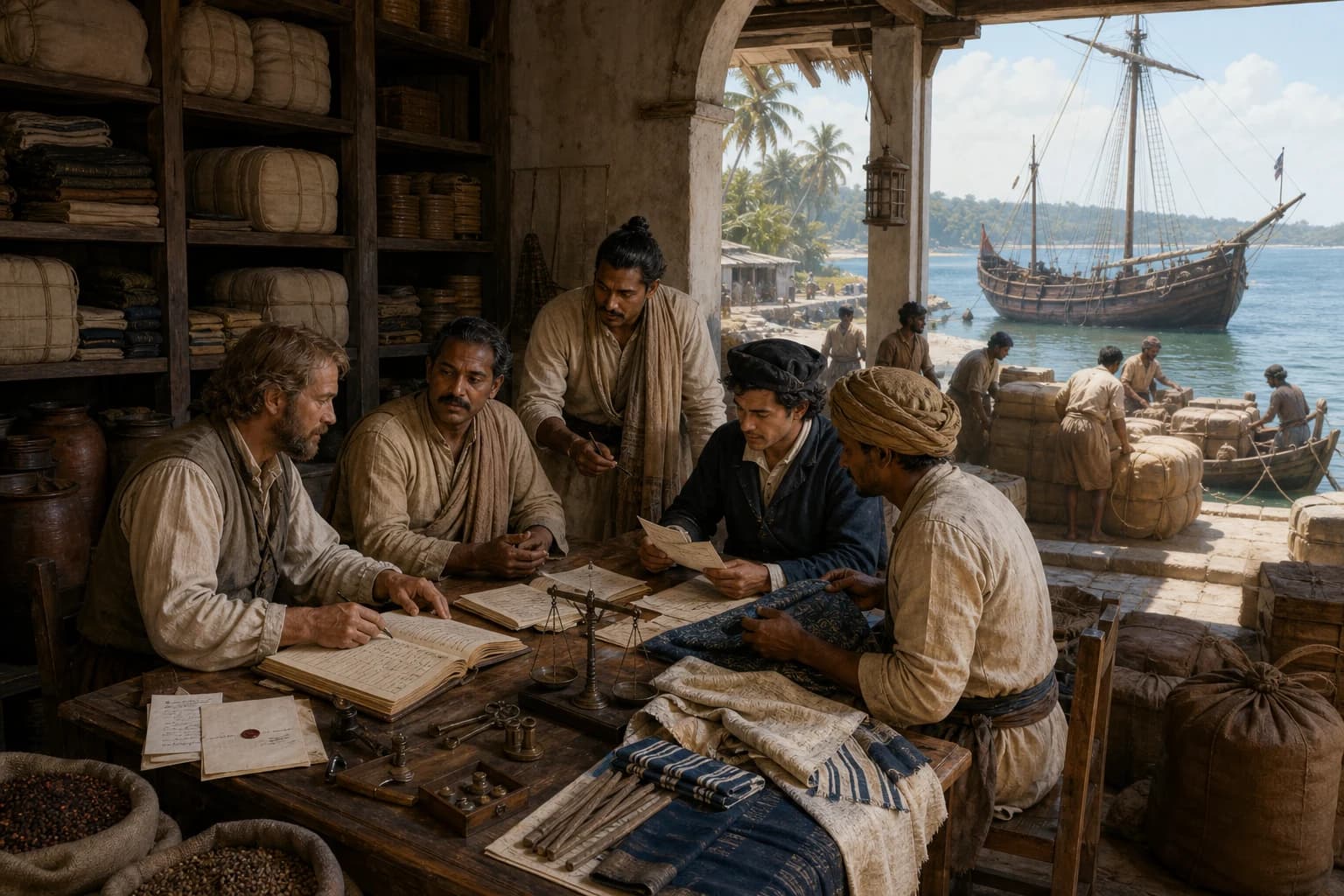
A factor was a resident commercial agent entrusted by merchants or a trading company. From an overseas port he received ships, instructions and goods; purchased and sold; kept warehouse and cash; recorded daily business; maintained relationships with local merchants and authorities; and reported price, risk and inventory home. A historical factory was a trading post where factors lived and worked, not a manufacturing plant. Early posts depended on a local ruler's permission. Some chartered-company factories later acquired forts, courts, revenue and territory, turning factors into administrators, but that imperial change cannot be projected onto every post.
Information arrives, judgment forms, and work passes on through a complete watch.
Take ship, home instruction, capital and outward goods into custody.
Survey, purchase, sell, collect and sustain local relationship.
Audit warehouse, cash, pack, wastage and security.
Send accounts, market letter, request and preparation for the next ship.
Rented house and store depending on local ruler, merchant and port network.
Consultations, daily diary, letters and a graded staff system.
Some posts militarized and gained fiscal and judicial power as agents bureaucratized.
Secure commodity, quality, packing, price and delivery ahead of a ship's call.
Keep lot, grade, wastage, cash and voucher as countable inventory.
Sustain lawful trade through merchant, broker, interpreter and official.
Execute, document change and bound discretion across months-long correspondence.
Institutions, experience, patronage, and opportunity shaped each person’s route.
Learn copying, books, language and warehouse detail.
Handle part of capital, purchase, inventory and trade relationship independently.
Lead post, consultation, principal account and company correspondence.
Enter company rule or build independent trade from relationship and capital.
The British Library's East India Company Factory Records describes a factory as a trading post occupied by merchants or factors. Early captains sought promising ports and permission from local rulers to trade and settle, leaving people, goods and communication so the next ship did not start again without buyer, warehouse or rule.
A factor was an entrusted agent holding distant merchants' money and goods. A factory might be a rented house and store or a walled compound. Factor did not mean modern plant manager, and factory did not automatically mean colony.
A supercargo faced monsoon and return window; a factor continued between arrivals. He watched harvest, war, prohibition, duty, exchange and competing demand, reserved next-season goods, collected debt and prepared warehouse, cash, packing and lighterage before a ship appeared.
Factory consultations, daily diaries, received letters and sent copies preserve that continuity. One price was not a market. Dated series of quantity, quality and counterparty let distant directors and successors interpret change.
Under company instruction the factor sourced textile, spice, tea, saltpetre or other regional goods through local merchants, brokers and producers, checking whether sample represented lot and converting weight, length, currency and duty. Cheap adulteration, delay and wrong specification could all miss a sailing.
Goods entered warehouse books by owner, lot, grade and destination. Drying, pest and fire prevention, guard, pack and tally continued until the supercargo chose an investment and the master accepted space and safe stow. The factor supplied prepared stock and evidence.
A post needed local permission and depended on merchant houses, brokers, interpreters, scribes, warehouse hands, boatmen and lenders. Company identity alone could not decode language, custom, jurisdiction and supply; broken relationships could strand capital in store.
Negotiation did not guarantee equality. Duty privilege, monopoly, naval threat, company troops and local politics changed leverage. The 1717 firman in British Library history shows political privilege shaping commercial terms. Local agency and expanding coercion both belong in view.
Purchase account, cash book, inventory, invoice, receipt, bill of exchange, debt list and market letter made each good traceable. A packet took months and its answer relied on old news, so a factor obeyed instruction while exercising bounded discretion during shortage or price movement.
Digitised Persia Factory Records show volumes, dates and incoming and outgoing papers forming an administrative chain. Record quality governed audit, comparison, next-voyage planning and continuity after transfer or death. A missing letter could lose capital at sea and in the ledger.
The East India Company later graded overseas servants as writers, factors, junior merchants and senior merchants. A writer learned copying, account and low commercial detail; factor carried more trust and could advance into merchant, council and president. Five years as writer and three as factor describe one institutional period.
Names outlived jobs as commerce gave way to territorial government, while other British, Dutch, Portuguese, French, Asian and private networks used other titles. Every advancement tree needs company, place and date.
Some chartered-company servants drew slight salary but could conduct bounded private trade, compensating for long residence and mortality. Warehouse, information and relationships could create fortune, while company and private cargo, time and opportunity invited diversion, priority, kickback and concealment.
Recommendation, bond, account, audit and seniority sought control. Not every private venture was corruption, nor was positional privilege neutral. Trust required separate books, disclosed interest and verifiable authority.
Some compounds added walls and guards and acquired military or judicial powers amid corporate rivalry and war. Fort St George and other sites grew into administration; after territorial and revenue acquisition, commercial servants became imperial bureaucrats.
That transition involved war, treaty, monopoly, taxation and rule over local societies rather than a natural promotion. Rented store, coastal factory, diplomatic mission and later presidency must not share one undifferentiated power set.
Resident staff faced disease, fire, theft, siege, interrupted shipping, bad debt, exchange and supply failure. Beyond immediate headquarters help, the factor preserved cash and food buffers, spread counterparties, arranged interpreters and guards, and wrote knowledge into books and letters.
A writer, clerk or merchant apprentice might become factor, chief factor, senior merchant, councillor or independent agent. The scarce product was inheritable relationship and credible record. If one departure erased every debt, contact and market fact, the factory had built no capacity.
career.factor
Usually not in this context. It was a trading post where factors resided, stored goods, corresponded and transacted.
A factor stayed ashore to maintain market, warehouse and relationships. A supercargo sailed with a voyage investment. They cooperated and could still disagree over authority and price.
Usually he was an agent using entrusted capital and owing an account. Some had authorized private trade and later became independent merchants.
No. Many early posts were permitted houses, stores and offices. Some chartered-company settlements militarized and later became colonial administrative centres.
One period's company ladder promoted writer to factor and then junior and senior merchant. Timing, recommendation and rule varied by date and presidency.
Company wage, allowance, authorized private trade and sometimes commission could combine. Low salary and positional opportunity created serious conflicts and audit risk.