INPUT
→Mandate
Read owners' orders, contract, destination and boundary of discretion.
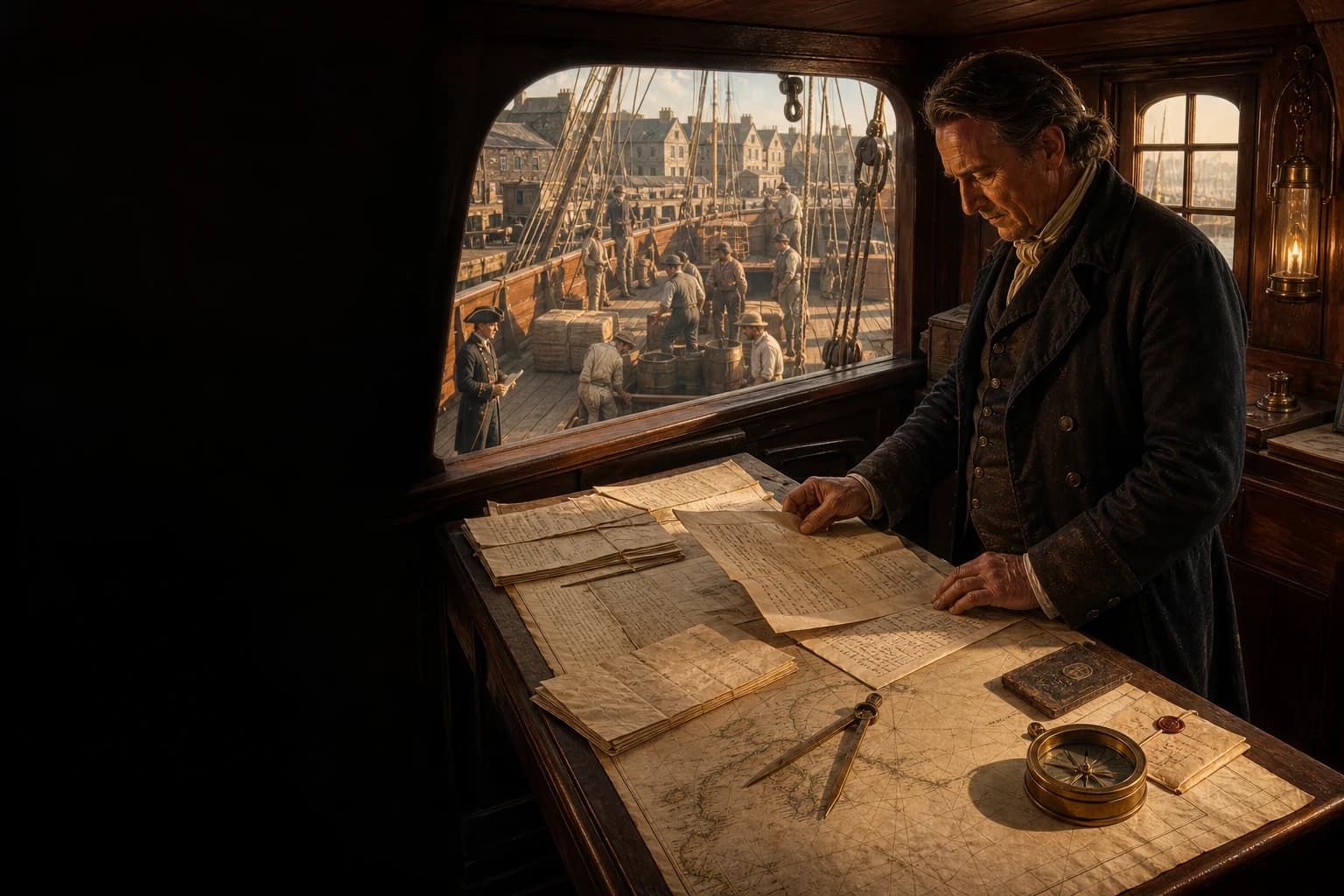
A real Age of Sail career dossier · 14
Merchant Master · Shipmaster · Skipper
The senior hand who organizes owners' capital, crew labour, cargo contract and uncertain sea into a deliverable voyage.
An Age of Sail merchant captain—more often master, shipmaster, skipper or a local equivalent in the record—was the owner's senior representative afloat. He organized crew and provision, judged vessel and stow, directed navigation and watches, received cargo and signed bills of lading, followed charterparty and sailing orders, and protected ship, people and commercial interest when casualty forced a deviation. Whether he traded cargo personally, owned shares or sailed with a supercargo depended on vessel, route and contract. Compulsory certification for British foreign-going masters emerged only in the mid-nineteenth century.
Information arrives, judgment forms, and work passes on through a complete watch.
Read owners' orders, contract, destination and boundary of discretion.
Organize crew, supply, condition survey, cargo stow and clearance papers.
Use watch, navigation, inspection and log to manage risk and time.
Pilot in, clear, discharge, account, repair and secure return freight.
Command, navigation, account, purchase and hull shares can meet in one person.
Mates, purser, carpenter and supercargo divide work while final coordination remains.
Examination, crew agreement and official log become a standardized administrative gate.
Combine season, route, condition, supply, danger and market time into continue or deviation.
Supervise stow, dunnage, separation, securing and discharge while reading trim and damage risk.
Interpret sailing order, charterparty, bill of lading, freight and port certificate.
Organize agreement, watch, discipline and wage while preserving owners' and shippers' trust.
Institutions, experience, patronage, and opportunity shaped each person’s route.
Learn ship labour, discipline and elementary literacy and number.
Accumulate navigation, watch, hold and people-management practice.
Command a commercial voyage through owner's appointment or later certificate.
Turn credit, shares and port network into a larger commercial organization.
The University of Exeter's comparison of seventeenth-century Italian, Dutch, English and French shipping maps similar command functions to patron, schipper, master and capitaine. English captain as commercial commander, legal superior and chief navigating hand becomes clear only around the 1580s and was first strongly associated with privateering. Master remained the older and common mercantile title.
Ownership and mastery could also overlap. Dutch freight contracts might call a share-owning schipper master, while Italian patron could lean toward owner or an owner who sailed in different ports. Merchant captain is therefore a search-friendly functional label; an individual still requires country, date, contract and ownership status.
A master interpreted owners' sailing orders: destination, timing, acceptable freight and the boundary of discretion. Orders preserved by Mystic Seaport for an 1830 voyage required the captain at New Orleans to work with named agents, obtain return freight, supervise its stowage and pay the ship's bills. A voyage did not end when the outward cargo left; the ship had to become an earning return passage.
He also judged hull, rig, ground tackle, boats, water and provisions, organized mates and crew, established wage or voyage terms and checked port and customs papers. A small ship forced direct navigation, purchase and account work onto the master; a larger one divided work among mate, purser, carpenter and supercargo while leaving coordination at the top.
Goods could not be stacked merely by value. Weight had to preserve stability and working draught; fragile, damp-sensitive, leaking, odorous and valuable goods needed separation; discharge order had to serve multiple ports. Master and mate supervised crew or stevedores and checked bilge, dunnage, access and securing against shift, crush and contamination.
Cargo plan therefore joined navigation. Overload, list or poor trim changed steering, speed and heavy-weather risk. Hold inspection, hatch protection and re-securing continued throughout the passage. A supercargo could direct purchase and sale without displacing the master's judgment of the ship's safety and actual stow.
Eighteenth- and nineteenth-century bills at The Mariners' Museum name shipper, consignee, description, weight or tonnage, destination and freight rate. The master issued the receipt after checking that the stated goods had arrived aboard in their apparent condition. Copies stayed with shipper, vessel and consignee to reduce false delivery and dispute.
The charterparty governed use and carriage, owners' instructions applied it to a voyage, and bills connected particular received goods to delivery. They were not one generic quest document. If quantity, packing or apparent condition was doubtful, an unqualified signature could carry the resulting shortage or damage claim back to vessel and owner.
The master selected the broad route and season, assessed weather, supply, piracy, war and port intelligence, and decided when to shorten sail, seek shelter, deviate or continue. Mates organized watches and deck labour, helmsmen carried out helm orders and seamen worked sail; a large merchantman might add a navigation specialist. Responsibility coordinated labour rather than replacing it.
Daily evidence came from log, dead reckoning, observation, sounding, hull report, sickness, provision and cargo inspection. When laytime met bad weather, the master balanced delay loss against vessel and crew condition. Commercial success was not defeating an enemy but delivering people and goods to the contracted market without losing the means of trade.
The National Archives notes that from the mid-eighteenth century masters or owners of most British-registered merchant ships kept a crew record before departure, later developing into crew lists and agreements. Name, job, joining, leaving, death and desertion entered administration; the 1850 statute added an official log in which the master recorded conduct among other events.
Earlier centuries lacked the same standard form, but recruitment, advance wage, ration, discipline, illness and desertion already shaped voyages. The master relied on mates and senior hands to keep watches and manage conflict while confronting arrears, coercion and violent discipline. Authority was conditioned by agreement and port law, not limitless private rule beyond land.
Approaching an unfamiliar harbour, a master could hire a local pilot while retaining judgment about whether his vessel should enter. Ashore he produced vessel, crew, cargo and health papers, contacted consignee or factor, organized berth, lighterage, customs inspection, discharge and resupply, and then handled wages, repair and homeward freight.
Royal Museums Greenwich preserves an 1817 voyage group containing charterparty, instructions, bills of health, bills of lading and freight papers. On one working table those documents linked owner, shipper, port and recipient. A mistaken paper could stop the hull as effectively as a shoal, except that the grounding occurred in a custom house or court.
Storm, leak, dismasting, sickness, raider or blockade could make original orders impossible. To preserve ship, people and cargo, the master might seek refuge, contract assistance, repair, jettison part of the load or buy supply. Necessity, alternatives, expense and damage had to enter a record, with owners or local agents contacted when possible.
Afterward, log, protest, repair account, cargo survey and correspondence could be reread by insurer, owner, cargo interest or court. A return-voyage audit required the master to authenticate the passage and explain deviation, jettison, repair, added port expense and cargo damage. A clerk could assemble vouchers and a supercargo submit the cargo account, but neither inherited responsibility for his navigational decision. The master could neither hide damage to save a schedule nor use emergency as a licence for arbitrary sale or contract change.
The National Archives finds no unified British Merchant Navy officer register before 1845, when voluntary and progressively compulsory master and mate examinations enter the record. The Merchant Shipping Act 1854 required the master and appropriate mates of a foreign-going ship to hold competency or service certificates and produce them with crew agreement and clearance.
Earlier command depended more on sea time, mate service, navigation and arithmetic, literacy and account, owner trust, family or port network and sometimes vessel shares. Certification standardized part of knowledge and service without guaranteeing business judgment or a current command. Lloyd's Captains' Registers also include holders of a master's certificate who did not captain a ship.
An employed master might take monthly or voyage wage plus commission or reward tied to freight, economy, delivery or trade. An owner-master shared vessel and voyage profit but exposed capital to repair, empty return, cargo claim and loss. Place, ship, war, trade and personal credit vary too much for one transhistorical salary table.
A career commonly accumulated from boy or ordinary hand through able seaman and mate into an owner's appointment or later certificate. Success opened larger hulls, ocean routes, shares and broker networks; failure could produce debt, lost credit, certificate inquiry or suit. The decisive resource was finally other people's willingness to entrust ship, cargo and credit.
career.merchant-captain
A merchant master answered chiefly to owners, cargo, contract and a commercial voyage. A naval captain held a state military commission and commanded mission, combat and naval discipline. Both held ultimate responsibility under different sources of authority.
Often on smaller vessels; larger ships could use mates or a specialist. The master need not steer every watch but remained responsible for the organization and major navigational judgment.
Yes when owners' instructions and contract authorized it, including seeking return freight. Where a supercargo sailed, that person might direct purchase and sale. Authority depended on the actual commission.
A bill acknowledged the goods received, their apparent condition, destination and carriage terms, serving as the shipper's receipt and a key delivery document. A mistaken signature could create a shortage or damage claim.
No. British registration and examination consolidated mainly in the mid-nineteenth century, with strong statutory requirements in 1854. Earlier and foreign systems relied on their own experience, guild, local rule and owner trust.
Sometimes. A master might be an employee or own part or all of the hull. Ownership substantially changed income, discretion and exposure to loss.