INPUT
→Mandate
Confirm capital, commodity, floor, priority and private-trade boundary.
A real Age of Sail career dossier · 15
Supercargo · Cargo Owner’s Agent
The agent who carries distant capital into an unfamiliar market and converts outward goods into a documented return investment.
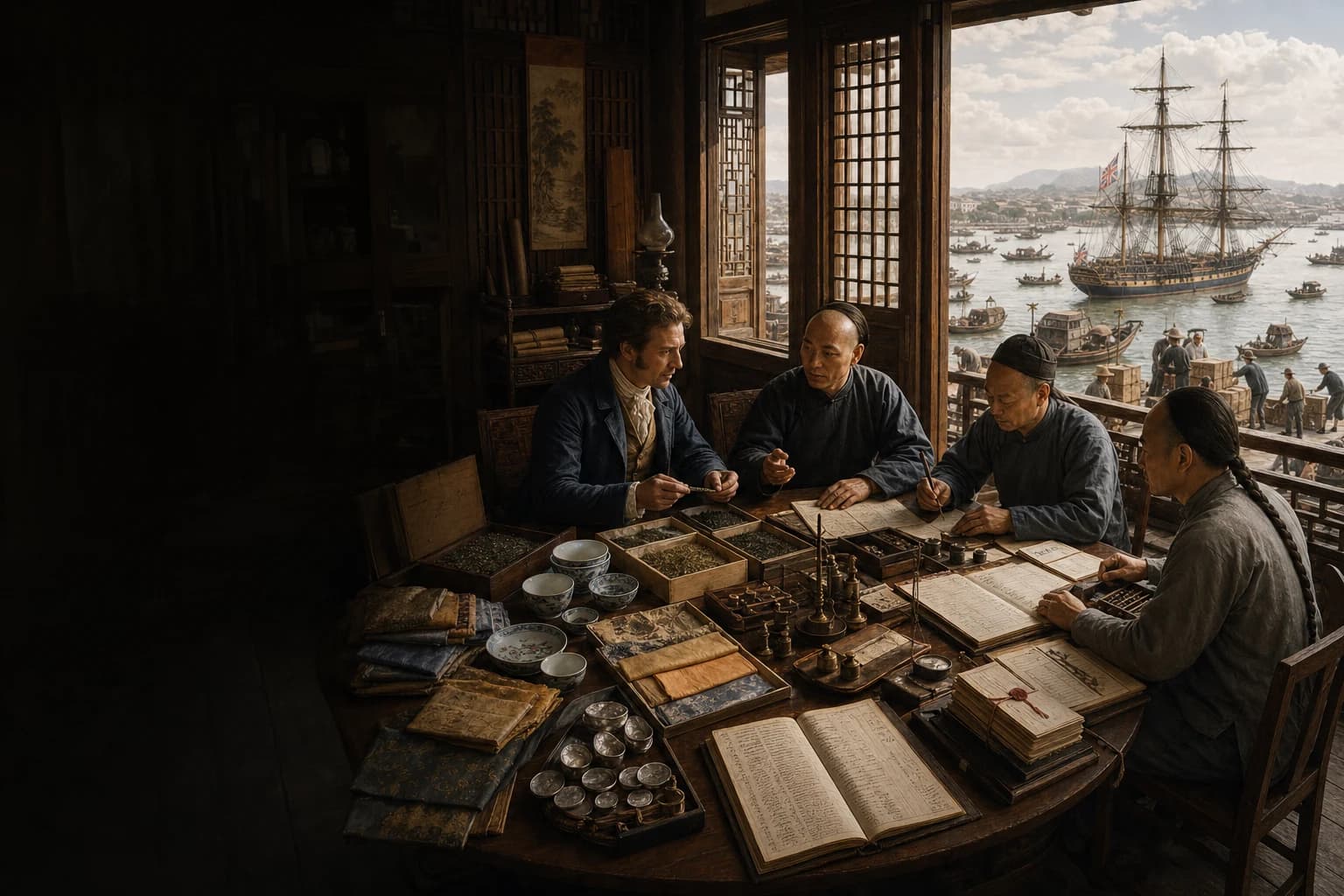
A supercargo sailed as the commercial representative of cargo owners, investors or a trading company. He sold outward goods, purchased return cargo, negotiated price, assessed quality, managed currency and credit, kept accounts and reported the investment. He was not the cargo foreman: the master retained vessel, navigation, crew and safe-stow responsibility; the purser centered ship's supply and accounts; a factor built a permanent shore network. Masters or pursers could combine the work on small ships, while East India Company China trade employed several supercargoes and kept them in the Canton factory.
Information arrives, judgment forms, and work passes on through a complete watch.
Confirm capital, commodity, floor, priority and private-trade boundary.
Gather price, sample, exchange, duty and counterparty intelligence.
Bargain, inspect and pay while reconciling space and stow with the master.
Close book, evidence, wastage and report on the return investment.
Master or purser might trade too; a dedicated supercargo was not universal.
Several supercargoes formed a hierarchy and organized continuing business from Canton.
Represented several investors across Northwest Coast, Canton and other return markets.
Compare quote, supply, duty, timing and counterparty credit.
Use sample, grade, measure and pack to read quality and likely wastage.
Record cash, silver, exchange, commission, freight, duty and private trade.
Make executable trade among investors' order, ship limit, local rule and relationship.
Institutions, experience, patronage, and opportunity shaped each person’s route.
Learn account, correspondence, measure and commodity classification.
Handle sample, tally, small purchase and voucher checking.
Control entrusted capital, principal bargain, team and final cargo account.
Turn voyage practice into a lasting market network and own capital.
Supercargo names the commercial agent who accompanied an investment. He carried owners' or company instructions and capital, sold outward goods, bought returns, inspected quality, recorded expense and settled the result. Master and mates retained responsibility for dunnage, securing and vessel stability; crew, lightermen or stevedores performed physical handling.
Exeter's seventeenth-century comparison finds no fixed counterpart aboard every English ship. A purser might combine the work, while many vessels left finance and cargo to master, mate or boatswain. The role was specialization produced by trade scale, not a universal second-in-command.
Before departure, a supercargo received a mandate: where and above what floor outward goods might sell, how cash and credit could be used, what returns ranked first and how much private trade was allowed. A 1784 Continental Congress document separately names John Clark as captain of Hydra and William Green as supercargo, exposing the split between command and commerce.
Instructions might remain sealed until a specified leg to protect the plan. The U.S. Supreme Court's Warren voyage record even shows captain and supercargo with different instructions, the latter's sealed orders changing destination into illicit trade. It is an extreme case, but makes the possible collision of commercial mandate and navigational command visible.
Value depended on supply, grade, pack, duty, exchange and timing. The supercargo found counterparties, compared samples, converted weight, length and money, negotiated payment and commission, and judged whether a promise would hold. Interpreter, broker and local merchant were essential where language and institution differed.
The Library of Congress's Canton merchant collections contain correspondence, account books, orders, bills of lading, ledgers, cashbooks, invoices and receipts. Ocean trade was a system of papers that checked one another. Market knowledge without account and evidence could not explain profit or loss to distant investors.
Purchase required judgment of grade, moisture, scent, colour, breakage and adulteration, whether a sample represented the lot, and whether marking and tally were sound. Damp tea, mildewed textile, broken porcelain or a weight mistake could consume an apparent price advantage during the return passage.
The supercargo selected goods and acceptable quality while the master judged weight, space, separation and ship condition. Market value and safe stow had to become one cargo plan. A profitable item that could not ship safely, missed the monsoon or exceeded cash and insurance remained an impossible investment.
Books might separate purchase and sale, brokerage, customs, storage, lighterage, freight, commission, exchange, wastage and cash balance. Invoice, receipt, bill, letter and price list made entries traceable. Authorized private trade also required separation from company investment.
A return-voyage audit matched original shares, purchase and sale, wastage, port charge, commission, private trade and cash against vouchers, then reconciled cargo account with master, purser, factor and shore ledger. East India Company minutes of 6 December 1614 record auditors calculating a returned voyage and allocating ‘three for one’ according to original shares. That was a voyage settlement, not a modern annualized return. The supercargo still had to explain how entrusted funds became return goods and a distributable result.
British Library records state that by 1715 an East India Company ship to China had an appointed supercargo, while these men lived together at Canton and organized country trade from the factory. Earlier ventures could carry chief, second and third supercargoes, dividing work and commission by standing. Voyage agency could become permanent overseas management.
That system belonged to regulated cross-cultural bargaining and unequal imperial expansion. Hong merchants, customs, interpreters, Asian shipowners and local law were participants rather than scenery. One trade statistic that manipulates a world market would erase institutions, relationships and power differences.
A supercargo chose commercial objectives but could not require dangerously unstable stow; a master controlled the vessel but could not freely spend cargo money or ignore authorized terms. Dispute gathered around deviation, waiting for price, return window, space and risk. Another week might improve price or lose the monsoon and provision.
The Warren case shows secret orders carrying a crew into smuggling and wage litigation. A sound mechanic keeps commercial mandate, navigation safety, shipping articles and local law separately visible. Illicit trade affects consent, seizure, insurance, credit and personal responsibility rather than becoming a colourless high-profit option.
The Smithsonian's Joseph Hawkins materials document an eighteenth-century slave-ship cargo superintendent or supercargo. Here the people called cargo were kidnapped, trafficked and enslaved. The office participated in management of Atlantic slavery and cannot be represented as ordinary commodity spoilage or a neutral optimization challenge.
A responsible account identifies the trade's legal and moral character and asks who created the archive and whose voice it suppresses. Any game treatment must center coercion, death, resistance, responsibility and institutional harm rather than offer a profitable human-trafficking career tree.
Pay could combine salary, voyage allowance, trade commission and restricted private privilege. Evidence around 1700 China voyages shows three supercargoes sharing commission in different proportions, but one company's period rate is not a global wage. Bad debt, audit and voyage loss consumed apparent return.
Entry demanded literacy, numeracy, practical accounting, commodity knowledge, language collaboration and merchant recommendation. Assistant or junior supercargo might advance to chief, shore factor, agency-house partner or independent merchant. The scarce asset was distant investors' confidence that price, money and evidence would not disappear.
career.supercargo
No. He represented cargo owners in purchase, sale, inspection, money and account. Master and mates controlled safe stow, and crew or shore labour moved the goods.
They controlled different domains. The captain held vessel, navigation, people and safety; the supercargo held authorized commerce. Contract, necessity and local law governed conflict rather than one universal ranking.
No. A master, purser or other trusted hand combined the work on many small vessels. Complex overseas ventures were more likely to appoint one or several specialists.
Yes. East India Company supercargoes in the China trade lived together in Canton and organized regional trade, turning voyage agency into an overseas establishment.
Salary, allowance, transaction commission and restricted private trade could combine. Arrangements differed by company and voyage and remained exposed to debt, audit and loss.
Literacy, calculation, accounts, commodity and market knowledge, language support and merchant trust mattered. A clerk or junior supercargo could advance through documented voyages.