INPUT
→Receive
Take mess provisions and check portion, tally and special arrangement.
A real Age of Sail career dossier · 10
Ship’s Cook · Cook
The specialist who controls sustained fire in a rolling wooden hull and converts repetitive allowance into timed hot food for hundreds.
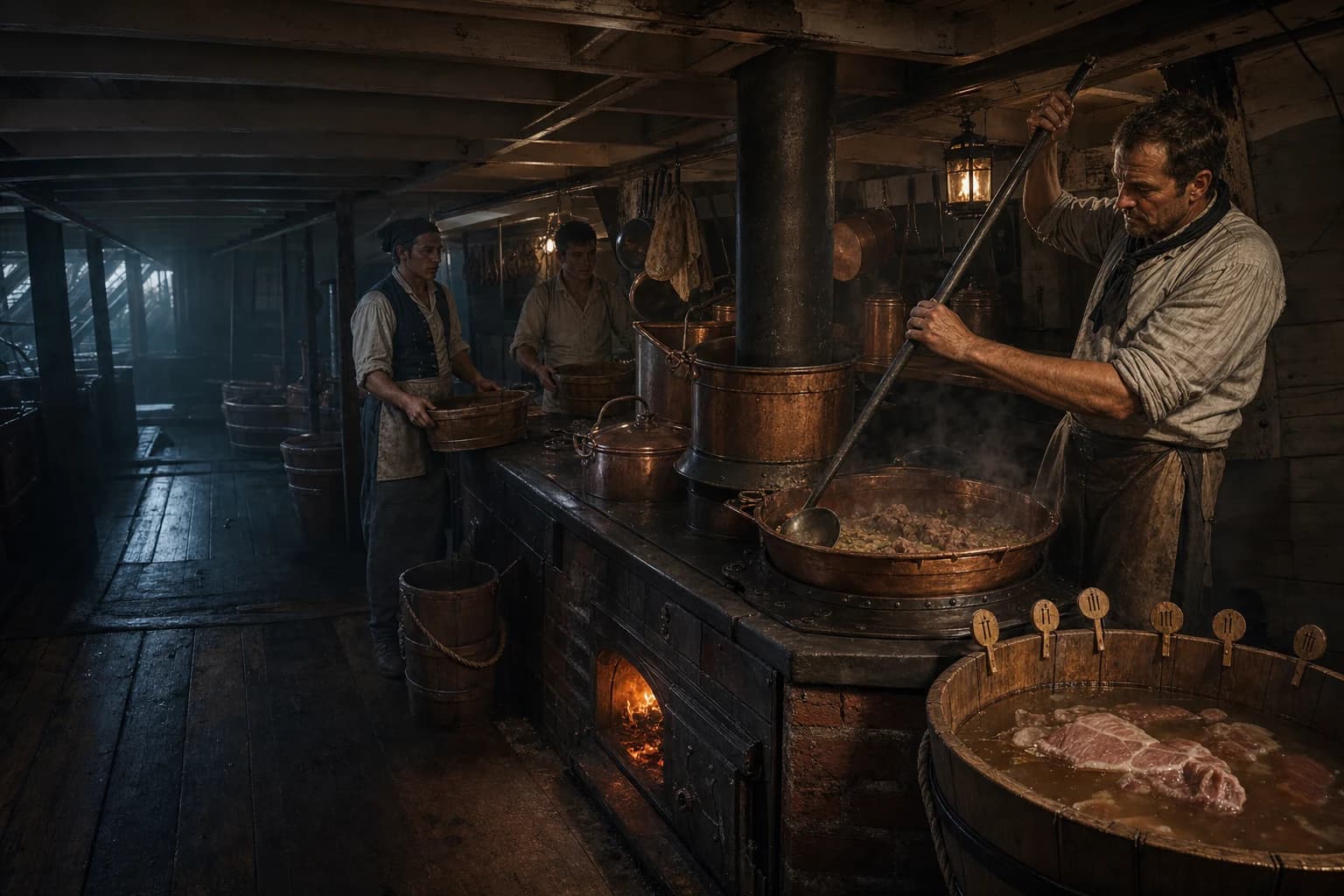
A formal Age of Sail ship's cook controlled the steep tub, naval stove, boilers and central preparation of hot food for the complement, while rotating mess cooks collected each mess's ration, brought it to the galley and carried the cooked food back. The ship's cook did not determine stores or allowance and could not cook away spoilage, water shortage or nutritional deficiency. He could reduce waste, cook food safely and control one of the most dangerous routine fires inside a wooden ship.
Information arrives, judgment forms, and work passes on through a complete watch.
Take mess provisions and check portion, tally and special arrangement.
Water salt meat and sequence pulse, grain, gear, fuel and issue.
Control flame, boiler, doneness, smoke and scald risk through ship motion.
Return tally-marked food, scour copper, secure gear and extinguish fully.
Central boilers served hundreds through a formal cook, assistants and rotating mess hands.
Fewer hands and smaller gear could combine preparation, cooking, cleanup or steward work.
Captain and officer messes might retain servant, caterer or private cook outside the ordinary chain.
Bring salt meat, pulse and grain with different times to issue on the watch schedule.
Manage fuel, draught, funnel, cover, hot surface and final extinction.
Lash steep tub, boiler, hot water and carrying route through roll and storm.
Use tally, sample, batch and mess cook to preserve quantity and ownership.
Institutions, experience, patronage, and opportunity shaped each person’s route.
Begin with carriage, cleaning, fuel and plain allowance.
Learn steep tub, fire, batch and boiler safety.
Coordinate galley, assistants and the hot-food timetable.
Sea-going volume and supply experience could transfer to other service systems.
The USS Constitution Museum describes cook as an important but substantially supervisory office. He kept the steep tub, tended the camboose fire so food was roasted, baked or boiled, and oversaw scouring of copper boilers. On a frigate complement near 450, the first demands were volume, repeatability and keeping mess portions distinct—not inventing individual dishes.
Mary Rose evidence instead describes two meals daily for hundreds, with more elaborate dishes for officers and perhaps three hands in the galley. Meal count, equipment and hierarchy changed with century, vessel and service. This dossier concerns the formal cook at the central galley, not automatically an officer's private cook, steward or rotating mess cook.
Constitution food research assigns daily issue to the purser's steward. Each enlisted mess rotated a mess cook who collected its provisions, sent salt meat to the formal ship's cook and carried hot food back in wooden tubs called kids. Equal meat portions received each mess's tally before they entered the galley's large copper, preserving ownership through a common batch.
The chain separated stock account, central cooking and mess distribution. Purser accounted for provisions and loss; ship's cook controlled galley and process; mess cook held the group's gear, carriage and cleanup. Officer messes could maintain their own servant, caterer or cook. Calling every failure 'the cook's fault' erases the system that produced a meal.
Preserved beef and pork carried heavy salt and normally soaked in fresh water before cooking. U.S. Navy regulations of 1814 explicitly charged the cook with the steep tub, proper watering of the meat, and clean, careful boiling and delivery. Steeping improved edibility; it could not turn spoiled meat fresh again.
In heavy weather, a tub full of water and meat became dangerous moving mass. The regulations ordered the cook to secure it. If it was unavoidably washed overboard, the captain certified the event and the cook swore to the pieces lost before the purser could receive accounting credit. Seamanship, food, evidence and liability met in one barrel.
Royal Museums Greenwich summarizes common provisions as salt beef or pork, cheese, fish, ale and ship's biscuit. The Constitution's particular U.S. ration also included flour, peas, rice, molasses, vinegar and spirits in weekly combinations. Fresh meat, fruit, vegetables and fish appeared at ports and supply stops but rarely lasted through a long passage.
Biscuit needed no common pot, while galley work centered meat, pulse and grain requiring heat. Small stores, seasoning and mess practice produced limited variation, but a cook could not conjure water, fuel or vitamins. Ventilation, drainage, damp, vermin and stowage time degraded ingredients before they reached him and imposed a hard limit on craft.
Mary Rose's sixteenth-century galley used two brick-built ovens and great brass cauldrons in the hold, without a modern chimney. The Constitution Museum explains that the Royal Navy began fitting lighter, more fuel-efficient iron fire hearths by the mid-eighteenth century in place of heavy brick structures liable to loosen as a hull worked and release smoke or sparks.
Constitution's 1813 equipage included covers, a sixteen-quart copper kettle, lidded copper pans, long iron ladle and tormentor, and a water-filled copper cistern around the hot funnel to keep it from igniting the deck. Technology changed, but the basic contradiction remained: sustained flame inside a moving hull full of timber, rope, canvas and powder.
The 1814 regulations required every fire and candle in cook room, hold, steward room, cockpit and between decks to be extinguished when the night watch was set. Light required permission and a sound lantern; watch officers and master-at-arms also policed flame. Galley safety was shipwide discipline rather than one cook's habit, and heavy weather or action could overrule the hot-meal schedule.
The cook also removed residue and oversaw scouring of copper boilers. Fouling contaminated the next great batch, accumulated grease added fire load, and poor copper maintenance could create harmful corrosion. Good work managed fuel, funnel, lid, hot water, slick deck and final extinguishing so a small error did not become a ship fire.
In calm conditions, preparation, steeping, firing, boiling, testing, issue and cleaning could follow one another. In a roll, scalding liquid, sliding covers, wandering tubs and falling carriers arrived together. The regulation's special warning to secure the steep tub shows how ordinary galley gear required seamanlike lashing and anticipation.
Constitution research says a sample of cooked meat could go to the officer of the deck for tasting before tally-marked portions returned to messes. A lost marker, late carrier or interrupted batch became a dispute over fairness and morale. Rhythm, batch integrity, securing and handover are more faithful game skills than recipe complexity alone.
Mary Rose osteology suggests one possible galley hand had once lifted heavily in a gun crew before damaging his knees. It offers a persuasive individual route by which an experienced seaman with limitation moved into cooking. It does not prove all cooks were disabled or describe three centuries of European and American service.
The job still demanded heat tolerance, lifting boiler and tub, balance on a moving deck, fire discipline and organization. For one early U.S. example, the Constitution Museum gives eighteen dollars monthly and a privilege of selling slush after supplying the boatswain's lubrication needs. Neither wage nor perquisite was universal.
Clean boiling, less waste, reduced salt and fair delivery mitigated specific harm and made repetitive allowance easier to eat. USS Independence orders also called ship's cooks at four on Saturday morning to heat laundry water, showing the galley could support shipwide hygiene beyond meals. Its timetable touched watches, sick diet and confidence in equal issue.
Spoiled provisions required the purser to seek survey, ration reduction belonged to the captain, and nutrition involved surgeon, supplier and route. Longer boiling could not replace absent fresh food or automatically remove every contaminant. A credible career system lets the cook improve conversion and safety without compressing the whole health system into one cooking statistic.
career.ship-cook
There was no timeless rule. Mary Rose interpretation gives two meals for hundreds; Constitution's specific system normally had three meals with dinner as the hot one. Service, vessel, watches and weather mattered.
Not exactly. This dossier covers common galleys, salt provisions, mess organization and fire risk aboard sailing vessels. Modern ship cooks work with refrigeration, different equipment, food-safety rules and formal employment requirements. Both manage bulk meals in constrained spaces, but this historical account is not a modern career guide.
The ship's cook controlled the common galley, steep tub, boilers and central preparation. Each mess rotated a mess cook to collect its ration, send it for cooking, carry it back and keep mess gear.
Usually not. Allowance tables, purser's stock, port supply and command orders determined ingredients. The cook decided how to use stove, fuel, water and time within those bounds.
Salt preservation left beef and pork heavily salted. Changing water in the steep tub reduced salt and improved cooking, but could not rescue meat already spoiled.
Controlled hearths, covers, insulation and water-filled funnel collars joined strict rules on lanterns, watches and extinction. Cook, watch officer and ship's company all carried part of the discipline.
No. Mary Rose preserves one possible transition from gun crew after knee damage, but cooking still demanded strength, balance, organization and fire control and the case cannot become a general rule.