In one minute
What did this event actually change?
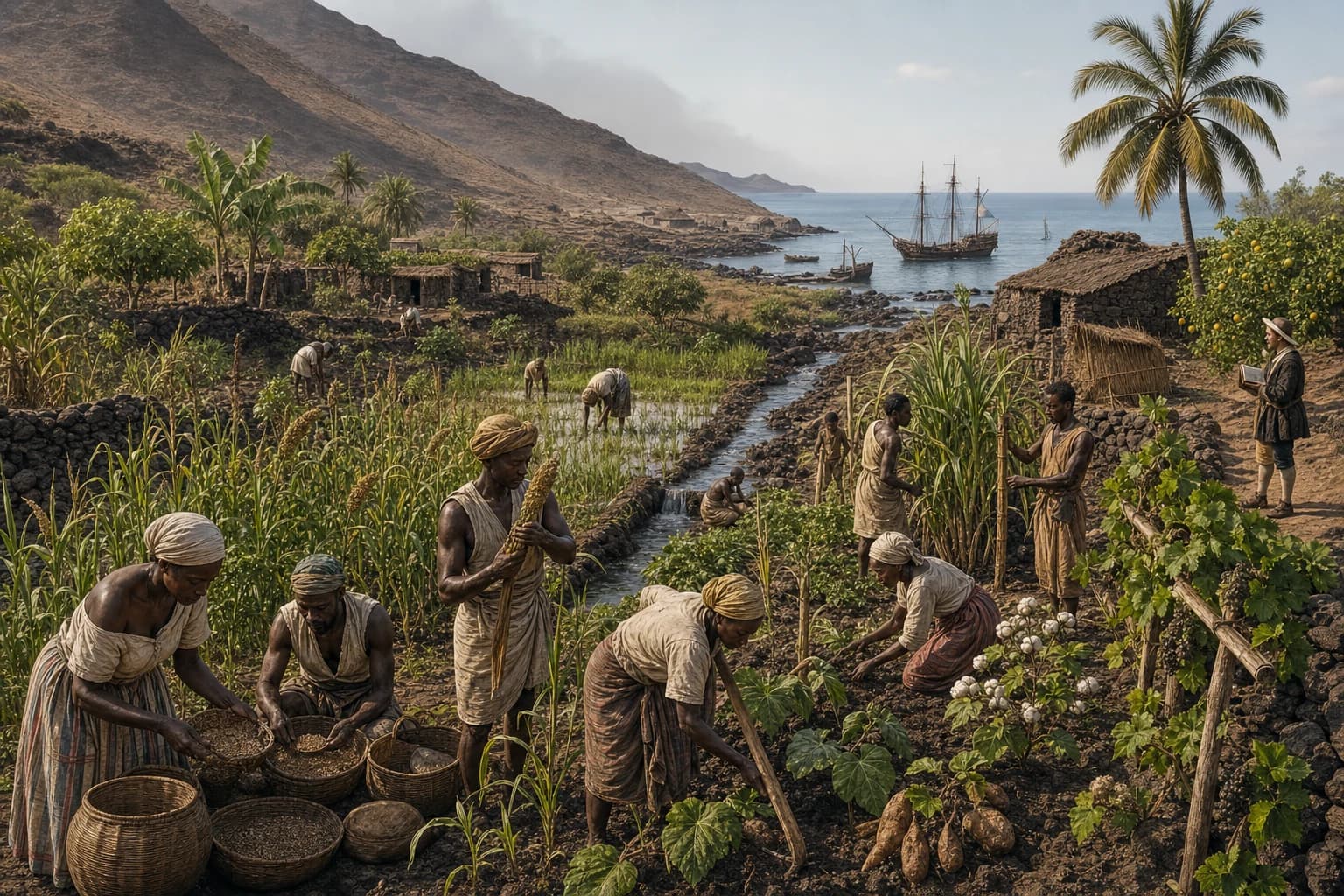
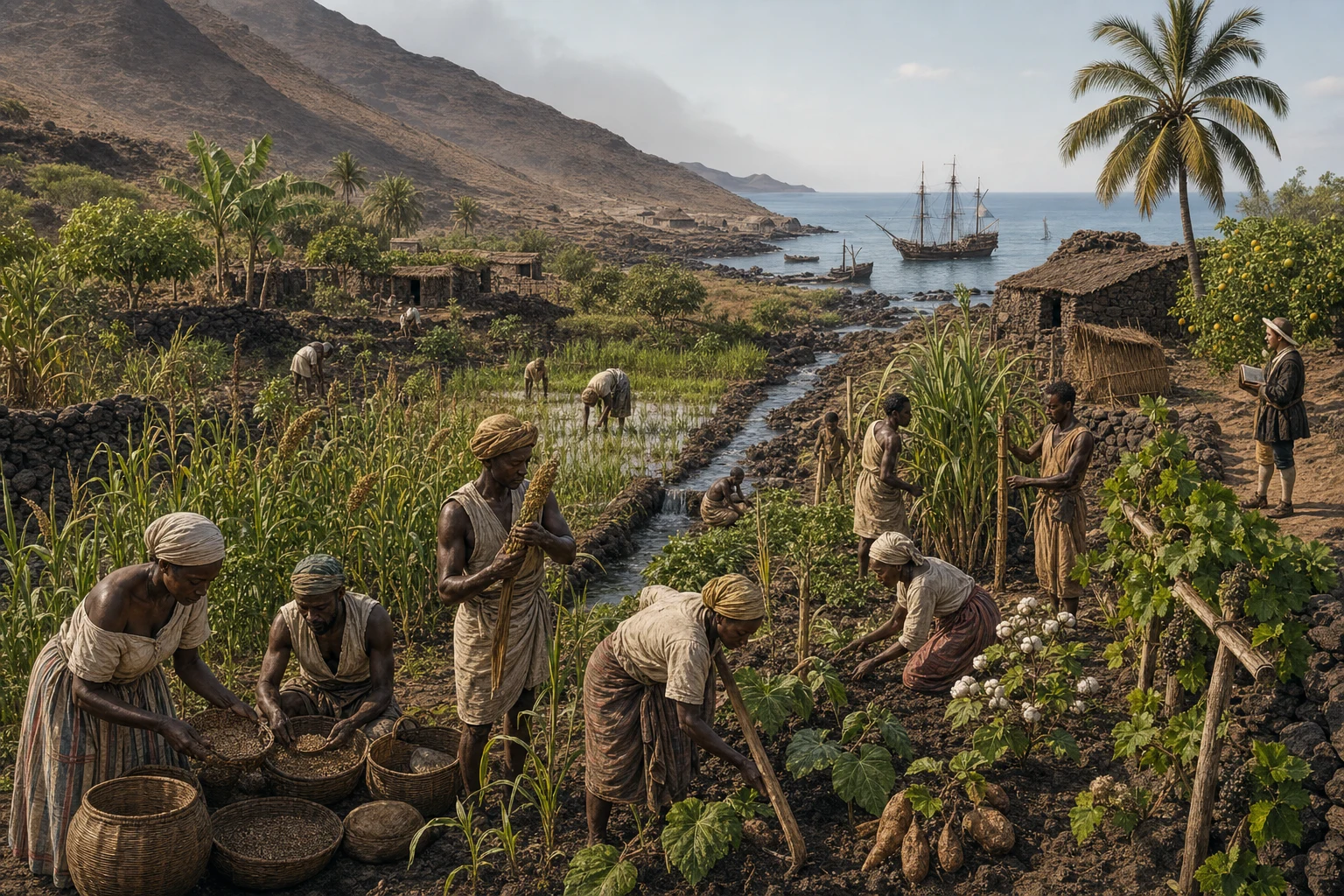
Santiago, the island of Ribeira Grande, became an Atlantic node for moving and acclimatizing crops during the sixteenth and seventeenth centuries. Its climate was warm but dry, with intensive cultivation confined to a few freshwater valleys; its harbour also lay between West Africa, Portugal, Brazil and the route around the Cape. West African rice, millets, yams and cotton knowledge met sugar cane, figs, vines, citrus, bananas and coconuts carried through Mediterranean and Asian histories, then American maize after 1492. This was not a planned modern botanical garden. It was a working colonial landscape of fields, orchards, livestock and victualling, sustained largely by African expertise and enslaved labour.
 View the complete scene ↗
The complete scene reconnects mixed fields and irrigation to the port. Its plants are identifiable, but the image is an evidence-led composite of a long acclimatization process—not a modern botanical garden or the record of one day.
- Place
- Ribeira Grande valley on Santiago, now Cidade Velha
- Key period
- Sixteenth–seventeenth centuries; some introductions began in the late fifteenth
- Functions
- Victualling, movement of seeds and cuttings, local cultivation and onward transfer
- Crop connections
- West Africa, the Mediterranean and Europe, Asia, and the post-1492 Americas
- Labour regime
- Enslaved Africans supplied much cultivation, herding, processing and transferred knowledge
Chronology
A process, not a single date
Causes, turning points and aftermath form one process, far larger than a capital’s fall, a signed treaty or a company’s founding date.
- 01
Settlement brings imported food plants, animals and seed to Santiago
Plant foods initially had to be imported. Freshwater valleys were then cleared, beginning the conversion of native coastal vegetation into fields and grazing land.
- 02
West African rice travels to Cabo Verde
Records identify several consignments from the Guinea coast that year, showing that island provisioning relied on existing West African rice regions and commercial networks.
- 03
An early account lists sugar cane, figs, vines and melons
Material associated with Valentim Fernandes confirms their early presence in colonial agriculture, although a written list cannot locate each plot or date each introduction.
- 04
Rice appears in cargo lists from Cabo Verde
The grain could serve as food or seed. Its documentation joins West African production knowledge, island cultivation and ocean transport.
- 05
Seed rice, yams and cane cuttings leave for Brazil
A ship bound for Brazil carried seed rice, African yams and sugar-cane cuttings—an unusually clear case of plants moving onward through the archipelago.
- 06
Citrus, pomegranate, coconut, banana and American maize enter written accounts
Historical names can be ambiguous. Milho, in particular, could refer to millet, sorghum or maize, so species and dates require source-by-source checking.
- 07
Ribeira Grande functions as a plant-transfer and acclimatization node
Ships linking West Africa, the Indian Ocean, Brazil, the Antilles and Europe call here, moving crops, livestock, people and agricultural knowledge through one network.
- 08
Environmental archaeology at Alcatrazes documents colonial landscape change
Cereal pollen, possible cotton pollen, charcoal, dung-related fungi and erosion layers on eastern Santiago provide evidence independent of the written accounts.
Why could a dry island become a crop-transfer station?
Santiago was no naturally luxuriant tropical garden. Rainfall was highly seasonal, drought recurred and exposed slopes eroded during intense storms. Ribeira Grande's advantage was the combination of valley water, a warm climate and cultivated ground close to an anchorage. Where water could be directed into a narrow valley floor or lower slope, a compact area could support fruit trees, grains, cane, cotton and vegetables together.
Position on the sailing routes mattered even more. Vessels heading from Portugal to West Africa, turning toward Brazil or continuing around Africa needed water, food, animals and repairs. Seeds, tubers and cuttings arrived among those supplies and could leave on a later ship after local cultivation. Cabo Verde's role therefore came from the union of harbour, field and sailing schedule, not simply a climate between temperate and tropical zones.
Which plants actually met in the same valleys?
Rice, pearl millet, sorghum and yams from West African farming systems supplied residents and ships with staples adapted to heat and irregular rain; cotton also fed local weaving and trade with the Guinea coast. Sugar cane originated in Asia and had already crossed the Mediterranean and Atlantic islands. Bananas and coconuts likewise carried longer Indian Ocean and African histories. Calling all of these 'European plants' erases centuries of earlier movement.
Figs, vines, melons and citrus mostly entered through Iberian or Mediterranean cultivation. American maize reached the archipelago relatively early after 1492, but old terms such as milho could describe maize, millet or sorghum, leaving its precise date debated. Cassava, pineapple and guava later became part of Cabo Verde's flora, yet they lack equally secure early-sixteenth-century documentation and do not all belong in a scene set around 1500.
Who made seeds survive an ocean crossing?
Crop transfer meant far more than placing seed in a ship's hold. Farmers had to read rain, soil and irrigation; choose sowing depth and companion crops; harvest and store; and reproduce rice, yams or cane correctly. Africans from the rice- and millet-growing societies of Senegambia and Upper Guinea brought these practices to Santiago, many through forced migration and enslavement.
Colonial landholders and merchants controlled land, ships and commercial returns, while enslaved people did much of the cultivation, herding, weaving and victualling. The 1530 shipment of seed rice, African yams and cane cuttings to Brazil proves that crops moved onward and implies that practical knowledge had to travel with people for those crops to take root. The accomplishments of this 'testing ground' cannot be credited to Portuguese navigation alone.
How did plant exchange reshape the islands and the Atlantic?
The sediment sequence at Alcatrazes records clearance, burning, herding and introduced economic plants as native coastal vegetation became a dynamic agricultural landscape. Fields sustained settlement and ocean voyages, but they also brought slope erosion, wood use and competition for scarce fresh water. Later cycles of drought and famine show that greater crop diversity did not automatically create food security.
Seeds and livestock shipped from Cabo Verde helped shape colonial agriculture in Brazil, while maize and other American crops moving east gradually altered African diets and farming. Often grouped under the Columbian Exchange, this was a multidirectional process in which plants travelled together with slave trading, land seizure, African and Indigenous knowledge, port commerce and ecological disturbance.
Evidence boundary
Fact, interpretation and uncertainty
The evidence reveals where imperial claims diverged from reality and where heroic stories compressed complex wars.
Ribeira Grande joined crop transit, local cultivation and onward export
ICOMOS's heritage evaluation, sixteenth-century plant lists and the documented 1530 seed cargo to Brazil reinforce one another. The island served victualling, production and transoceanic transfer at once.
Historical plant names do not always map onto one modern species
Milho, milho branco and milho miúdo could describe maize, pearl millet, sorghum or other grains. A first written mention supplies a latest-known presence, not an exact day of introduction.
The 'experimental garden' was a colonial working landscape
No modern botanical institute or laboratory directed the process. Acclimatization took place in fields, orchards, grazing land and markets through the everyday knowledge and labour of enslaved and free cultivators.
Questions
Common questions
Why is Cidade Velha called a centre of plant acclimatization?
It combined a warm climate, a few freshwater valleys and a port on intercontinental routes. Seeds, tubers and cuttings could be tried locally and then shipped to other colonies.
Which African crops were grown in early Cabo Verde?
Research identifies rice, pearl millet, sorghum, yams and cotton among the early crops, with combinations varying by island, water supply and period.
When did American maize reach Cabo Verde?
It entered during the sixteenth century, with some scholarship identifying records around the 1540s. Because historical milho could name several grains, 'established around the mid-sixteenth century' is safer than one exact first year.
What left Cabo Verde for Brazil in 1530?
Archival research records a vessel carrying seed rice, African yams and sugar-cane cuttings. It is key evidence for the islands' intermediary role in crop transfer.
Did Portuguese sailors introduce all these plants?
Portuguese colonial shipping organized much transport, but the crops came from several regions and their cultivation depended on African, Mediterranean, Asian and American knowledge. Enslaved African expertise was especially important.
Did plant exchange make Cabo Verde permanently fertile?
It increased diversity and provisioning capacity while also intensifying clearance, erosion, water pressure and dependence on colonial trade. Drought and famine remained recurring dangers.
Sources
Sources and further verification
Archives, museums, international organizations and academic publications support the facts and interpretive limits in this account.
- Cidade Velha, Historic Centre of Ribeira GrandeUNESCO World Heritage Centre
- Cidade Velha nomination evaluationICOMOS / UNESCO World Heritage Centre
- Diversity of Useful Plants in Cabo Verde Islands: A Biogeographic and Conservation PerspectivePlants / University of Lisbon and University of Cabo Verde
- ‘With Grains in Her Hair’: Rice in Colonial BrazilSlavery & Abolition / Taylor & Francis
- Excavating Alcatrazes, Santiago Island, Cape VerdeAntiquity / Cambridge University Press
- The Introduction and Spread of Maize in AfricaThe Journal of African History / Cambridge University Press
- Maize in the Portuguese Atlantic: historical terminology and early diffusionCulture & History Digital Journal / CSIC
Age of Seas editorial research distinguishes verifiable facts, historical interpretation and potentially misleading simplifications.Editorial standards and corrections ↗