In one minute
What did this event actually change?
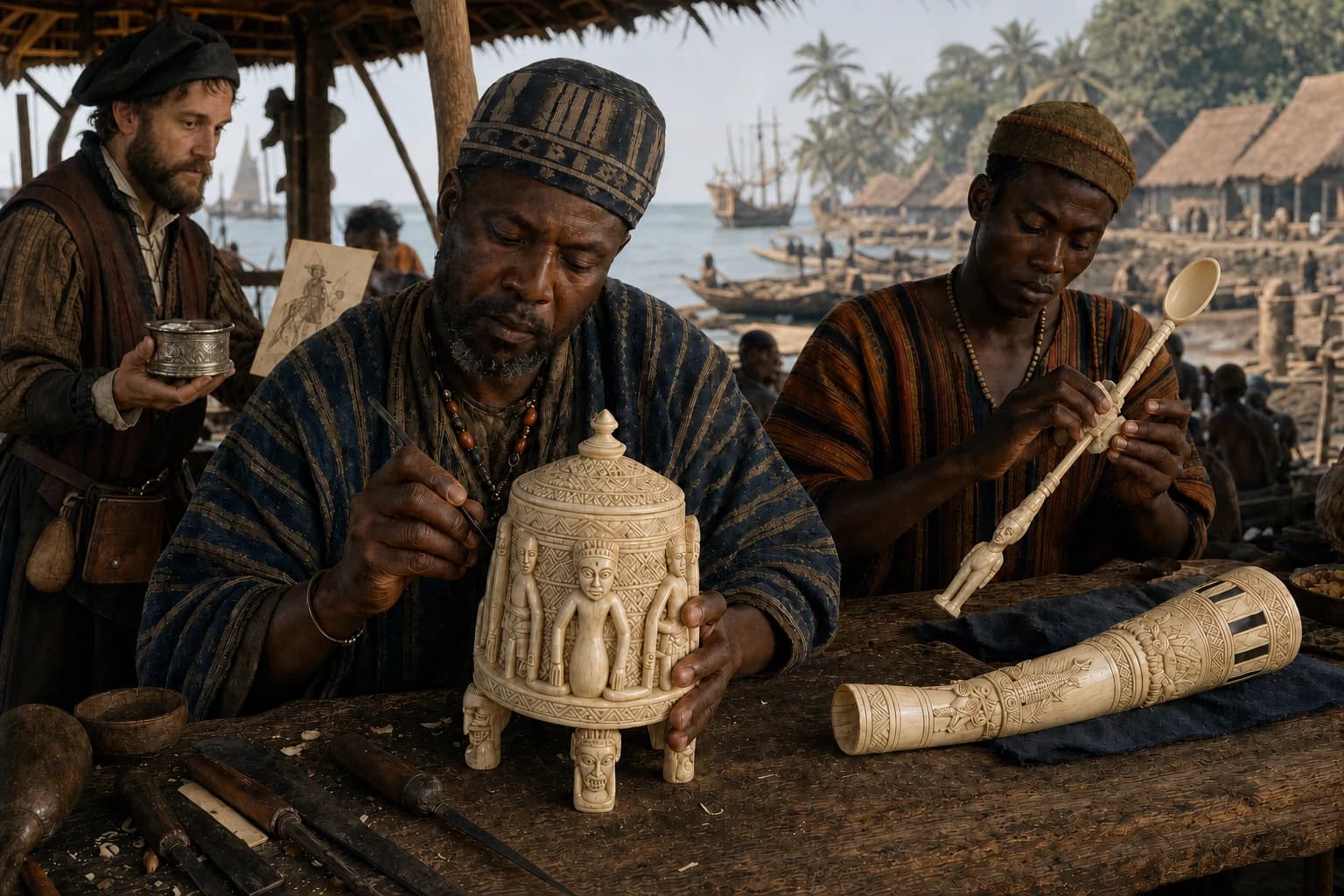
Sapi-Portuguese ivories are export artworks made around 1490–1530 by artists on the coast of present-day Sierra Leone for Portuguese and other European clients. They include lidded saltcellars, side-blown hunting horns or oliphants, spoons, forks and liturgical containers. Portuguese writers used Sapi as a broad name for several coastal peoples, so museums now often attribute individual works more cautiously to Temne or Bullom artists. A patron might supply a European metal vessel, heraldry or print as a model for function and subject. The artists then reorganized frontal figures, snakes, crocodiles, animals and dense geometric bands through their own highly trained carving practice. These works were neither passive European copies nor a local tradition untouched by trade: they were new art made by African authors within particular commissions, materials and markets.
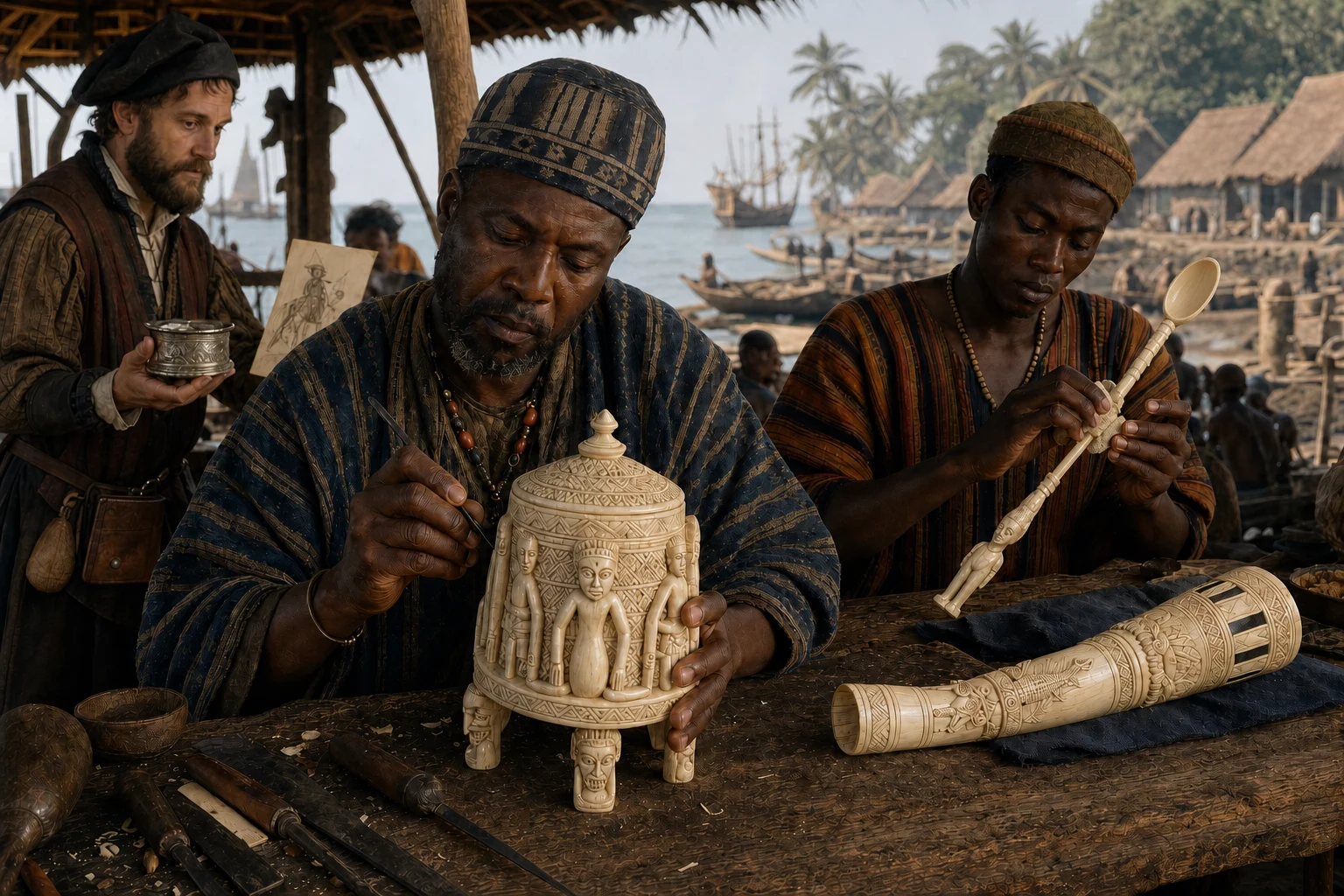 View the complete scene ↗
The complete scene reunites saltcellar, thin figural spoon, horn, carving tools and an imported formal model inside one workshop. It is an evidence-led composite—not a portrait of a named artist or a documented meeting.
- Main period
- About 1490–1530; some studies extend production to around 1540
- Place of production
- The coast of present-day Sierra Leone within wider Upper Guinea networks
- Artists
- Coastal peoples called Sapi by Portuguese writers, now often identified cautiously as Temne or Bullom
- Characteristic objects
- Lidded saltcellars, side-blown horns, thin spoons and forks, and liturgical vessels
- Principal markets
- Portuguese patrons, royal gifts, elite European tables and cabinets of curiosity
Chronology
A process, not a single date
Causes, turning points and aftermath form one process, far larger than a capital’s fall, a signed treaty or a company’s founding date.
- 01
Upper Guinea already sustains accomplished carving traditions
Shared frontal figures, head proportions and formal choices connect later export ivories with nomoli stone sculpture. Portuguese contact did not invent local carving skill.
- 02
Portuguese voyagers reach the Sierra Leone coast
Visitors enter existing coastal political and commercial networks and depend on local rulers and brokers for access to goods, people and permission to trade.
- 03
A recognizable corpus of ivory made for Portuguese markets emerges
European saltcellars, horns, tableware and liturgical containers supply new functions and outlines; local workshops determine how the finished forms are carved and organized.
- 04
Heraldry dates one royal presentation horn unusually closely
Shields and inscriptions on a Smithsonian horn narrow its creation to this interval and identify a probable gift from Crown Prince Manuel to Ferdinand of Aragon.
- 05
Saltcellars, horns, spoons and ritual vessels enter Europe
Trade inventories and surviving objects reinforce one another. Extremely thin bowls, deep relief, openwork and patterned bands reveal sustained professional training.
- 06
European collections preserve the objects while losing their origin
Some inventories misidentify them as Indian, Turkish or generically Oriental. Their cross-cultural form helps conceal the African artists who made them.
- 07
Art historians reconstruct distinct Sapi and Bini corpora
Comparison among style, old inventories, heraldry and West African works in other media restores different Sierra Leone and Benin workshop traditions.
- 08
Connected art history emphasizes reciprocal influence
Luís U. Afonso argues that Sapi export ivories absorbed European inputs but also contributed to innovation in Portuguese Manueline art.
Who were the Sapi, and why do labels now say Temne or Bullom artist?
Sapi or Sape names neither one artist nor a single modern ethnic group with fixed boundaries. Sixteenth-century Portuguese writers used it broadly for several linguistically and politically distinct communities in present-day Sierra Leone and nearby coastlands, including ancestors of Bullom and Temne peoples. Sapi-Portuguese remains useful for recognizing the historical corpus, but an outsider's collective label cannot stand in for every carver's exact identity.
Museums increasingly use attributions such as 'Temne or Bullom artist(s).' This admits that the works came from highly skilled coastal artists while individual names, settlements and workshop lineages are usually unrecorded. An absent signature does not mean absent authorship: controlled thin walls, elaborate openwork, recurring compositional rules and identifiable hands all point to intensive professional practice.
What did Portuguese patrons request, and what did the artists transform?
Saltcellars, European-style hunting horns, table implements and Christian liturgical containers served imported settings. Patrons could bring a metal vessel, a coat of arms, a print or verbal requirements. Royal heraldry and European hunt scenes on several horns make such inputs especially clear. The commission therefore concerned a new function, not simply the purchase of an unchanged local utensil.
A specified object type did not determine every image. Artists placed frontal people, sharply articulated faces, snakes, crocodiles, dogs, geometric bands and daring alternations of solid and open space into those outlines. Comparable formal choices occur in local nomoli stone figures. The final works satisfied foreign orders while translating their models through the workshop's own visual argument.
How were the ivories displayed—and misread—in Europe?
A tall or lidded saltcellar joined costly material, concentrated labour and ceremonial dining in one status object. Horns could function in the hunt, ceremony or royal gift exchange, while fragile thin-walled spoons often rewarded display more than repeated use. Portuguese ships carried such works into elite households, royal treasuries and later cabinets of curiosity, where they stood beside unusual natural specimens and other rare objects.
Within those collection systems, Sierra Leone's authorship often disappeared. Cataloguers guessed India, Turkey or a vague Orient from unfamiliar material and imagery. Twentieth-century reattribution did more than attach a new geographical label: inventories, heraldry, style and other West African sculpture allowed scholars to recover African makers whom European collecting had rendered invisible.
Why is 'cultural fusion' still an incomplete explanation?
Fusion can make the encounter sound as if it occurred outside unequal power. African rulers and commercial systems controlled access to ivory, while Portuguese traders brought an overseas luxury market, royal monopolies and an expanding traffic in captive people. Artists made decisions inside commissions, material supply, local knowledge and workshop training. Surviving objects demonstrate creativity; they do not prove that every transaction was equal or peaceful.
Influence also did not run along one arrow from Europe to Africa. A 2021 connected-art-history study argues that Sapi ivories and their empirical forms contributed in turn to Manueline visual culture. Calling these works African art does not erase the Portuguese commission. Acknowledging the commission should not transfer the artist's judgment, technique and invention to the buyer.
Evidence boundary
Fact, interpretation and uncertainty
The evidence reveals where imperial claims diverged from reality and where heroic stories compressed complex wars.
Professional coastal artists made several categories of ivory for European markets around 1490–1530
Museum objects, heraldic dating, Portuguese trade inventories and early European collection records support one another; saltcellars, horns and spoons form a coherent corpus rather than isolated curiosities.
Most works cannot be assigned to a named carver or one documented workshop
Sapi is a broad Portuguese label and the objects long ago left their production sites. Temne, Bullom and individual-hand attributions rely mainly on stylistic and historical comparison, not a complete workshop archive.
A European object type does not mean Europeans designed the whole work
Patrons could specify use and supply models, but figural treatment, animals, geometry and structural carving show active coastal translation; newer research also follows African influence back into Portuguese art.
Questions
Common questions
What are Sapi-Portuguese ivories?
They are ivory export artworks made around 1490–1530 by coastal artists in present-day Sierra Leone for Portuguese and European clients, including saltcellars, horns, spoons, forks and liturgical containers.
Which modern people does Sapi identify?
It was a broad label in early Portuguese accounts, not the name of one modern ethnic group. Museums cautiously attribute many works to Temne or Bullom artists.
Why did artists carve ivory saltcellars?
European elite dining used conspicuous saltcellars to display material, workmanship and status. Coastal artists accepted that commissioned form and reorganized its surfaces and supports through their own carving practice.
What do the snakes, crocodiles and figures mean?
They relate to coastal West African visual traditions, authority and ideas about water, but not every motif can be decoded securely. Later Baga traditions offer clues, not a word-for-word key to objects made around 1500.
Are Sapi-Portuguese and Bini-Portuguese ivories the same?
No. Both served Portuguese exchange, but Sapi works mainly came from Temne, Bullom and related artists in Sierra Leone; Bini works emerged from the Edo court-art system of Benin in present-day Nigeria.
Can comparable ivory objects legally be made or bought today?
Historic museum objects are different from modern ivory commerce. International and national laws tightly restrict commercial ivory trade to protect elephants; studying early art does not endorse new ivory production.
Sources
Sources and further verification
Archives, museums, international organizations and academic publications support the facts and interpretive limits in this account.
- Afro-Portuguese IvoriesThe Metropolitan Museum of Art
- Lidded saltcellar, Temne or Bullom artist(s)The Metropolitan Museum of Art
- Hunting horn, Bullom or Temne artistSmithsonian National Museum of African Art
- Sapi-Portuguese ivory hunting horn, 1490–1530The British Museum
- Sapi Export Ivories and Manueline Art: A Connected HistoryViator / University of Lisbon
- Crossing Cultures: Afro-Portuguese Ivories of Fifteenth- and Sixteenth-Century Sierra LeoneSmithsonian Libraries and Archives
- Nomoli and Pomdo Stone Figures of Upper GuineaThe Metropolitan Museum of Art
Age of Seas editorial research distinguishes verifiable facts, historical interpretation and potentially misleading simplifications.Editorial standards and corrections ↗