 leviathan
One raises the seabed. One defeats the hook.
Kraken and Leviathan come from different traditions. The North Atlantic Kraken rose from fishermen’s lore, sounding lines and natural history: the seabed seems to shoal, an island-like back surfaces, and its descent pulls the sea into a whirlpool. Leviathan comes from ancient Hebrew poetry; Job asks whether a hook can capture, bind or tame it. Nineteenth-century prints, poems and discoveries of giant squid later traded features between them. What they share is the instant when the person holding a tool discovers how small the hand has become.
Separate the two routes before following their deep-water convergence.
Two small tools reach into two different abysses
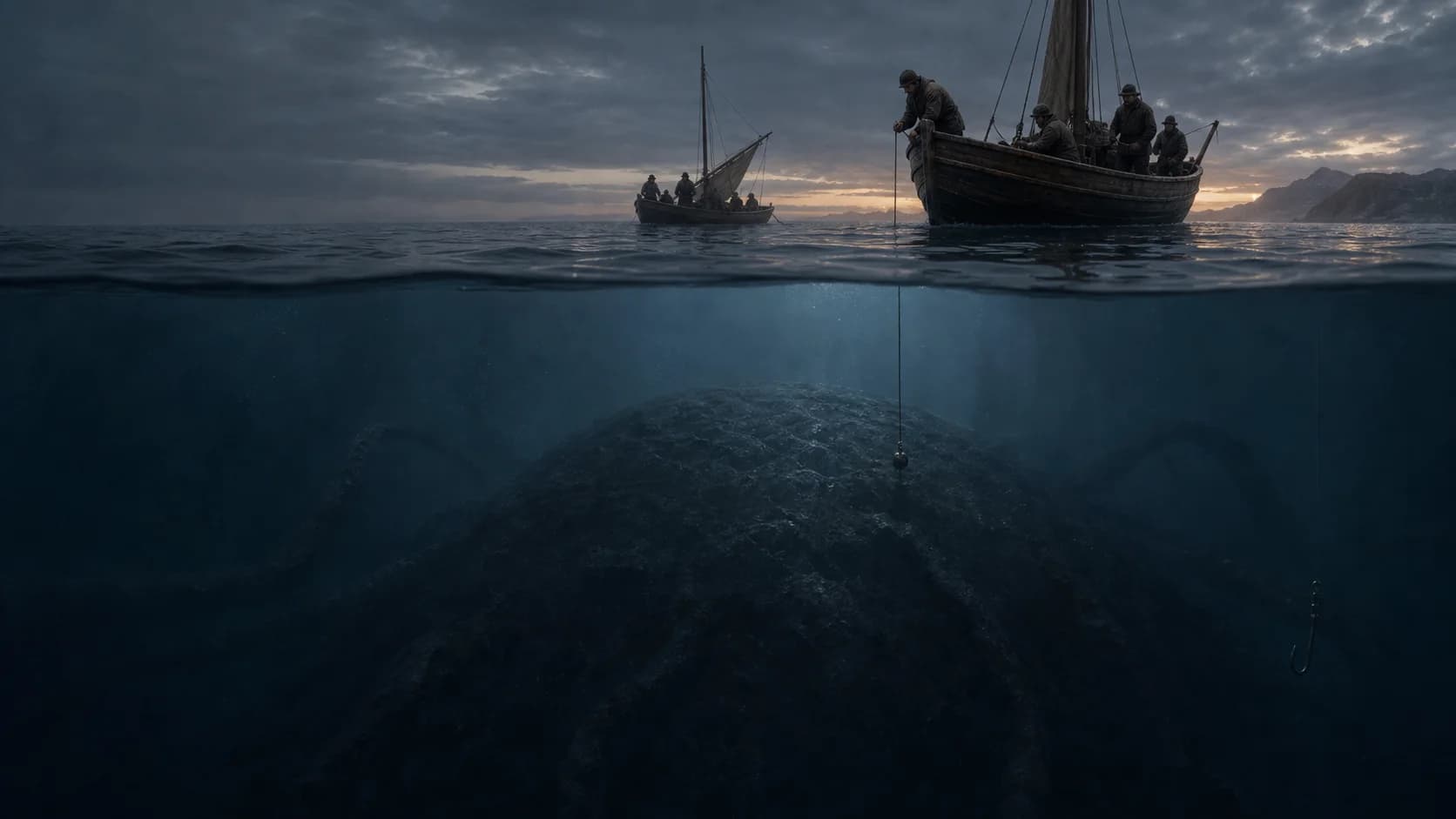
A sounding lead aboard a fishing boat and the fishhook in Job are both instruments for making the sea manageable. One tells sailors how much water remains beneath the keel; the other brings an unseen fish into the hand. The Kraken and Leviathan reach their greatest scale before either shows a face. One makes the lead report a seabed that is rising. The other makes a voice from the whirlwind ask whether a hook can bear the name Leviathan.
Modern posters place two monsters across a fighting sea and reduce the question to octopus or dragon. The records preserve a larger scene. Kraken accumulated water depths, fisheries, islands and whirlpools in northern seafaring knowledge. Leviathan passed through defeat, play, wildness and final judgment in ancient poems. Each first made its own world feel the size of the sea; only later did they meet on the same imaginative map.
In the thirteenth century, a sea creature looked more like an island
KONUNGS SKUGGSJÁ · THE KING'S MIRRORc. 1250 ↗ When it appeared to men, it looked more like an island than a fish.The Old Norse creature is hafgufa; Larson's translation uses “kraken” in this passage.
The Norwegian King’s Mirror, composed around the middle of the thirteenth century, uses a dialogue between father and son to teach trade, navigation, courtly life and natural knowledge. When the father reaches the Greenland seas, he reluctantly describes the hafgufa: it seldom approaches land, its size strains belief, and when people see it, it appears more like an island than a fish. The author even supposes that only two exist, for bodies like these could leave little food for other fish if they multiplied like whales.
Its feeding is stranger than its dimensions. The hafgufa opens a mouth as broad as a sound or fjord, gives a great belch, and draws fish toward the food or scent it releases before closing its jaws. A 2023 study read this passage beside recently documented trap and tread-water feeding in whales, which hold their mouths open at the surface while fish gather within. The parallel may preserve an echo of observation. It does not turn one legendary creature into a clean modern species identification.
In 1755, the sounding lead found a living seabed
ERIK PONTOPPIDAN · NATURAL HISTORY OF NORWAY1755 ↗ Where they expected eighty or one hundred fathoms, the lead often found only twenty or thirty.
Erik Pontoppidan, bishop of Bergen and natural historian, gathered correspondence, inquiries and coastal accounts in The Natural History of Norway. He brought Kraken, Kraxen and Krabben into European natural history while admitting that his evidence remained incomplete. Fishermen nevertheless knew a practical sequence: where they expected eighty or one hundred fathoms, the lead suddenly found only twenty or thirty; cod and ling crowded the hooks; the water continued to shoal. Then the boats stopped fishing and rowed away.
The bottom was rising. Pontoppidan wrote that the first exposed back looked like a cluster of small islands fringed with seaweed, followed by sandbank-like heights and horns or arms as large as masts. Even the estimate he chose for caution made the visible back roughly a mile and a half in circumference. It offered no complete anatomy. Pontoppidan thought no human eye had probably beheld the whole body. Here Kraken begins as a change in water depth, and only then becomes an animal.
The moment sailors feared came when it sank
Later images placed all danger in the arms: a mast is seized and a deck breaks. Pontoppidan did say those branches might pull down the largest man-of-war, yet his recurring nautical hazard moves in the other direction. When the enormous body descends, water collapses after it. Swell and whirlpool draw the surrounding boats toward the centre. The surface seems to close just as its most dangerous movement begins.
That is why fishermen watched the lead rather than waiting for a cephalopod to appear. Their adversary was a sea whose rules had changed. Pontoppidan also preserved a report from 1680 of a young Kraken stranded in the channel at Alstahaug, its limbs caught among trees and rocks and its stench obstructing passage. However the tale travelled, it measured the creature through shores, channels and moving water.
Leviathan comes from the whirlwind and makes a fishhook weightless
约伯记 · JOB 40:25 / 41:1SOURCE ↗ Can you draw Leviathan from the deep with a hook, or press down its tongue with a cord?HEBREWתִּמְשֹׁךְ לִוְיָתָן בְּחַכָּה וּבְחֶבֶל תַּשְׁקִיעַ לְשֹׁנוֹ׃
Leviathan in Job does not wait to be sounded. God asks from the whirlwind: can you draw Leviathan out with a hook or press down its tongue with a cord? Will it beg, make a covenant, serve for life, become a plaything for girls, or be divided among merchants? Fishing, binding, contract, enslavement, pet keeping and trade enter one after another, and lose their force inside the question itself.
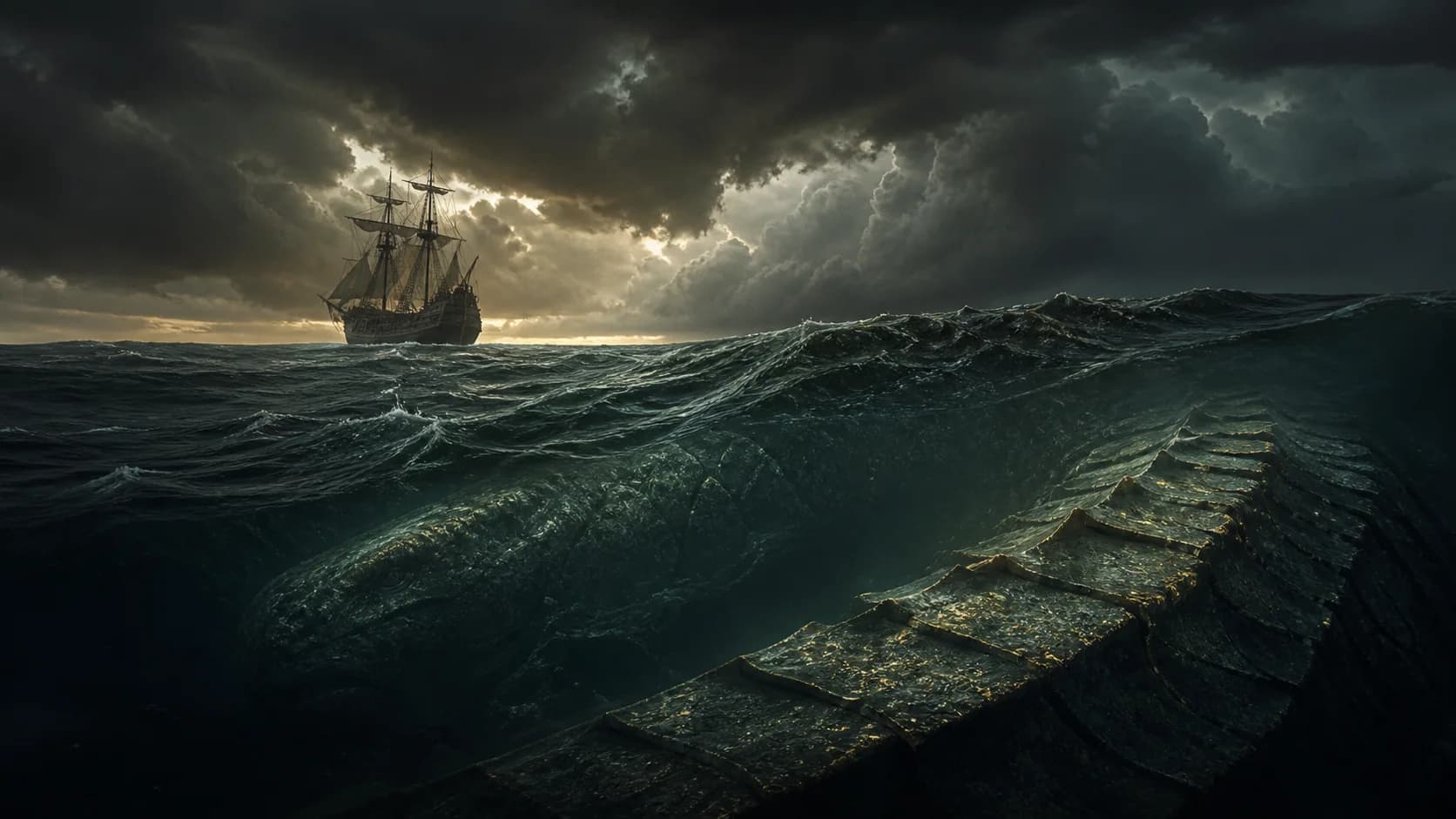
The creature wears interlocking armour, breathes smoke and fire, and receives weapons like straw; it makes the deep boil and leaves the sea white behind it. Psalms and Isaiah give the same name other fates. Its many heads can be crushed as chaos, it can play in the broad sea where ships pass, and it can remain the fleeing and twisting serpent awaiting judgment. Leviathan gains epic scale not from fixed anatomy, but from the way each poem rearranges the proportions of human, sea and divine power.
In 1801, an engraving gave Kraken its tentacles
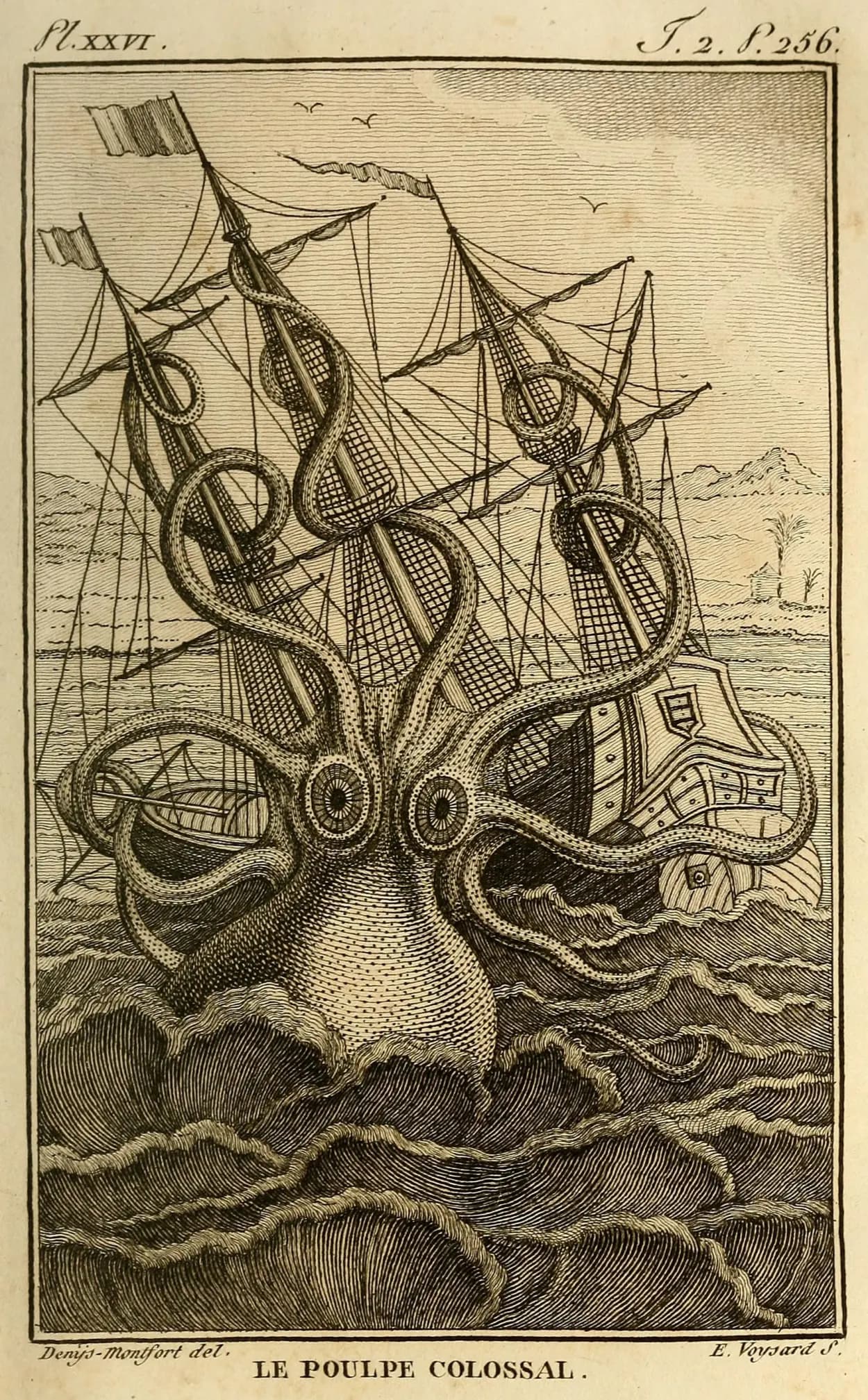
The French naturalist Pierre Denys de Montfort discussed two enormous octopuses in his mollusc history of 1801–02. He separated the northern sailors’ kraken from a ‘colossal octopus’ said to have attacked a vessel off Angola. His celebrated engraving shows sailors kneeling in prayer to Saint Thomas as thick arms climb the hull and coil around the mast. An uncertain marine scale acquired a clear, reproducible dramatic pose.
The picture outlived Montfort’s classification. It moved Kraken from island-fish and rising seabed toward the cephalopod, and made the ship attack its visual climax. Twenty Thousand Leagues Under the Sea and later fiction enlarged the octopus or squid body; film and games turned tentacles into an instant emblem. Much of what people now call Kraken belongs to this image tradition formed after 1800.
In 1830, Tennyson put Kraken to sleep until the end of the world
ALFRED TENNYSON · THE KRAKEN1830 ↗ Far beneath in the abysmal sea, its ancient, dreamless, uninvaded sleep—the Kraken sleeps.
Alfred Tennyson’s sonnet places Kraken below ‘the thunders of the upper deep,’ sleeping uninvaded and dreamless through the ages. Millennial sponges grow beside it and countless polyps move their arms. Only when the latter fire heats the deep will it be seen by humans and angels, rise roaring to the surface, and die.
Pontoppidan’s fishing-ground monster here absorbs a Leviathan-like apocalypse. No creatures duel, yet an influential fusion takes place: the northern kraken receives biblical abyss, sleep and final fire, while later images repeatedly lend cephalopod arms to Leviathan. ‘Kraken versus Leviathan’ looks less like an inherited rivalry than a view downstream from an exchange of forms.
The giant squid appeared, and the legendary sea did not grow smaller
In the mid-nineteenth century, Danish zoologist Japetus Steenstrup connected stranded remains with giant cephalopods, and Architeuthis entered scientific taxonomy. The longest giant squid reliably recorded reaches about thirteen metres in total length. It has eight shorter arms and two extremely long feeding tentacles; because soft tentacles stretch, scientists rely more heavily on mantle length. Cameras off the Ogasawara Islands photographed a living animal in its natural habitat in 2004, published in 2005. Only in 2012 was a giant squid filmed moving in its deep native environment.
The giant squid gave Kraken an astonishing real body without proving a thirteenth-century island, a mile-and-a-half back or a ship-swallowing whirlpool. Its own high point is quieter: an animal long enough to span several storeys was not filmed alive in its own deep sea until the twenty-first century. The seabed rises; the hook fails. Kraken and Leviathan arrive by different traditions at the same revelation. The epic can begin when a person looks down at the tool in hand and understands that the thing ahead never grew to a human scale.
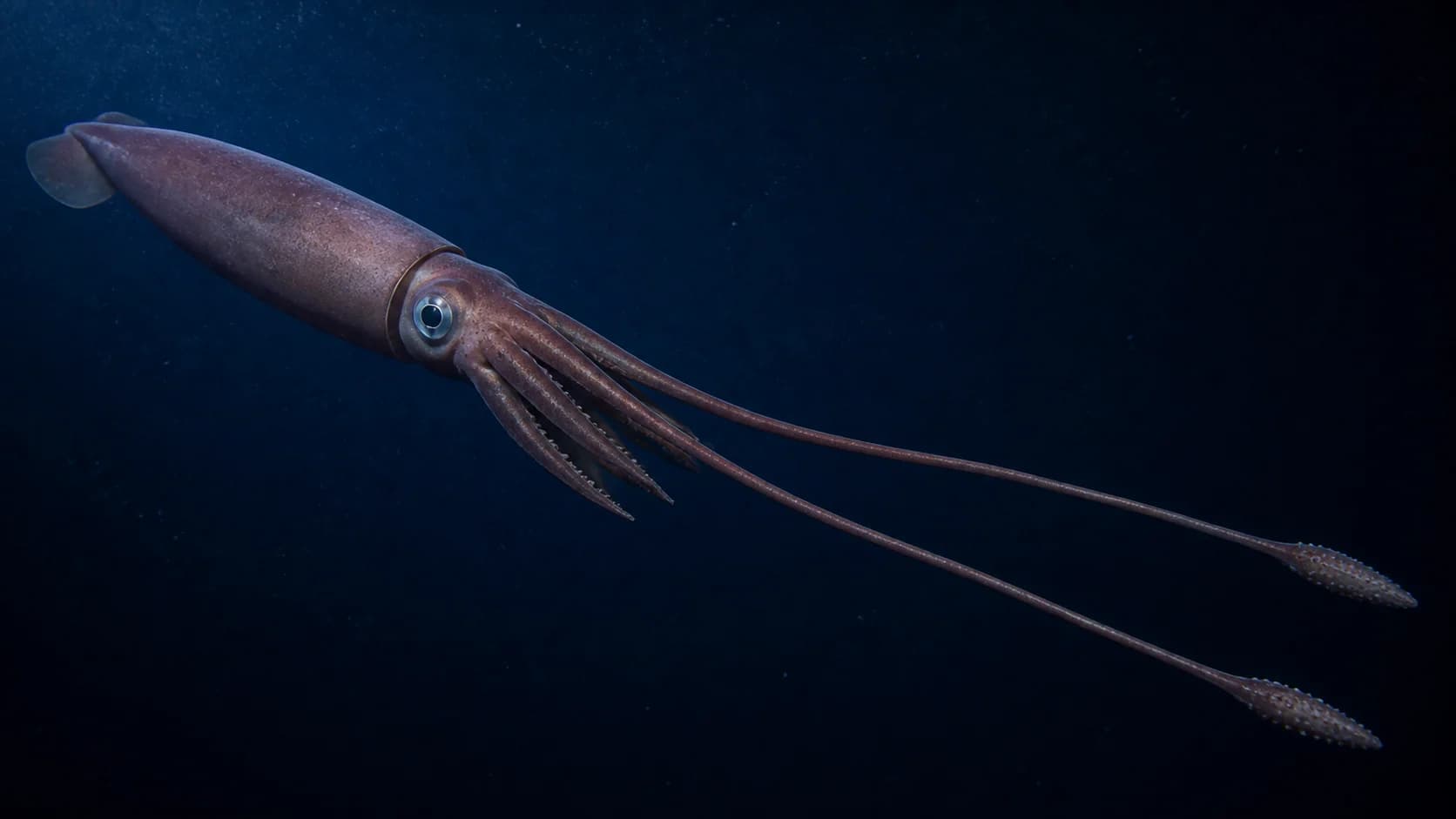
Eight arms and two long feeding tentacles. The documented maximum total length is about thirteen metres; mantle length compares size more reliably.
Original scientific reconstruction · anatomy after Smithsonian referencesThey never fought in the old stories. The figure measured by both is the human standing at the surface.
After the lead returns
01Did Kraken and Leviathan fight in an ancient story?+
No shared ancient combat tale became part of either tradition. Modern film, games and online comparisons frequently cast them as opponents.
02Are kraken and hafgufa the same word?+
No. The Old Norse name in The King’s Mirror is hafgufa. Laurence Larson’s 1917 English translation used ‘kraken’ in the passage, helping later histories connect the two.
03Was the early Kraken already a giant octopus?+
The King’s Mirror and Pontoppidan stress an island-like body, feeding, shoaling water and whirlpools. Montfort’s 1801–02 work is an important turn toward the giant-octopus image.
04Did Pontoppidan really make Kraken a mile and a half around?+
Yes. He gave that circumference for the visible back or upper portion and presented it as the smaller estimate chosen for caution. It was an eighteenth-century reported scale, not a modern measurement.
05Can a giant squid sink a large ship?+
There is no reliable evidence of giant squid attacking and sinking large vessels as old prints depict. They are real deep-sea animals, with a documented total length around thirteen metres.
06How did Tennyson change Kraken?+
His 1830 poem placed it asleep in the abyss until the final fire, when humans and angels would see it rise and die. It gave a northern sea monster an apocalyptic, almost biblical scale.
07Why does the sounding lead matter in Pontoppidan’s account?+
Fishermen first detect Kraken through water that becomes unexpectedly shallow as the body rises. A practical navigation tool turns the monster into a change in the entire seascape.
08What is the deepest difference between Kraken and Leviathan?+
Kraken largely took shape through North Atlantic seafaring report and early modern natural history. Leviathan mainly acts within ancient Hebrew poetry as chaos, wildness and a measure of divine power.
Follow both lines back to texts and specimens
- 01The King’s Mirror (Konungs Skuggsjá), chapter on Icelandic whales and the hafgufaProject Gutenberg · Larson translation
- 02Parallels for cetacean trap feeding and tread-water feeding in the historical record across two millenniaMarine Mammal Science · 2023
- 03The Natural History of Norway, Book II, sections XI–XII (1755)Internet Archive · Erik Pontoppidan
- 04The Natural History of Norway — catalog and page imagesBiodiversity Heritage Library
- 05Release the Kraken: The Giant Octopus in Art and Natural HistoryBiodiversity Heritage Library
- 06Histoire naturelle, générale et particulière des mollusques, vol. 2Biodiversity Heritage Library · Denys de Montfort
- 07Le Poulpe Colossal (1801), public-domain engravingWikimedia Commons
- 08Job 40:25–41:26, Hebrew text and translationsSefaria Library
- 09Psalms 104:25–26Sefaria Library
- 10Isaiah 27:1Sefaria Library
- 11The Kraken, first published in Poems, Chiefly Lyrical (1830)Project Gutenberg · Tennyson’s Early Poems
- 12How Big is the Giant Squid?Smithsonian Ocean
- 13First-ever observations of a live giant squid in the wildProceedings of the Royal Society B · 2005
Related signals
Along the same route
 01
01Leviathan: the sea monster humanity could never hook
From the fishhook challenge in Job to a monster both shattered and playful in the Psalms: why did Leviathan acquire no fixed body, yet become the sea's most enduring name for the unknown?
Continue along the route ↗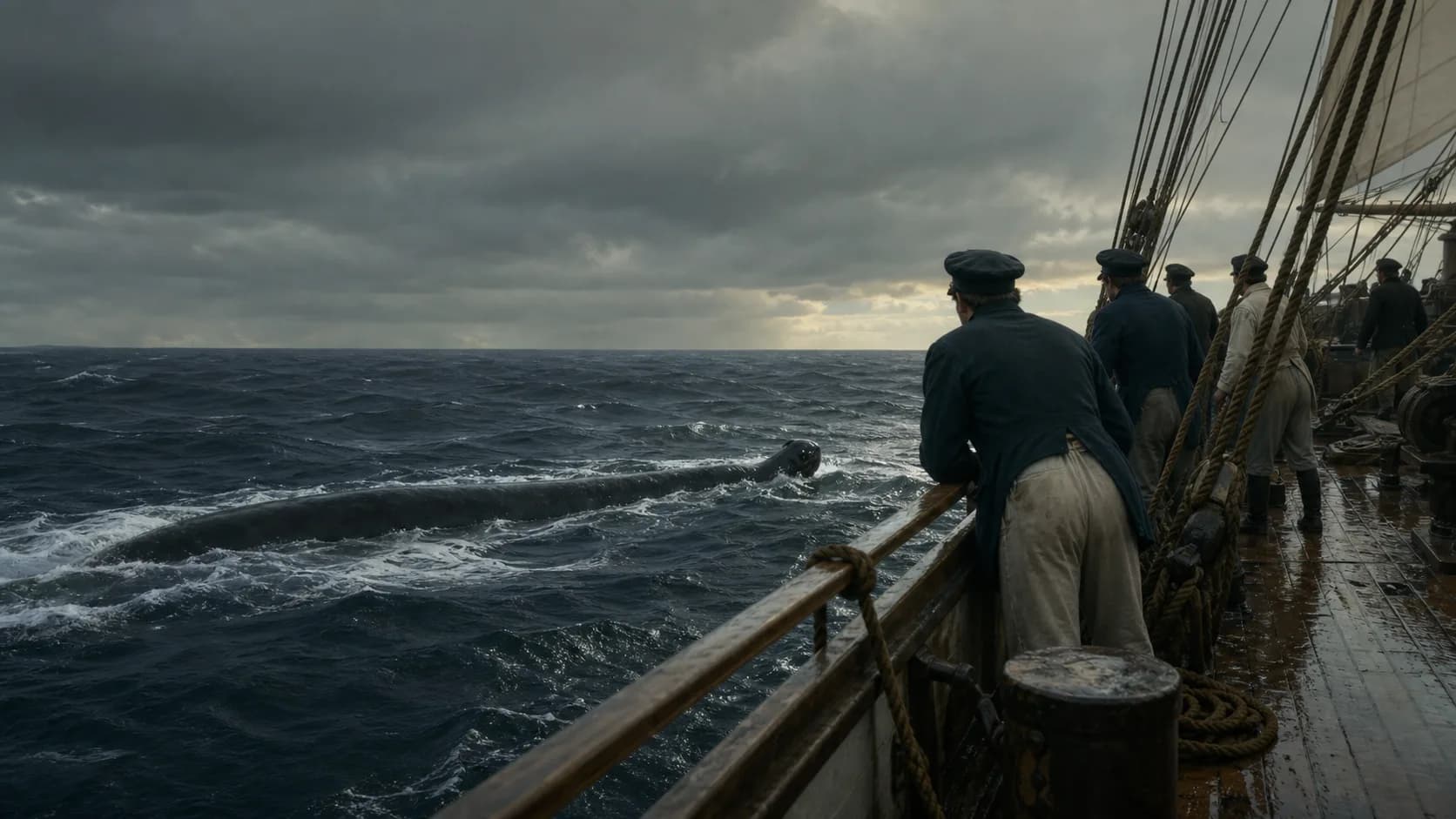 02
02The Sea Serpent: Every Witness Saw a Different Length of Body
From a Norwegian woodcut of 1555 and a Greenland voyage of 1734 to sworn Gloucester testimony and the HMS Daedalus report: how a sea serpent acquired its body through incomplete sightings.
Continue along the route ↗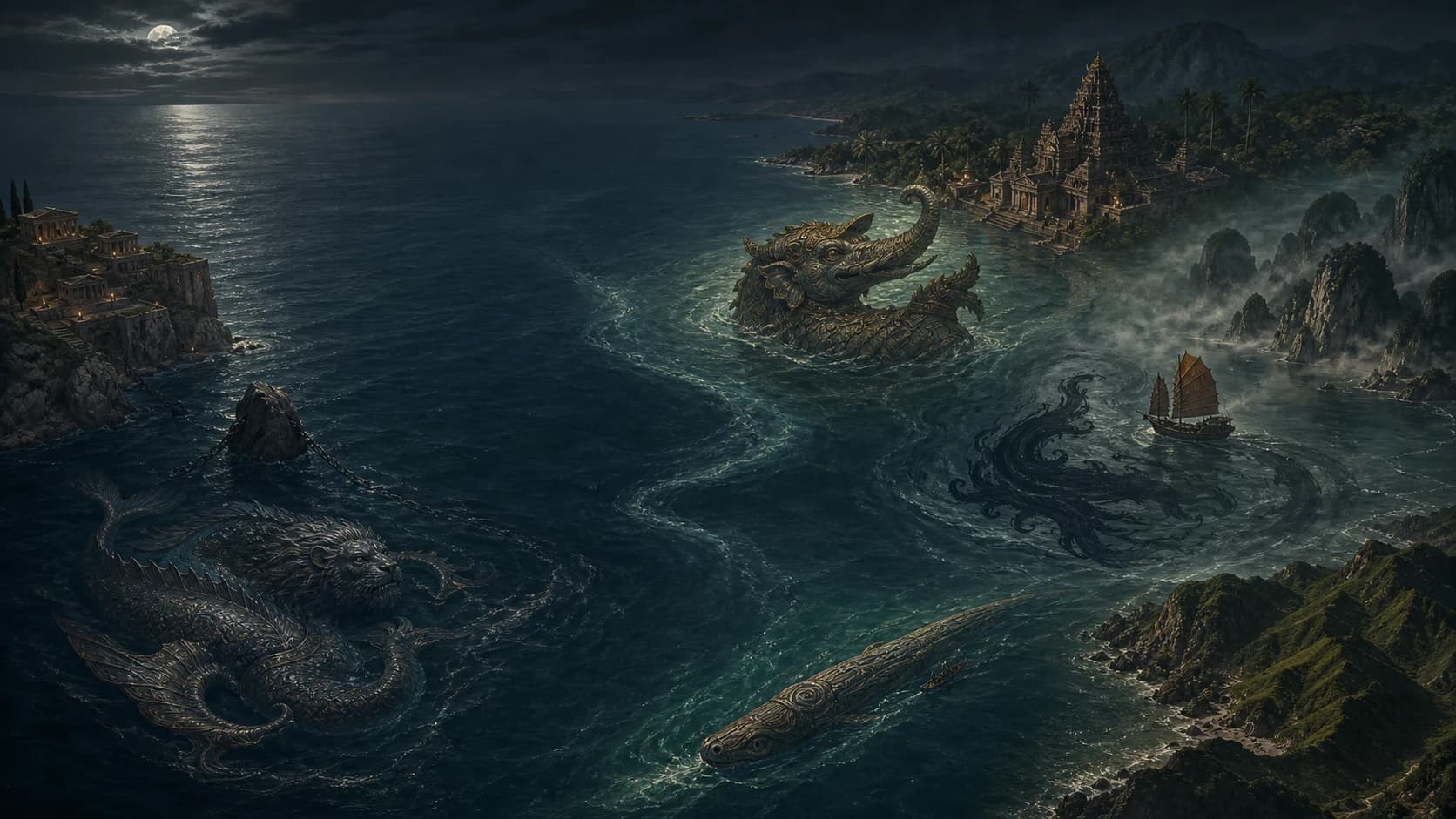 03
03Sea monsters of the world: every coast gives deep water a different verb
From the Greek ketos that consumes a sacrifice and the Indian makara that carries a water deity to China's Album of Sea Oddities, Hokusai, Māori taniwha and Mami Wata across the African Atlantic: monsters that demand, guard, guide and bestow.
Continue along the route ↗