 leviathan
SIX COASTS. SIX WAYS TO MEET DEEP WATER.
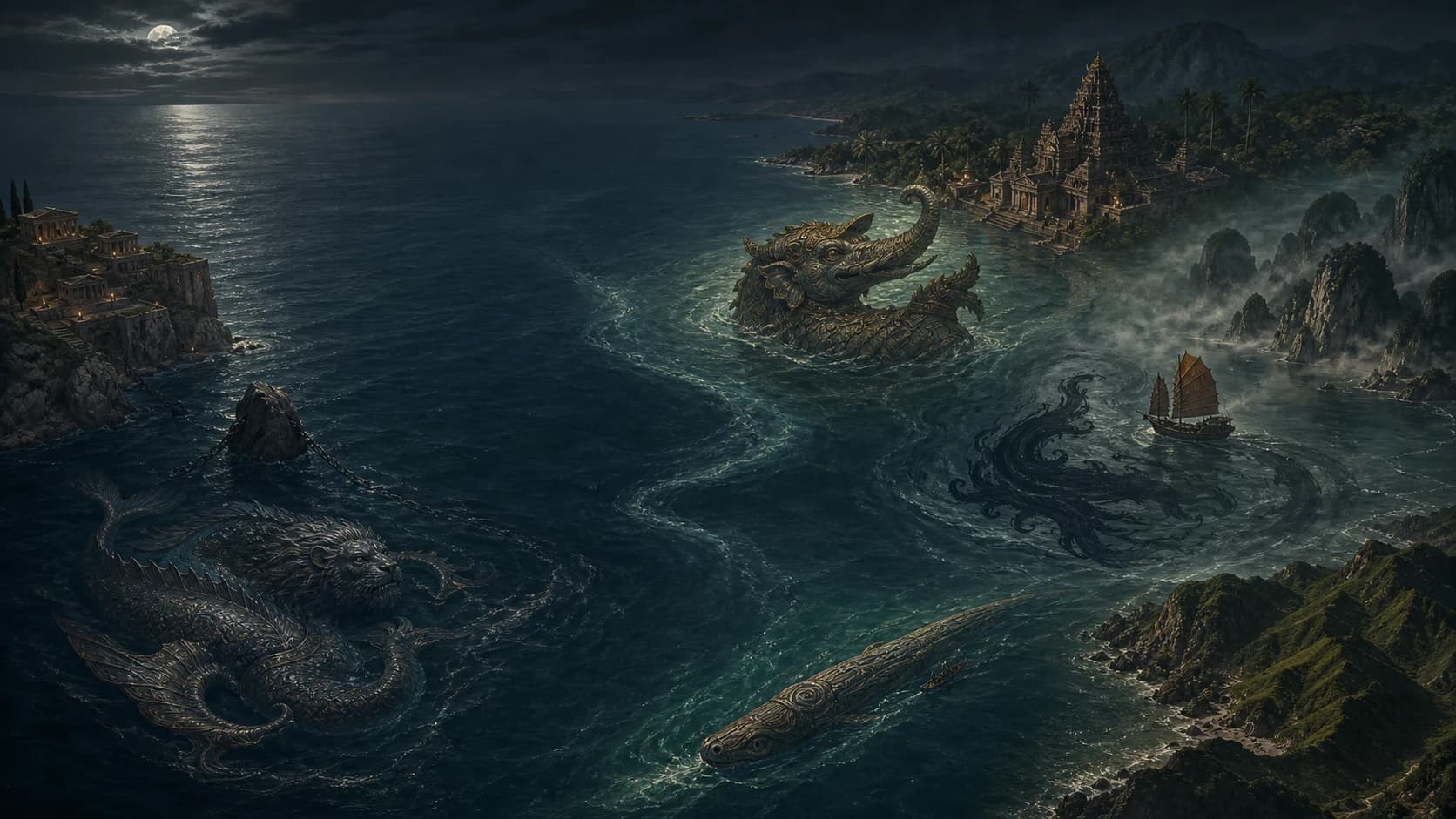
The world's sea monsters grow from different waters and relationships. A Greek ketos collects a human price; the South Asian makara combines crocodile, fish and elephant as water's vehicle and guardian; a Māori taniwha may consume travellers or guide a canoe; Mami Wata carries beauty, wealth, healing and danger across Africa and the Atlantic. Bodies migrate, but meanings remain rooted on particular coasts. A true atlas must also record what each monster does there.
SIX COASTS, SIX LOCAL ROLES FOR MONSTERS.
One world ocean becomes many different things at the shore
Place an Archaic Greek vessel, a South Asian threshold beast, a Qing imperial album, an Edo drawing and Māori accounts of named waterways on one table. They share scales, teeth, long jaws and coiling bodies. Yet resemblance quickly misleads. One monster waits for a sacrifice; one carries a god; one guards a community; another brings wealth and peril to land.
The sea monster therefore behaves more like a verb than a noun. The question changes from ‘what animal is it?’ to ‘what does it do here?’ Demand, carry, record, migrate, guide, bestow. Each action fixes the creature inside a relationship, and turns the global atlas from a shelf of exotic animals into six coasts that cannot replace one another.
On the Ethiopian shore, the ketos rises to collect a price
OVID · METAMORPHOSES IV · 688–690LATIN TEXT ↗ Before all was told, the water resounded; a beast came from the boundless sea, looming, its breast possessing the broad water.LATIN SOURCEnondum memoratis omnibus unda
insonuit, veniensque inmenso belua ponto
inminet et latum sub pectore possidet aequor.
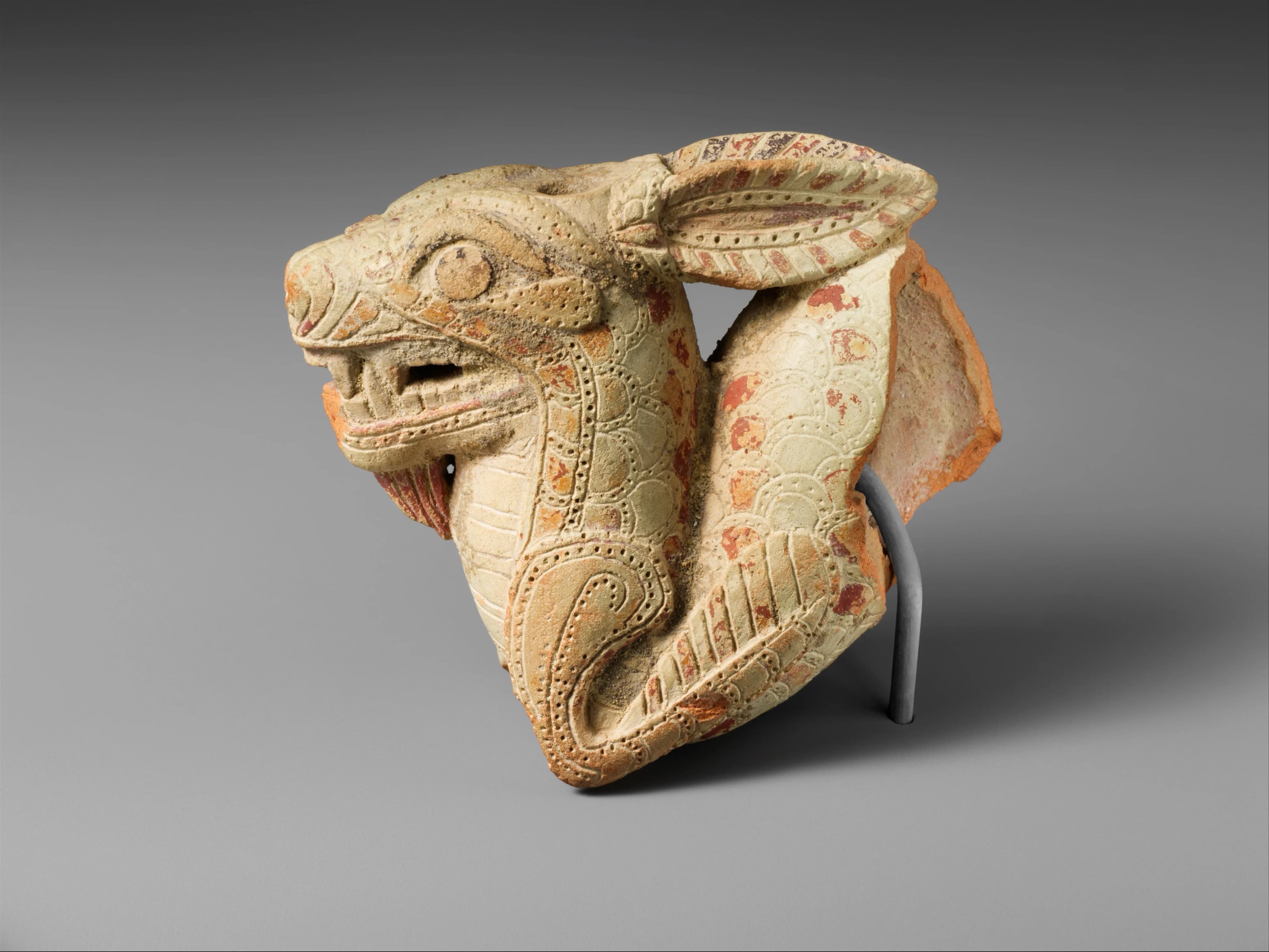
The Greek ketos never possessed the anatomy of a natural-history specimen. A small vase at The Met, made in the later seventh century BCE and among the earliest surviving representations, has a leonine head, huge eyes, beard, flattened furry ears, fangs, a scaled belly and two flippers. Liquid poured through the tongue between its teeth. Lift the vessel and the container itself becomes a captured mouth from the deep.
In the Andromeda story, the ketos executes a coastal judgment. Cassiopeia insults the Nereids; a monster ravages the kingdom, and her innocent daughter is chained to a sea rock to pay for the mother's words. Ovid makes the whole water resound as the creature rises and covers a broad reach of sea. Perseus kills it, but later images keep the same law of exchange: an offence committed ashore is answered when the ocean comes to collect a person.
 FANGFINLION HEAD
A hole in the tongue poured liquid between the fangs: the monster's body became the vessel.
THE MET · OPEN ACCESS ↗At the Ganges and the temple threshold, the makara carries the force of water
OBJECT NAME · SOUTH ASIATHE MET ↗ Aquatic monster. Vehicle of water deities. Protective form at the threshold.SANSKRIT NAMEमकर · makara
The South Asian makara is also a composite creature, but it is seldom confined to the role of an enemy awaiting a hero. Crocodile, fish, elephant and other forms enter its continually changing body. It serves as a vehicle of Varuna and the river goddess Ganga and appears on architecture, jewellery and weapons. A wheeled clay makara at The Met, made in the second or first century BCE, may have been a child's toy; related objects may have been placed by rivers for protection from aquatic danger.
Its mouth consumes, but also releases vines, lotus and life. At the edge of a building the makara joins ordinary space to sacred water; as a protective terminal it lets people carry a river's uncertainty on a bracelet or sword. The ketos makes a coast surrender an offering. The makara bears danger and abundance together—the same fangs becoming a gate into order.
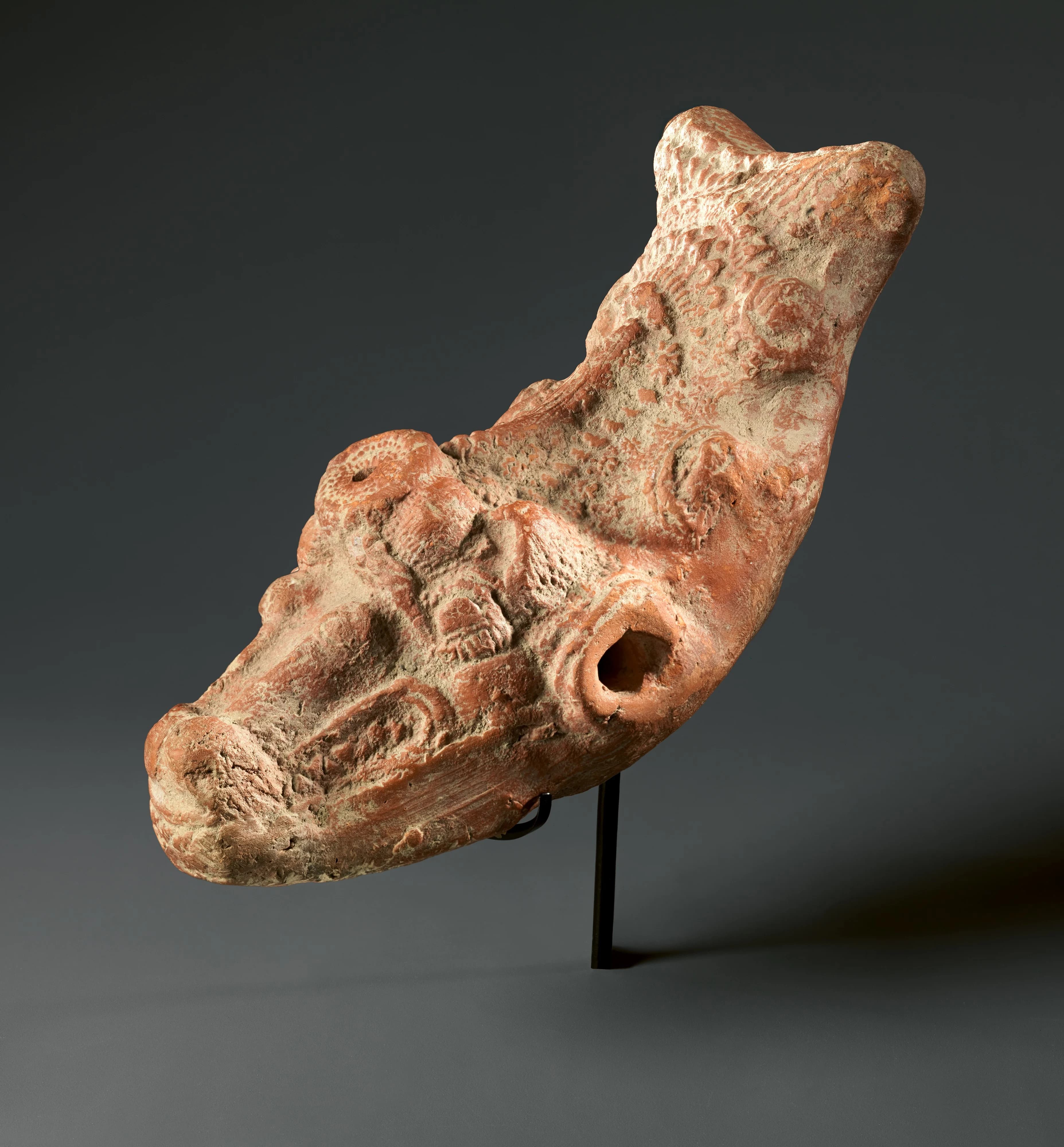
This seven-inch clay creature once had wheels. An aquatic monster could also cross a child's floor.
THE MET · OPEN ACCESS ↗In 1698, Nie Huang bound eyewitness, book and hearsay into one Album of Sea Oddities
《尚书 · 禹贡》故宫博物院 ↗ Its tribute is salt and fine ramie cloth; the creatures of the sea are manifold.CLASSICAL CHINESE厥貢鹽絺,海物惟錯。
The Chinese term haicuo means the teeming variety of the sea, not a mistake. In 1698, while living in Funingzhou on the Fujian coast, Nie Huang completed four albums containing 155 leaves and 371 marine beings. The first three are now in Beijing's Palace Museum and the fourth in Taipei. Sharks, flying fish, shells and creatures inherited from texts, local report or unresolved observation occupy the same ocean of paper.
Nie did not stand on one side of a modern fact-versus-fiction border. He examined specimens and drew scales, fins, spines and manes; he also compared classical works and recorded coastal testimony. Traditional line, shading and diagrammatic dissection share a page. The strange is not expelled from natural history. It marks knowledge while it is still forming: a creature can be drawn, compared and questioned while the sea retains its answer.
Hokusai's monster had already crossed one cultural sea
HOKUSAI · UNPUBLISHED DRAWINGBRITISH MUSEUM ↗ The sea monster assails a ship.JAPANESE TITLE海の魔物、船を攻める
In the 1820s–40s Katsushika Hokusai prepared drawings for an unpublished Great Picture Book of Everything. Among 103 sheets now at the British Museum is ‘The sea monster assails a ship’. It continues another scene in which the late-Ming maritime figure Zheng Zhilong threatens the creature with a gun. The actors and imagined place are Chinese; the artist worked in Edo; the intended reader would have sailed into the scene through a Japanese printed book.
Here the monster's verb is migrate. A Chinese narrative enters a Japanese world compendium and acquires Hokusai's wave, vessel and attacking body, only to remain in manuscript when the book is abandoned. Two centuries later the drawings reach a London museum and return globally as digital images. A monster has no single habitat when paper, translation, collecting and screens become its currents.
CHINESE MARITIME STORY
EDO · 1820s–40s
103 DRAWINGS
CROSSES AGAIN
In Cook Strait, a taniwha may guide the canoe instead of blocking it
WHAIWHAIĀ · WAIKATO WATERSTE ARA ↗ The many stranding places of Whaiwhaiā.TE REO MĀORINgā paenga he rau o Whaiwhaiā.
In Māori traditions, taniwha inhabit sea, river, lake and cave. They may appear as giant reptiles, sharks, whales or even drifting timber. Some kill or abduct people. Others are kaitiaki—guardians of particular iwi—who receive offerings and karakia. Kupe's taniwha Tuhirangi guided and protected canoes in Cook Strait. Some Māori later understood Pelorus Jack, the white dolphin that accompanied ships through dangerous water, as Tuhirangi in another form.
Log-shaped taniwha bind the being still more closely to hydrology. Whaiwhaiā appeared throughout Waikato waters and inspired the saying that it had a hundred stranding places. Humuhumu, guardian of Ngāti Whātua, resembled a tōtara log that could move against the current; it disappeared after people removed shellfish from its lagoon. A taniwha is not a generic dragon pinned to New Zealand. It lives in a named bend, current and genealogy.
Between Africa and the Atlantic, Mami Wata brings wealth with danger
SMITHSONIAN · MAMI WATAEXHIBITION ↗ Beautiful and seductive, protective yet dangerous.ORIGINAL ENGLISHBeautiful and seductive, protective yet dangerous.
Mami Wata may name one water spirit or a collectivity of spirits. Across West and Central Africa and the Atlantic diaspora, she is recognised through beauty, foreignness, snakes, mirrors, wealth, healing and fertility. The Smithsonian's National Museum of African Art describes the central tension: seductive and beautiful, protective yet dangerous. This presence does not wait for a hero to kill it. Encountering her can transform a life and require a return.
Her modern visual history is itself a voyage. A late nineteenth-century German image of a female snake charmer was later reprinted through an Indian calendar and circulated widely in western and central Africa. Artists joined that imported face to older water-spirit traditions and remade it in masks, figures, altars and paintings. The new picture did not erase local power. It gave that power another visible body: the ocean brought commodities, and also a face that could be renamed.
Maps assembled distant monsters—and quietly rewrote them
LIBRARY OF CONGRESS · MAP MONSTERSWORLDS REVEALED ↗ If the client commissioning a chart did not pay for sea monsters, none appeared.ORIGINAL ENGLISHif the client commissioning the chart did not pay for sea monsters, he or she did not receive them.
European medieval and Renaissance maps placed whales, sea pigs, serpents, sirens and travellers' marvels in one paper ocean. Images were copied from classical texts, natural histories and earlier maps. The northern creatures on Olaus Magnus's 1539 Carta Marina were borrowed repeatedly by later maps of Iceland. What resembles a zoological distribution may instead trace the copying of a successful image.
The monster could even become a purchasable ornament. In presenting research on map monsters, the Library of Congress notes that many nautical charts contain none: if a client did not pay for the decorative element, it did not appear. Monsters signalled marvel and danger, but they could also advertise the status of an expensive chart. The world map put distant coasts together while a common set of scales—and a commission—smoothed away their local relationships.
A true monster atlas writes the verb beside the body
Ask only whether these beings are physically real and the ketos shrinks into a misidentified fish, the makara is dismembered into crocodile and elephant, the taniwha is taken away from its bend, and Mami Wata is filed incorrectly under mermaid. Comparing bodies can explain why fins resemble one another. It cannot explain why one coast surrenders a daughter to its monster while another asks one to escort a vessel.
This atlas therefore ends without a universal scale. At the Ethiopian rock it writes demand; at the Ganges threshold, carry; on the Fujian album, record; in Hokusai's drawing, migrate; in Cook Strait, guide; across the African Atlantic, bestow—and demand in return. When six verbs illuminate one ocean, the epic measure of the world's monsters appears. They are not one fear scattered around the globe, but different relationships invented wherever people meet unknowable water.
Beyond the map fold
01Is a ketos simply a whale?+
Greek kētos could denote a large marine creature and contributed to words such as Latin cetus. The ketos of myth and art, however, combines a leonine head, fangs, scales, ears and fins and cannot be equated with a modern whale.
02Why does the makara resemble both crocodile and elephant?+
Makara imagery is deliberately composite and changes by region and period. It joins crocodilian, fish, elephant and other traits to express aquatic fertility, danger and protection, and serves as the vehicle of water deities.
03Is the Album of Sea Oddities science or fantasy?+
Nie Huang combined observed specimens, classical research and coastal testimony. Its value lies partly in showing early natural knowledge taking shape before a modern fact-versus-fiction boundary was imposed.
04Did Hokusai depict a Japanese monster?+
The British Museum places these sheets among Hokusai's drawings of China and the wider world. The attacking monster continues a scene involving the Chinese maritime figure Zheng Zhilong, so it is a Japanese reimagining of foreign narrative.
05Are all taniwha dangerous?+
Some taniwha harm people; others protect a particular people or voyager. Their character depends on named waters, genealogy and relationship, not on a universal temperament.
06Is Mami Wata a mermaid?+
Mami Wata sometimes takes mermaid or snake-woman form, but the term more broadly describes a water spirit or collectivity of spirits linked to wealth, healing, fertility, danger and changing experiences of modernity.
07Did old maps use monsters to mark every unknown place?+
Monsters could convey marvels, danger or natural knowledge, and they could be optional paid decoration. Many practical nautical charts have none, so the familiar rule is too simple.
08Why do monsters from distant cultures share body parts?+
Fins, serpentine bodies, crocodilian jaws and fangs are effective ways to picture motion and predation under water. Trade, conquest, manuscripts, prints and collecting also carried successful images across regions.
Return each coast to its own archive
- 01Terracotta vase in the form of a ketosThe Metropolitan Museum of Art · Open Access
- 02Metamorphoses, Book IV: Perseus and AndromedaUniversity of Virginia · Ovid Collection
- 03Perseus and Andromeda — story and paintingsThe National Gallery, London
- 04Toy in the form of a makaraThe Metropolitan Museum of Art · Open Access
- 05The Nature Deities of Early South AsiaThe Metropolitan Museum of Art
- 06The Gods of War: Sacred Imagery and Arms — makara iconographyThe Metropolitan Museum of Art
- 07Album of Sea Oddities, volume onePalace Museum · Famous Paintings
- 08Album of Sea Oddities, volume twoPalace Museum · Famous Paintings
- 09The Album of Sea Oddities in the Qing courtJournal of the Palace Museum
- 10The sea monster assails a ship — Hokusai drawingThe British Museum
- 11Hokusai: The Great Picture Book of Everything — large print guideThe British Museum
- 12TaniwhaTe Ara Encyclopedia of New Zealand
- 13Taniwha — enchanted logs and guardian traditionsTe Ara Encyclopedia of New Zealand
- 14Currents: Water in African ArtSmithsonian National Museum of African Art
- 15Mami Wata: Arts for Water Spirits in Africa and Its DiasporasSmithsonian Institution
- 16Sea Monsters on Medieval & Renaissance MapsLibrary of Congress
- 17Imaginary Maps in Literature and Beyond: Map MonstersLibrary of Congress · Worlds Revealed
- 18Mapping the Land of Fire and IceLibrary of Congress · Worlds Revealed
Related signals
Along the same route
 01
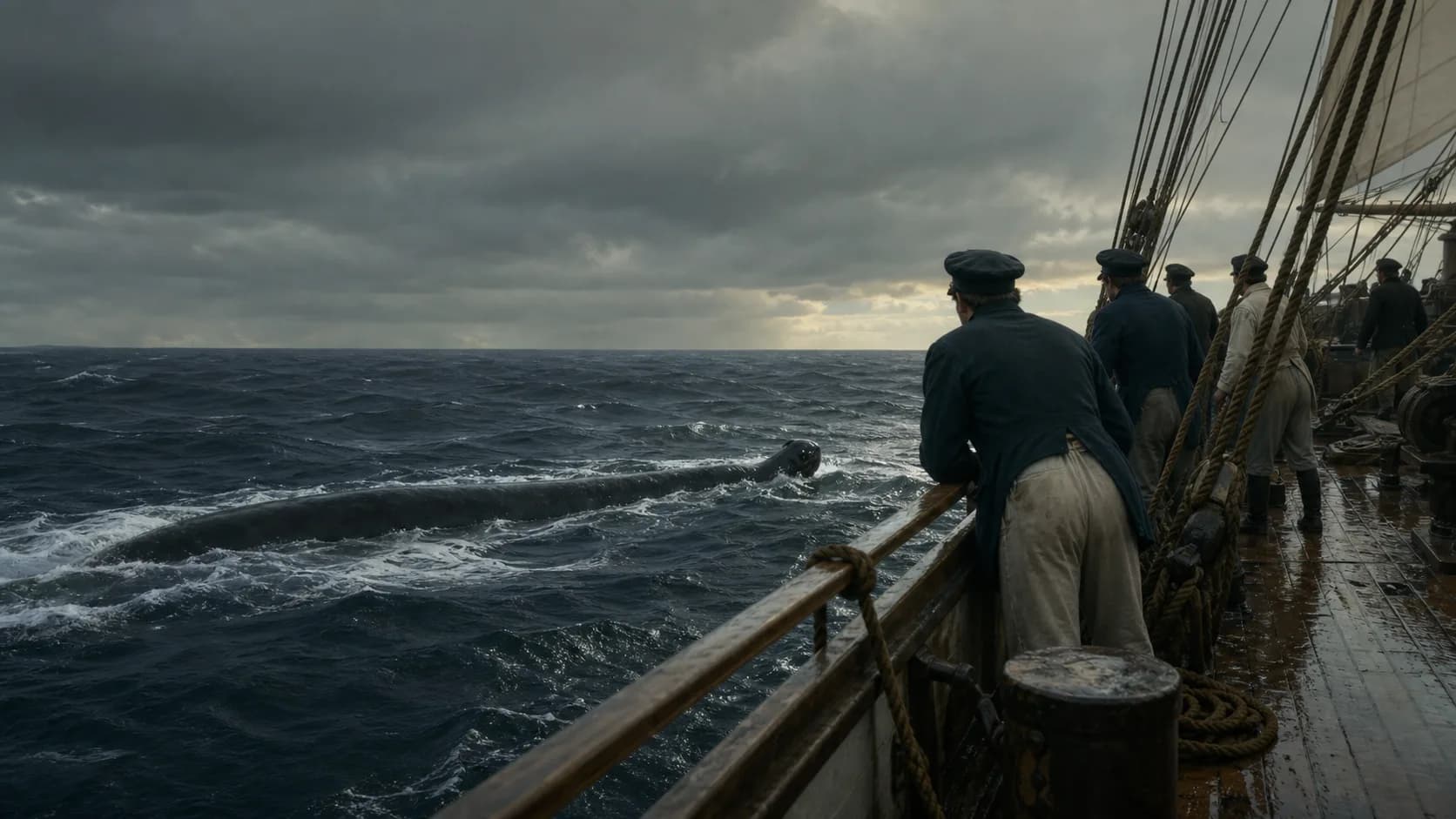
01The Sea Serpent: Every Witness Saw a Different Length of Body
From a Norwegian woodcut of 1555 and a Greenland voyage of 1734 to sworn Gloucester testimony and the HMS Daedalus report: how a sea serpent acquired its body through incomplete sightings.
Continue along the route ↗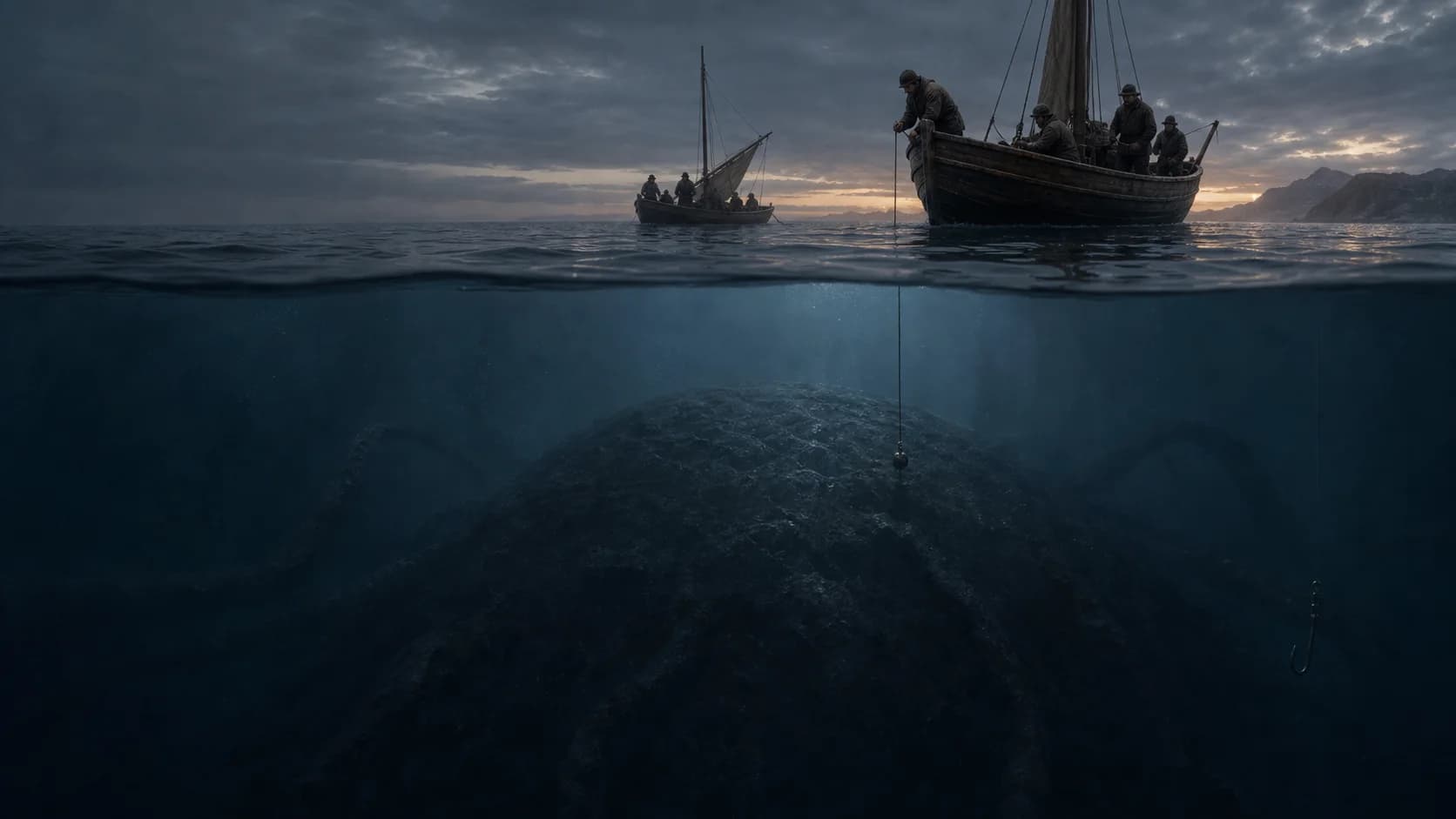 02
02Kraken and Leviathan: the seabed rises, the fishhook fails
From the hafgufa of The King’s Mirror and Pontoppidan’s sounding lead to Job’s fishhook, Montfort’s octopus and Tennyson’s sleeping deep: how Kraken and Leviathan became two different measures of the epic sea.
Continue along the route ↗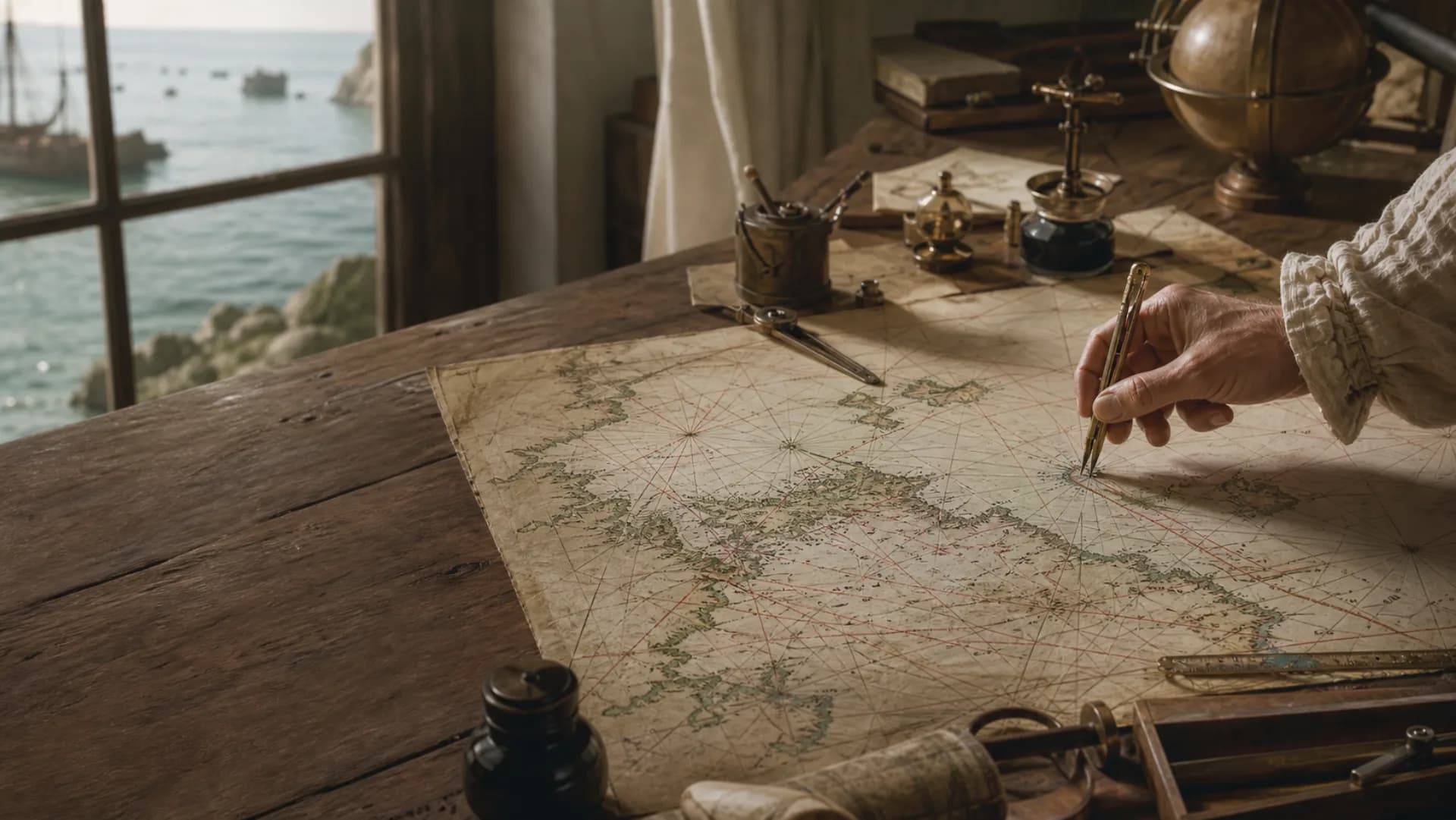 03
03How to read an early nautical chart
Begin with date and purpose, then read the coastline, port names and compass-line network before turning to flags, figures and sea monsters.
Continue along the route ↗