 leviathan
We have never seen the whole body.
The sea serpent was not one fixed animal returning for four hundred years. It was a shape made by observation: a head above one wave, several dark humps beyond it, a piece of back gone before anyone could measure it—and an unseen interval that witnesses joined together. A book of 1555 made it an omen of political upheaval. Nineteenth-century naturalists and naval officers tried to pin it to paper with questionnaires, affidavits, coordinates and speed estimates. The more exact the records became, the less their creatures resembled one species. The sea serpent's most durable anatomy was the blank between wave crests, completed by the mind.
Four centuries, four incompatible rulers.
Length written from report
A whole vessel as reference
Range across witnesses
Only the portion visible
These figures come from different distances, seas and regimes of writing. They show how people estimated; they are not dimensions that can be overlaid into one animal.
The surface never surrendered an entire body
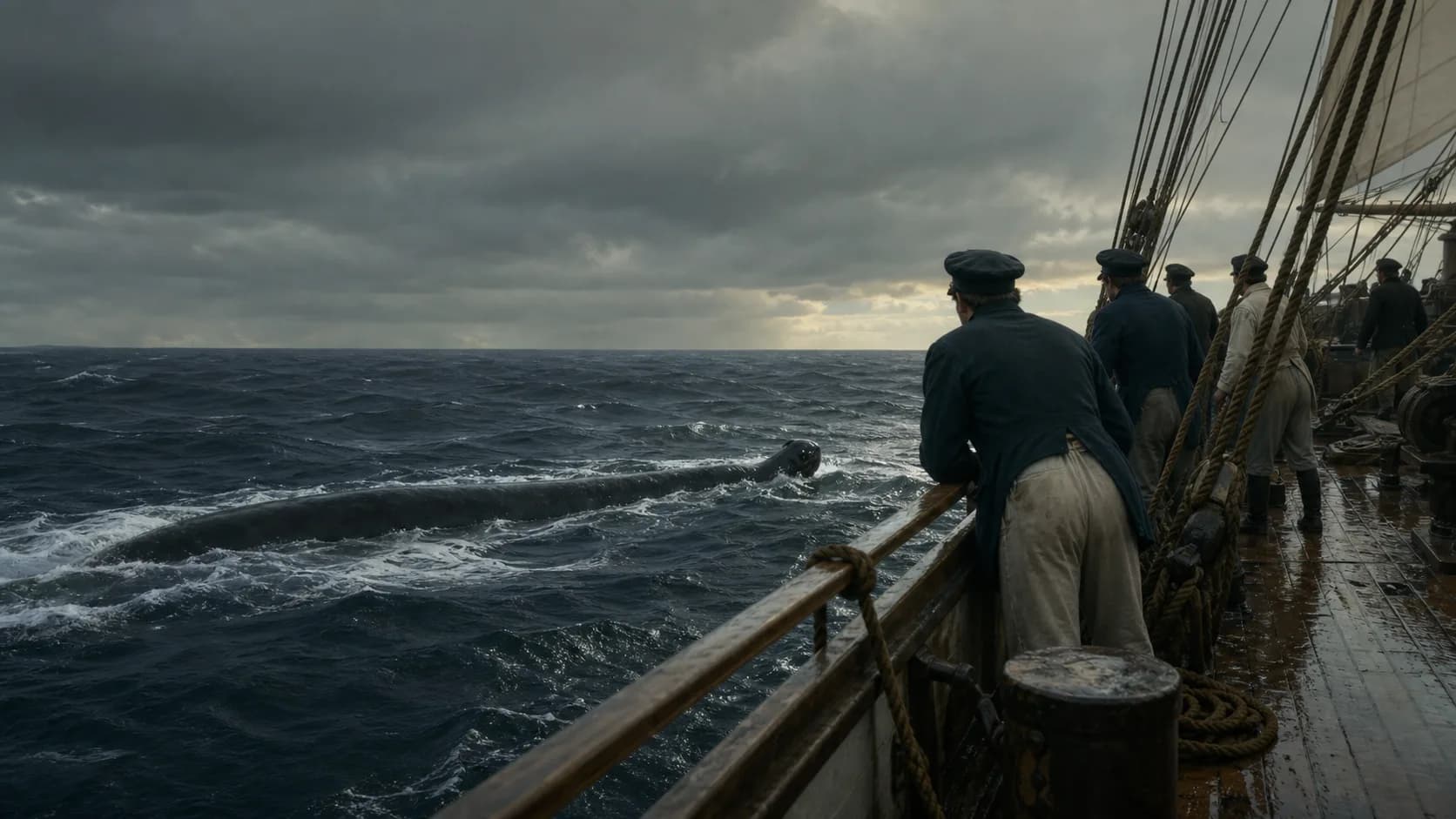
Large things at sea rarely lie before an observer like specimens on a table. A ship rises and falls; the witness moves with it. A head clears one swell, and the next moment only a dark back remains several boat-lengths away. The scene supplies no ruler and no view from above to show whether the gap contains one body, another animal or a succession of wind-driven waves. Length is often born after the eye has left the water.
That separates the sea-serpent tradition from Leviathan. Leviathan first possesses a name in ancient texts, while armor, smoke, flame and untamable strength change with the passage. The modern sea serpent begins as an encounter, then seeks a name through testimony, engraving, newspapers and natural history. One grows outward from a word; the other grows inward from a broken outline. Nineteenth-century art made the two increasingly similar without giving them a common origin.
In 1555, Norway's serpent became an omen for a kingdom
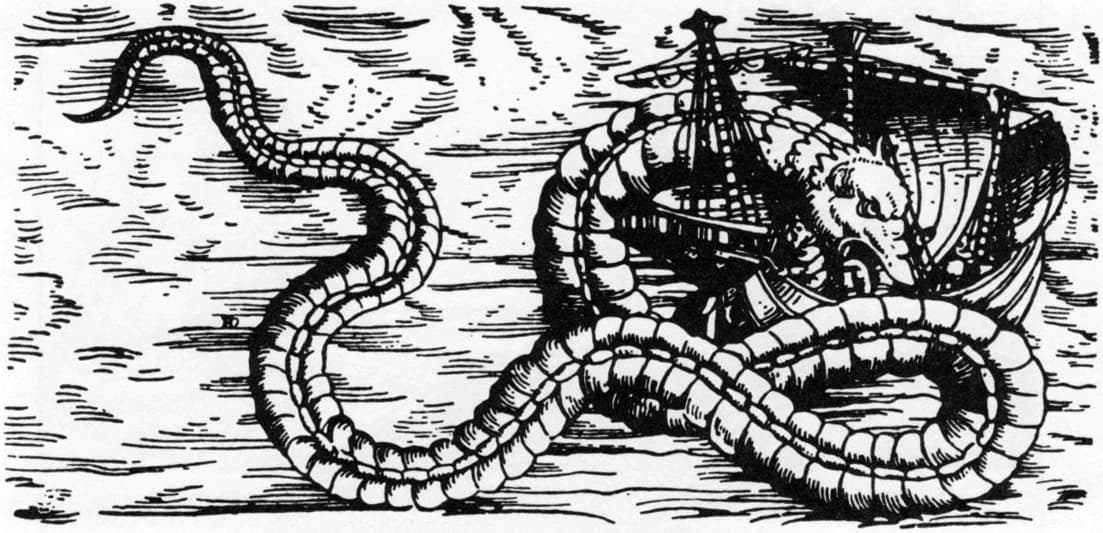
OLAUS MAGNUS · LIBER XXI · XLIII1555 ↗ The Norwegian serpent is more than two hundred feet long and twenty feet thick, dwelling among the rocks and caverns of the Bergen coast.
Writing in exile in Rome, Olaus Magnus made the north both tangible and remote in his History of the Northern Peoples. Merchants and fishermen along the Bergen coast, he said, agreed that a serpent more than two hundred feet long and twenty feet thick lived among the rocks and caverns. On bright summer nights it emerged to eat calves, lambs and pigs, or crossed the sea in search of octopus, lobster and crab. Cubit-long hair hung from its neck; its black scales were sharp and its eyes burned red.
The coiled body beside a ship is what survives most vividly in the woodcut. In Olaus's text, however, the creature also carries time: after its appearance a prince will die or go into exile, or war will follow. Animal, report and political omen occupy the same page. The serpent inhabits the kingdom's fear of upheaval as fully as it inhabits the water. Two hundred feet is less a surveyed dimension than a scale large enough to engulf order.
In 1734, something unclassifiable rose off Greenland
HANS EGEDE · A DESCRIPTION OF GREENLAND1734 ↗ It raised its head as high as the main-top; its body was as bulky as the ship and three or four times as long.
Hans Egede recorded that a ship bound for the Greenland colony saw a terrible marine creature at latitude 64 degrees in 1734. Its head rose as high as the mainmast; its body was bulkier than the vessel and seemingly three or four times as long. A long pointed snout spouted like a whale, while broad appendages or fins projected from the body. Strangest was the tail: after the bulky trunk had passed, a serpentine underside appeared again a whole ship's length away.
This is not a clean description of a snake. A whale's spout, a finned trunk, a shell-like rough surface and a serpentine lower body collide in one encounter. Later artists could smooth those contradictions into one continuous and recognisable silhouette. The original words preserve something more forceful and unstable: it resembles several animals, but no one anatomy gathers all its parts.
In 1817, Gloucester brought a monster to the affidavit table
LINNÆAN SOCIETY OF NEW ENGLAND · REPORT1817 ↗ Every witness was examined separately and was not informed what others had stated.
After repeated sightings outside Gloucester Harbor, Massachusetts, in August 1817, the Linnaean Society of New England did more than collect a marvel. Its committee questioned witnesses separately and did not tell them what others had said. Each statement was written down, read back, signed and sworn before a magistrate. A schedule of twenty-five questions pressed on distance and light, direction and motion, horizontal or vertical bends, then head, eyes, mouth, gills, fins, mane, tail and sound.
The procedure did not produce a single portrait. Amos Story saw only ten or twelve feet at close range, then at least fifty feet on another day. Solomon Allen estimated eighty or ninety feet and about fifty rough 'joints' or bunches. James Mansfield supplied forty to sixty feet. Seventeen-year-old John Johnston rowed almost within reach at dusk and instead saw a straight body without protuberances. Each may have reported honestly; they did not report the same picture.
How a string of buoys became a hundred-foot body
The Gloucester evidence repeatedly evokes a string of buoys: ten, thirty, even fifty dark humps arranged upon the surface. Witnesses compared them with barrels, masts, vessels and harbor distances; the committee converted those fragments into forty, seventy or one hundred and twenty feet. But a questionnaire could not reveal whether the hidden intervals contained one flexing spine, several animals or waves breaking in succession. The serpent acquired most of its length inside the gaps that nobody saw.
The committee soon received a small snake killed near shore. Its bent spine gave the body a row of knot-like humps. Naturalists erected a new genus and species, Scoliophis atlanticus, and suggested it might be the great serpent's young. It was later recognised as an ordinary land snake with a deformed spine. The mistake does not make the whole inquiry absurd. It reveals the moving danger of early natural history: investigators had learned to interrogate testimony with care, yet a specimen that matched expectation could still carry them too far.
In 1848, the serpent passed beside a Royal Navy ship
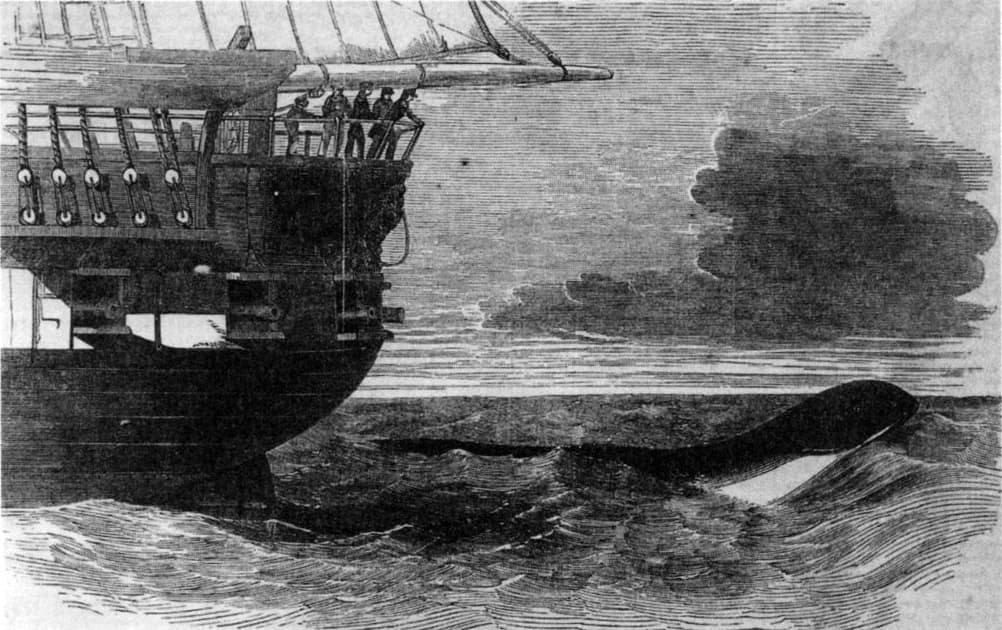
CAPTAIN PETER M'QUHAE · ADMIRALTY REPORT1848 ↗ Had it been a man of my acquaintance, I should easily have recognised his features with the naked eye.
At five in the afternoon on 6 August 1848, HMS Daedalus was crossing the South Atlantic. Captain Peter M'Quhae's official report to the Admiralty supplied a position—24°44′ south, 9°22′ east—as well as cloud, a fresh north-westerly wind and a long south-westerly swell. A dark elongated object remained in view for roughly twenty minutes. Its head and shoulders stood about four feet clear of the sea, some sixty feet of body was visible, and several officers watched it pass close alongside. The captain believed much more remained submerged.
A Royal Navy captain, coordinates and instrumental language gave the old story new authority. The Illustrated London News soon gave readers a complete, smooth serpent moving with its head held high. Anatomist Richard Owen proposed a seal; M'Quhae publicly defended his judgement. Their exchange left no decisive identification. What survives is a collision between two ways of seeing: officers on deck believed proximity guaranteed recognition, while a naturalist looked through words and pictures for a skeleton that could exist.
The oarfish gave the legend a real and alien skeleton
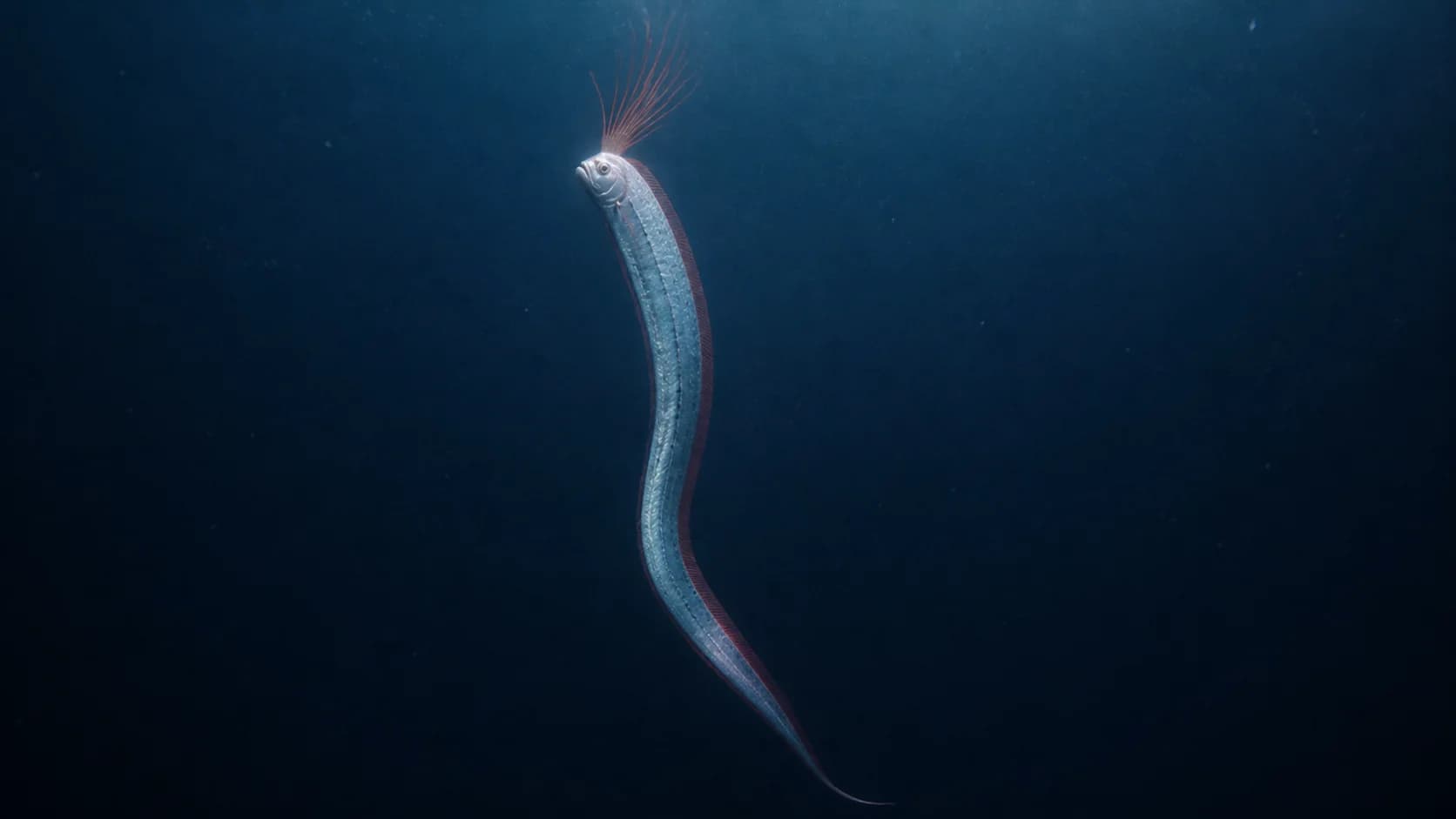
Among the animals summoned to explain sea serpents, the giant oarfish looks most like an answer swimming out of an old engraving. It is the longest living bony fish. Its silver body is thin as a ribbon, red crest rays rise above the head, and a continuous dorsal fin ripples along its length. It usually inhabits depths of about 200 to 1,000 metres, making a living animal at the surface an exceptional sight. When stressed or injured it may swim on its side, its undulation producing a bright, wavering ridge at a distance.
It cannot carry every feature witnesses supplied: Egede's spout and broad fins, Gloucester's ranks of humps and the Daedalus creature's persistently raised head do not settle naturally into one oarfish. Whales, seals, decomposed basking sharks, driftwood, wave trains and other large fish can each account for other pieces. The sea-serpent tradition's closest approach to a natural-history answer may therefore be plural—many real encounters returning to shore under one familiar name.
Its most epic dimension has always remained underwater
For centuries the sea serpent has been shortened to a misidentification, then has recovered its length beyond the next swell. Its endurance does not depend simply on refusing evidence. The ocean cuts evidence into pieces: the eye is pressed against the horizon, waves conceal the trunk, speed erases scale, and memory compresses alarm into a sentence that can be repeated ashore. Each age brought better instruments to the rail—woodcut, questionnaire, affidavit, coordinate and camera—and the surface still returned only a portion.
The serpent's great scene is therefore not an attack, but the moment it passes calmly beside a ship and every face turns. One person sees a head, another a back, another only black intervals among waves. By the time they reach paper, a body longer than the vessel has formed. It swims not through one ocean but along the narrow route between the known and the unknown. Humanity measured the sixty feet above water. Depth preserved the epic remainder.
After the wave closes, the testimony remains
01Are the sea serpent and Leviathan the same monster?+
Their later images often share a serpentine outline, but their traditions differ. Leviathan is a named figure with symbolic roles in ancient texts; the modern sea serpent was assembled largely from scattered sightings, news reports and natural-history debate.
02Which historical sea-serpent sighting became the most famous?+
The 1848 HMS Daedalus report became especially influential because its captain submitted time, position, weather, distance and visible length to the Admiralty, after which the Illustrated London News published a famous engraving.
03Did witnesses in the Gloucester inquiry really swear affidavits?+
Yes. The 1817 committee interviewed them separately, wrote and read back their accounts, obtained signatures and had the statements sworn before a magistrate. It also used a schedule of twenty-five questions.
04What was Scoliophis atlanticus?+
It was a genus and species erected from a small land snake with a bent spine in 1817. Investigators briefly connected it with the great marine serpent; that identification was later abandoned.
05Was the legendary sea serpent actually an oarfish?+
An oarfish's length, ribbon-like body and rare appearances at the surface can explain some reports. Spouting, broad limbs, multiple humps and other features call for different animals or sea conditions.
06Why did witnesses describe sea serpents as so long?+
Vessel and animal were both moving, while waves repeatedly concealed the body. Observers joined a head, several humps and distant wave crests, then estimated the whole with boat lengths, barrels or harbor distances.
07Did Olaus Magnus really describe a two-hundred-foot serpent?+
Yes. Book XXI, chapter 43 of his 1555 History of the Northern Peoples describes a Norwegian serpent more than two hundred feet long and twenty feet thick, whose appearance foretold political upheaval.
08Why take old sea-serpent reports seriously today?+
They preserve both genuine observation under difficult conditions and the processes by which testimony, natural-history classification, news illustration and cultural expectation together constructed an animal.
Follow every wave back to its record
- 01Historia de gentibus septentrionalibus (1555), Liber XXI, Cap. XLIIIProject Runeberg
- 02The Great Sea-Serpent — Olaus Magnus translationProject Gutenberg
- 03A Description of Greenland (1745), pp. 87–89Wikisource · Internet Archive
- 04Report of a Committee of the Linnaean Society of New England (1817)Internet Archive · Wikimedia Commons
- 05The Cape Ann Sea Serpent of 1817Cape Ann Museum
- 06The Great American Sea SerpentLibrary of Congress · Folklife Today
- 07The Great Sea Serpent — H.M.S. Daedalus wood engraving (1848)Library of Congress
- 08Captain M'Quhae's official report of the Daedalus sightingThe Zoologist · Sacred Texts Archive
- 09The Great Sea-Serpent, The Economist, 14 October 1848Internet Archive · The Economist Historical Archive
- 10Sea monsters: the legends and the real animals that inspired themNatural History Museum, London
- 11The Quest for the Sea Serpent: Oarfish or Folklore?Biodiversity Heritage Library
- 12Were nineteenth-century sea-serpent reports influenced by fossil discoveries?Historical Biology
Related signals
Along the same route
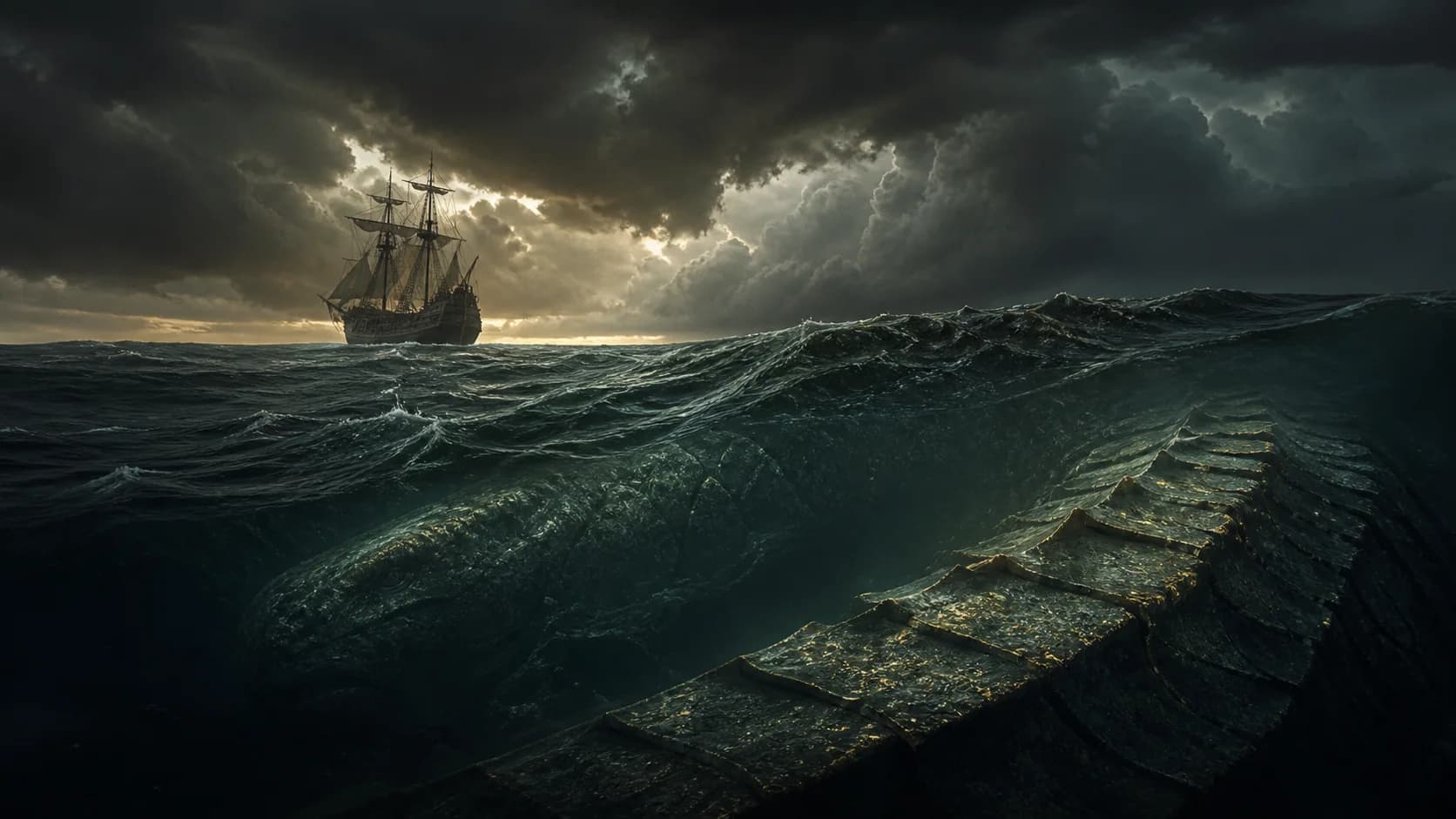 01
01Leviathan: the sea monster humanity could never hook
From the fishhook challenge in Job to a monster both shattered and playful in the Psalms: why did Leviathan acquire no fixed body, yet become the sea's most enduring name for the unknown?
Continue along the route ↗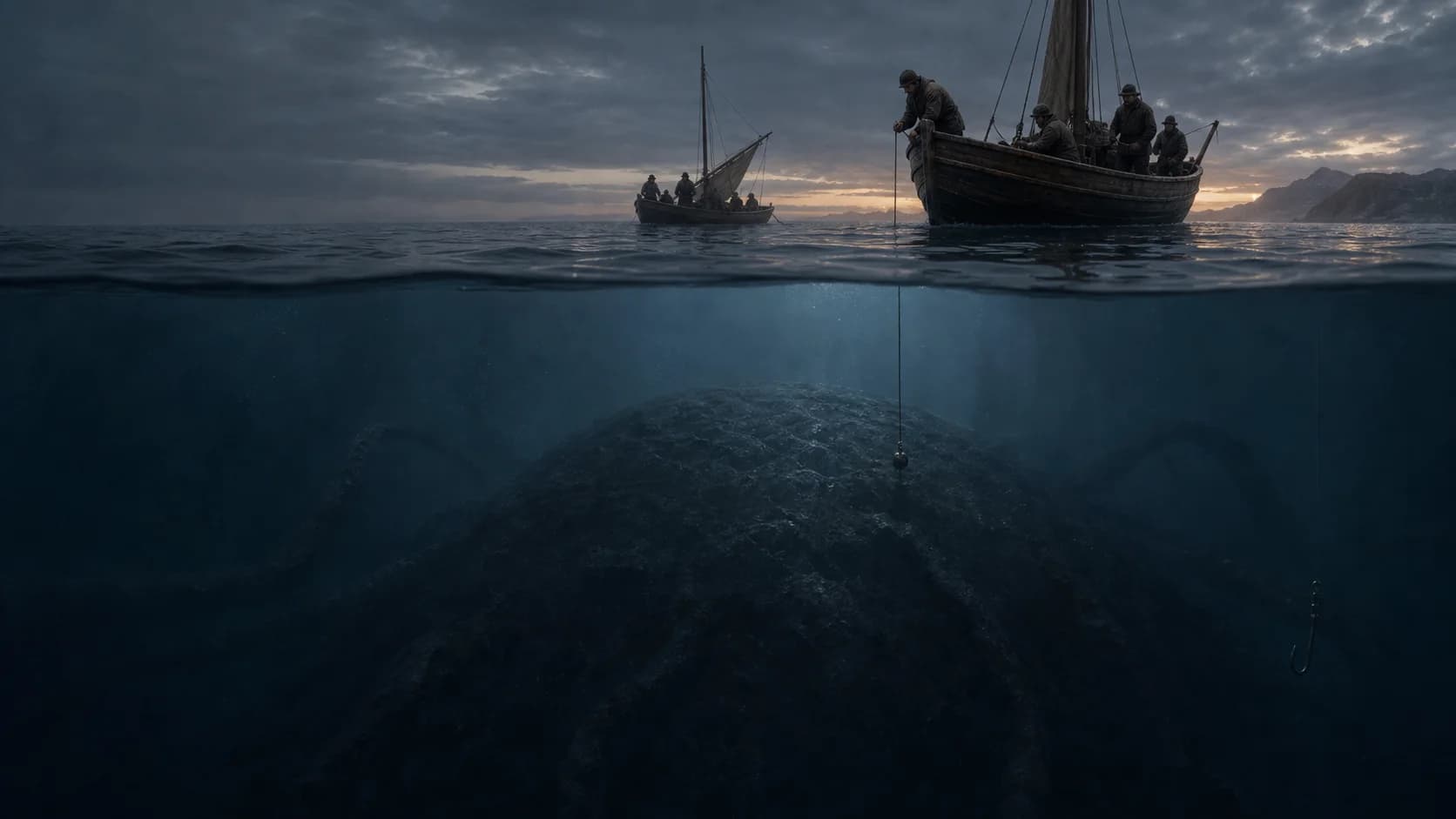 02
02Kraken and Leviathan: the seabed rises, the fishhook fails
From the hafgufa of The King’s Mirror and Pontoppidan’s sounding lead to Job’s fishhook, Montfort’s octopus and Tennyson’s sleeping deep: how Kraken and Leviathan became two different measures of the epic sea.
Continue along the route ↗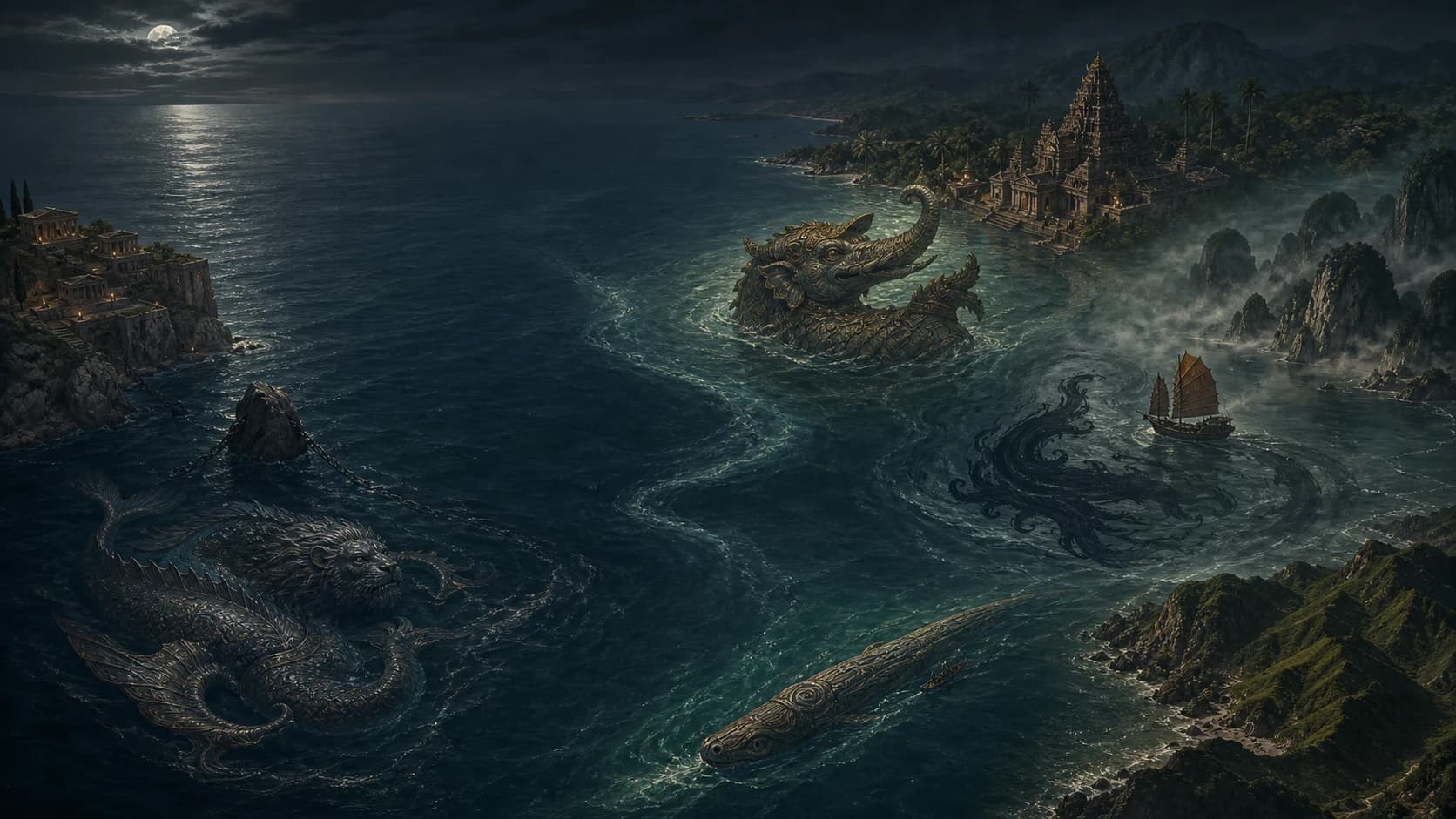 03
03Sea monsters of the world: every coast gives deep water a different verb
From the Greek ketos that consumes a sacrifice and the Indian makara that carries a water deity to China's Album of Sea Oddities, Hokusai, Māori taniwha and Mami Wata across the African Atlantic: monsters that demand, guard, guide and bestow.
Continue along the route ↗