 leviathan
SIX MEN, OR THE WHOLE SHIP.
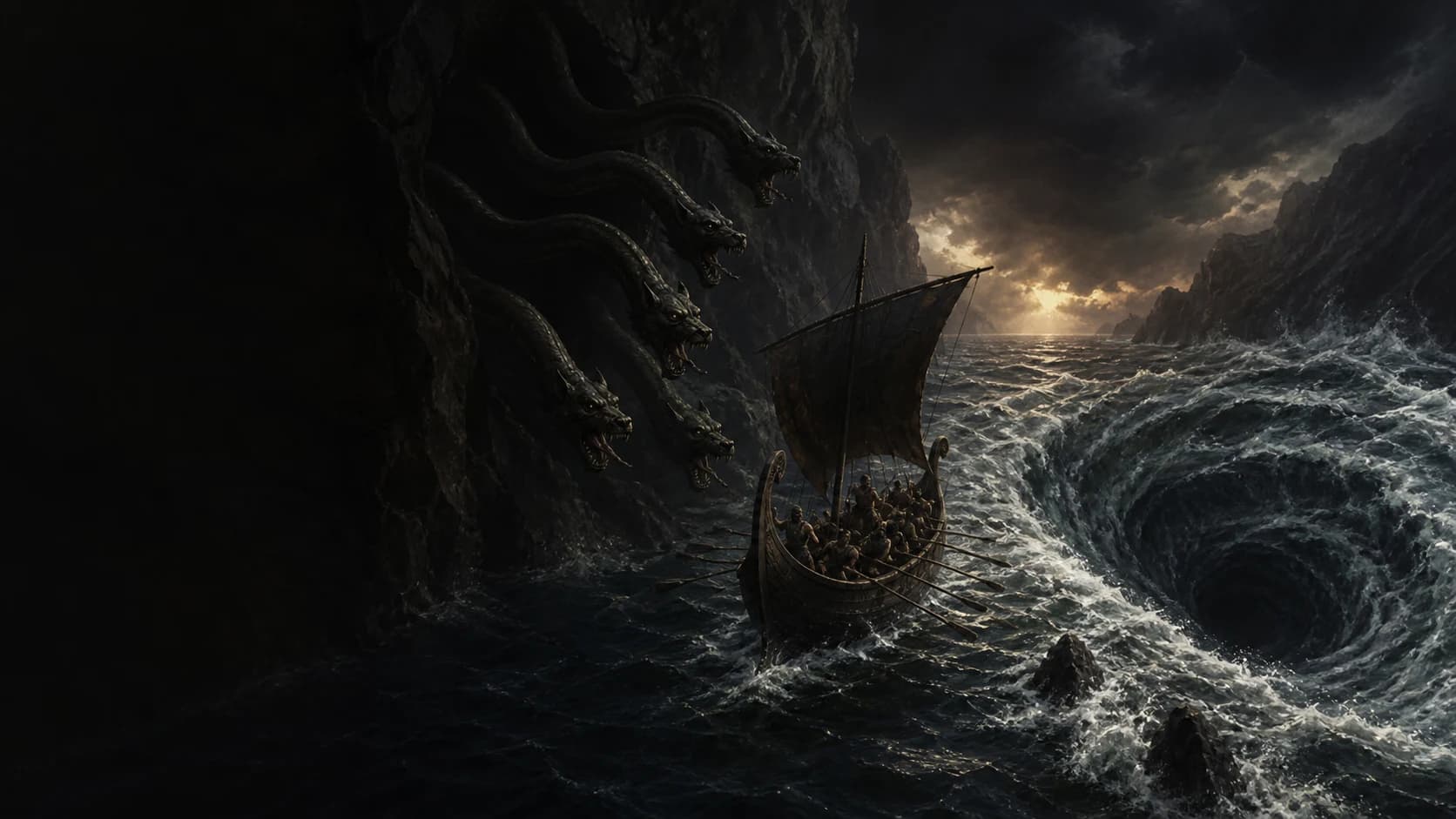
Scylla and Charybdis hold a ship between two destructions. Hug the cave and six-headed Scylla takes six men; sheer away and Charybdis swallows the whole company. Circe names the price in advance: six instead of all. On the first passage Odysseus hears his companions call his name from the air. Later he returns alone, clings like a bat beneath the fig tree, waits for Charybdis to release his mast and keel, then lets go at the only possible instant.
THE STRAIT DOES NOT ASK WHO CAN WIN. IT ASKS HOW MUCH YOU WILL LOSE.
SIX LONG NECKS SIX COMPANIONS
ONE SHIP THE WHOLE CREW
The cliffs stand no more than a bowshot apart
When Circe describes the channel, she first gives it a human measure. An arrow could cross between the rocks. Oars cannot calmly correct a course from one danger to the other, and a lookout has no time to understand one side before choosing against it. Scylla keeps a cave in the higher cliff. A great wild fig grows on the lower rock opposite, and beneath it Charybdis draws down the black water. There is no safe centre waiting to be found.
The later phrase ‘between Scylla and Charybdis’ makes the scene sound like two risks weighed at opposite ends of a scale. Homer's strait is harsher. Both dangers act at once and the vessel must keep moving. The hero cannot bring everyone through intact; he can only know the cost before arrival. The bowshot is not decorative geography. It is the amount of time left for choice.
Circe writes the passage as a brutal equation
ODYSSEY XII · 105–110PERSEUS ↗ Drive the ship hard past Scylla's rock. Better to miss six companions from the vessel than all your company together.ANCIENT GREEK SOURCEἀλλὰ μάλα Σκύλλης σκοπέλῳ πεπλημένος ὦκα
νῆα παρὲξ ἐλάαν, ἐπεὶ ἦ πολὺ φέρτερόν ἐστιν
ἓξ ἑτάρους ἐν νηὶ ποθήμεναι ἢ ἅμα πάντας.
Three times each day Charybdis casts the water up and three times sucks it down. If the ship meets her intake, not even earth-shaking Poseidon can save it. Circe orders Odysseus to drive hard along Scylla's rock. She promises no unharmed passage, only a cold comparison: better to miss six companions from the ship than to miss the entire company together.
Six is not an arbitrary toll. Six long necks reach from Scylla's cave, each head able to carry one man from the deck. The cost seems anatomically prepared. Odysseus still asks whether he can escape the whirlpool and arm himself against Scylla. Circe answers that this is no enemy who retreats from a spear. Delay for combat, and the six heads will make a second cast. Her first lesson is not courage. It is passage.
The monster on the left has six mouths; the monster on the right has no face
Scylla cries like a newborn puppy. She has twelve misshapen feet, six exceedingly long necks and three dense rows of teeth in every terrible head. Her middle remains hidden in the cavern while she fishes below for dolphins, dogfish and anything larger. When a vessel passes, its men become only another kind of prey lifted from the surface. Homer gives her a countable body: foot, neck, head and tooth approach the deck in order.
Charybdis is the opposite. She extends no hand and offers no face to look upon. Black sand appears at the centre when the water collapses; when the sea returns it boils like a cauldron over a great fire and throws foam above both cliffs. Scylla divides death into six seizures. Charybdis turns the entire sea into one act of swallowing. They share a channel without becoming mirror images.
The captain hides the fate of six men and lets the crew watch the whirlpool
Before the narrows, Odysseus tells the oarsmen to keep away from smoke and surf and pull close beneath the cliff. He does not tell them Scylla waits above. Homer gives the reason precisely: if they know what will descend, terror may stop their rowing and send them huddling into the hold. To preserve the speed of the whole ship, the captain removes one danger from common knowledge.
He nevertheless puts on armour, takes two spears and goes to the foredeck, ignoring Circe's command not to arm. He searches the misted rock until his eyes ache and still cannot see Scylla first. The hero's familiar posture—arm, sight, engage—has become a preparation that arrives too late. What preserves life is the rhythm of oars falling together while their rowers do not yet know the price.
The last thing they call is the name Odysseus
ODYSSEY XII · 245–250 / 258–259PERSEUS ↗ Scylla took six companions from the hollow ship—the strongest in hand and might. From above they called me, each by name, for the last time.ANCIENT GREEK SOURCEτόφρα δέ μοι Σκύλλη γλαφυρῆς ἐκ νηὸς ἑταίρους
ἓξ ἕλεθ᾽, οἳ χερσίν τε βίηφί τε φέρτατοι ἦσαν.
… ἐμὲ δὲ φθέγγοντο καλεῦντες
ἐξονομακλήδην, τότε γ᾽ ὕστατον, ἀχνύμενοι κῆρ.
οἴκτιστον δὴ κεῖνο ἐμοῖς ἴδον ὀφθαλμοῖσι πάντων.
Every face turns toward Charybdis. The water drops, the black floor shows and the crew go pale. In that instant Scylla takes the six strongest men from the other side. When Odysseus looks back, he sees hands and feet already hanging above him; then he hears each man call his name for the last time. This is not an anonymous battle cry. It is a final appeal directed at the captain who remains on the deck.
Homer compares them to fish flung writhing toward shore. Scylla lifts all six to her doorway and eats them as they scream and reach down. Odysseus calls it the most pitiful sight his eyes endured while searching the pathways of the sea. The vessel survives. Circe's calculation proves exact. Yet a correct decision in seamanship leaves six hands forever beyond reach.
At the centre of a wine cup, Scylla becomes woman, hounds and sea-dragon
Classical art gives Scylla a body made for frontal encounter. A late fifth-century BCE gilt-silver cup at The Met places her on its tondo: a young woman's upper body catches the wind; three savage hounds spring from her waist among scales, and one extremity becomes a ketos. She raises a broken steering oar while the dogs snap at fish around her.
Each time a drinker lifts the cup, Scylla appears through the receding wine. She is no longer only an unseen strike from a cliff. A golden laurel frames a beautiful threat that returns the viewer's gaze. Three dogs do not copy Homer's six heads, but the broken rudder carries an entire wreck into the image. She has met a ship already and retained a trophy from it.
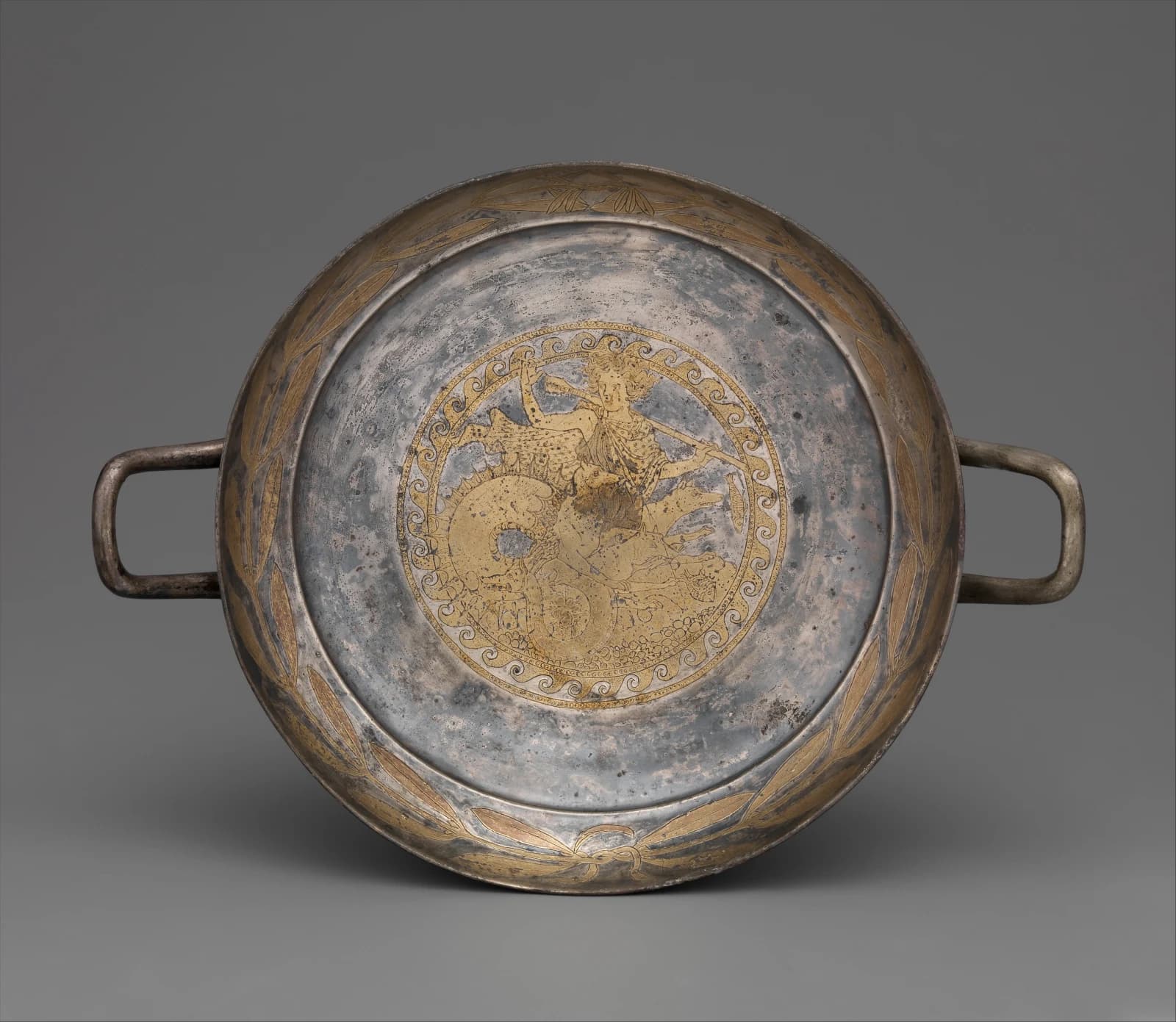
Woman, three hounds, sea-dragon and broken rudder compressed into one silver centre.
THE MET · OPEN ACCESS ↗Another heroic ship is passed over the waves like a ball
The Argonautica brings another generation of heroes among Scylla, Charybdis and the Wandering Rocks. Hera fears that Charybdis will gulp down the Argo, or Scylla select the greatest of its heroes. She summons Thetis and the Nereids. Sea-nymphs take stations among rock and breaker while Thetis lays a hand on the steering blade. Human judgement no longer bears the passage alone.
Apollonius chooses a startlingly bright simile. Girls on a beach lift their skirts and toss a round ball from hand to hand; the Nereids send the Argo in the same way, high through the air above the surge and always clear of rock. Odysseus pays six lives for passage. The Argo is carried through by divine hands. Two epics allot two fates to the same dangerous sea.
Aeneas rounds Sicily and turns courage into a long way round
AENEID III · 420–425PERSEUS ↗ Scylla holds the right; relentless Charybdis the left. She draws vast waves into the abyss, then raises them again and strikes the stars with water.LATIN SOURCEdextrum Scylla latus, laevum implacata Charybdis
obsidet, atque imo barathri ter gurgite vastos
sorbet in abruptum fluctus rursusque sub auras
erigit alternos et sidera verberat unda.
Book 3 of the Aeneid opens the strait again. Scylla holds the right and relentless Charybdis the left: one drags ships from a dark cave onto rock, the other draws huge waves into an abyss and strikes the stars with their return. The prophet Helenus gives Aeneas a different route—circle the distant Sicilian headlands rather than look upon the cave echoing with sea-dogs.
Aeneas's fleet still hears the water and is raised three times toward heaven, then dropped three times toward the depths. Palinurus turns at once; oars and sails work together to leave. The epic act is the preservation of a people, not closeness to danger as proof. Virgil gives the later dilemma a third motion: when the chart allows it, the courageous course may be a very long arc.
The real strait reverses direction about every six hours
The Strait of Messina runs about thirty-three kilometres between mainland Italy and Sicily. At the northern narrows it contracts to roughly 3.15 kilometres, while the seabed rises into an 80–120 metre sill and then falls rapidly toward kilometre-deep water in the south. The semidiurnal tides of the Tyrrhenian and Ionian basins are almost out of phase. Water runs through the throat toward one basin, then reverses about six hours later.
A University of Messina synthesis records currents reaching 1.85 metres per second at spring tides and exceeding two metres per second when wind and density flow are added. A short slack precedes reversal; then a bubbling shear line, locally called the taglio, crosses the strait. For a low ancient vessel driven by oar and sail, back-currents, sudden depth change and local eddies could make the surface appear wilful. Scylla and Charybdis place those forces in cave and deep, giving a difficult waterway two names that can be remembered.
On the second passage, he no longer has a ship
ODYSSEY XII · 431–444PERSEUS ↗ I sprang to the tall fig tree and clung like a bat. I held on until she returned mast and keel; when the timbers appeared, I released hands and feet, sat upon them, and rowed with my own hands.ANCIENT GREEK SOURCEαὐτὰρ ἐγὼ ποτὶ μακρὸν ἐρινεὸν ὑψόσ᾽ ἀερθείς,
τῷ προσφὺς ἐχόμην ὡς νυκτερίς.
… νωλεμέως δ᾽ ἐχόμην, ὄφρ᾽ ἐξεμέσειεν ὀπίσσω
ἱστὸν καὶ τρόπιν αὖτις.
… ἑζόμενος δ᾽ ἐπὶ τοῖσι διήρεσα χερσὶν ἐμῇσι.
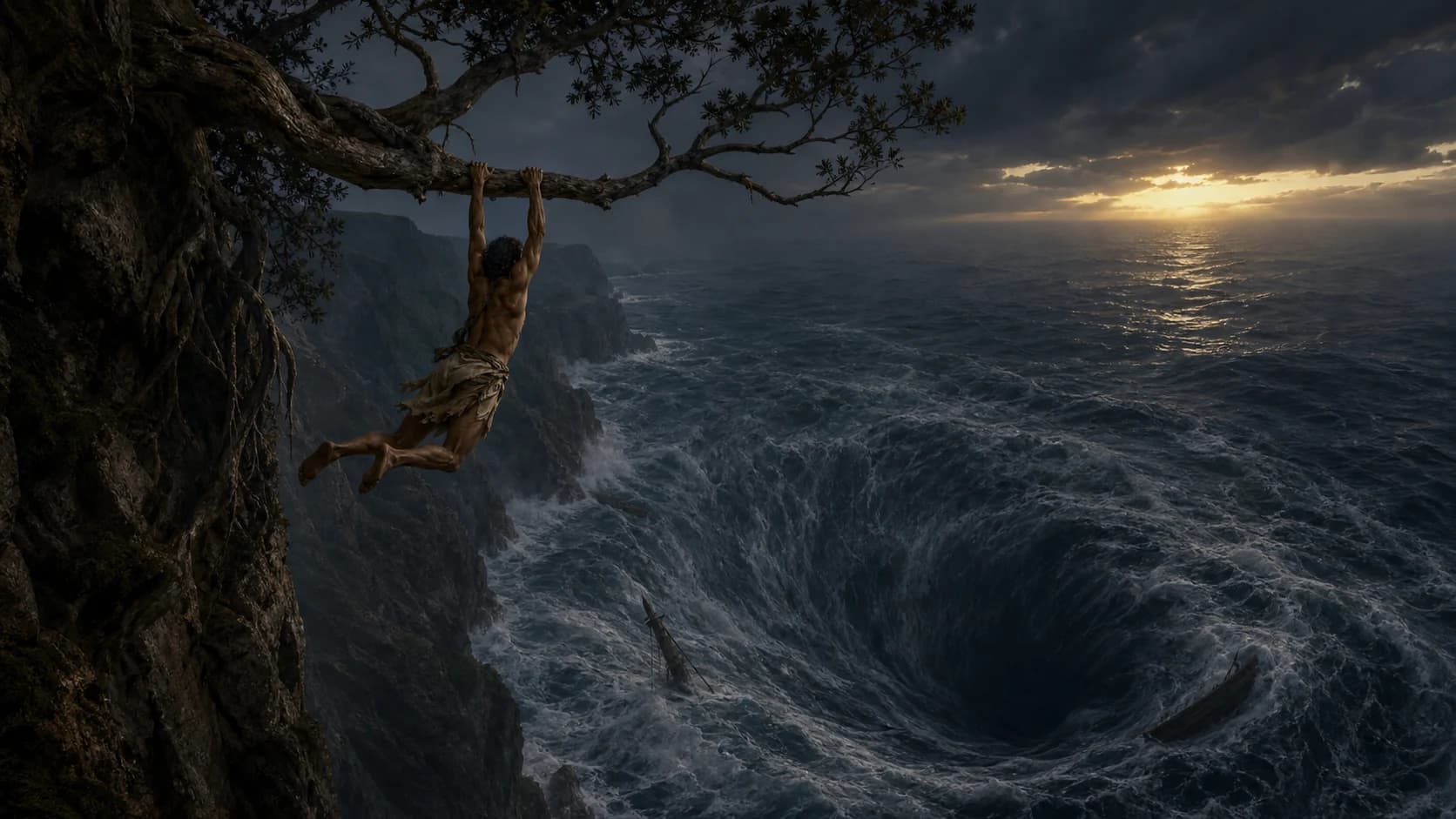
After the strait, the crew kill the cattle of Helios and Zeus destroys the ship with a thunderbolt. Every companion dies. Odysseus lashes the scattered mast to the keel as a raft, and a south wind carries him back to Charybdis through the night. At sunrise the sea begins to drain. A wave raises him toward the fig tree Circe described. He catches its branch and hangs like a bat. His feet find no hold, the roots lie far below, and the great upper boughs remain beyond reach.
So he waits. Charybdis has swallowed mast and keel; the delay lasts as long as a judge settling a full day of disputes before rising for supper. When the two timbers reappear, Odysseus releases hands and feet, drops beyond them into the sea, climbs aboard and rows with his palms. On his first passage he was an armoured captain who exchanged six men for a ship. On the second he has no spear, oarsmen, rudder or deck—only two hands near the end of their strength. He kills no monster. When the sea returns its last two objects, he makes himself a course again.
Questions left by the strait
01What are Scylla and Charybdis?+
In Odyssey 12, Scylla is a six-headed creature in a high cliff cave who takes one sailor per head. Charybdis is the gulf beneath the opposite rock that swallows and returns the sea and can consume an entire ship.
02Why does Odysseus choose Scylla's side?+
Circe judges that Scylla will cost six companions, while Charybdis can destroy the ship and everyone aboard. She tells him to hug Scylla's cliff and drive past at speed.
03Does Odysseus warn the crew about Scylla?+
No. He warns them away from Charybdis but suppresses Scylla, fearing that the oarsmen will stop and hide in the hold if they know.
04Why is Scylla often shown as a woman with dogs at her waist?+
Classical art developed a visual form distinct from Homer's long-necked six heads: a female torso above fish or serpent parts, with dogs emerging from the waist. The Met's late fifth-century silver cup is a major example.
05Does the Argo pass Scylla and Charybdis too?+
The Argonautica brings the Argo among these dangers. At Hera's command, Thetis and the Nereids carry the ship through the waves like girls passing a ball.
06What does ‘between Scylla and Charybdis’ mean?+
It means caught between dangers where avoiding one approaches another. Homer's scene is not a neutral compromise: Circe explicitly chooses six deaths to prevent the loss of all.
07Is Charybdis a real whirlpool in the Strait of Messina?+
Ancient geographers associated the story with Messina, where opposing tidal flows, back-currents and local eddies are real. The poem gives those forces mythic scale and rhythm.
08How does Odysseus survive Charybdis the second time?+
He hangs from the fig tree over the whirlpool until Charybdis returns his swallowed mast and keel. He drops into the sea, climbs onto the timbers and paddles away with his hands.
Return to the sources along both cliffs
- 01Odyssey, Book 12 — Ancient Greek textPerseus Digital Library · Tufts University
- 02Odyssey, Book 12 — A. T. Murray translationPerseus Digital Library · Tufts University
- 03Argonautica, Book IV, lines 757–967Theoi Classical Texts Library · R. C. Seaton translation
- 04Gilt silver kylix with Scylla, late 5th century BCEThe Metropolitan Museum of Art · Open Access
- 05Dangerous Beauty: Medusa in Classical ArtThe Metropolitan Museum of Art Bulletin
- 06Scylla — collection biography and related objectsThe British Museum
- 07Aeneid, Book 3 — Latin textPerseus Digital Library · Tufts University
- 08Aeneid, Book 3 — Theodore C. Williams translationPerseus Digital Library · Tufts University
- 09Geography I.2 — reverse currents and Homeric watersStrabo · LacusCurtius, University of Chicago
- 10Geography VI.2 — Charybdis in the ship-channelStrabo · LacusCurtius, University of Chicago
- 11Lo Stretto di Messina: un ecosistema di upwelling peculiare nel MediterraneoUniversity of Messina Research Archive
- 12Capo Peloro — tides, opposing currents and garofaliRegione Siciliana · Cultural Heritage
- 13Bibliotheca, Epitome 7 — Scylla, Charybdis and the fig treePerseus Digital Library · Tufts University
Related signals
Along the same route
 01
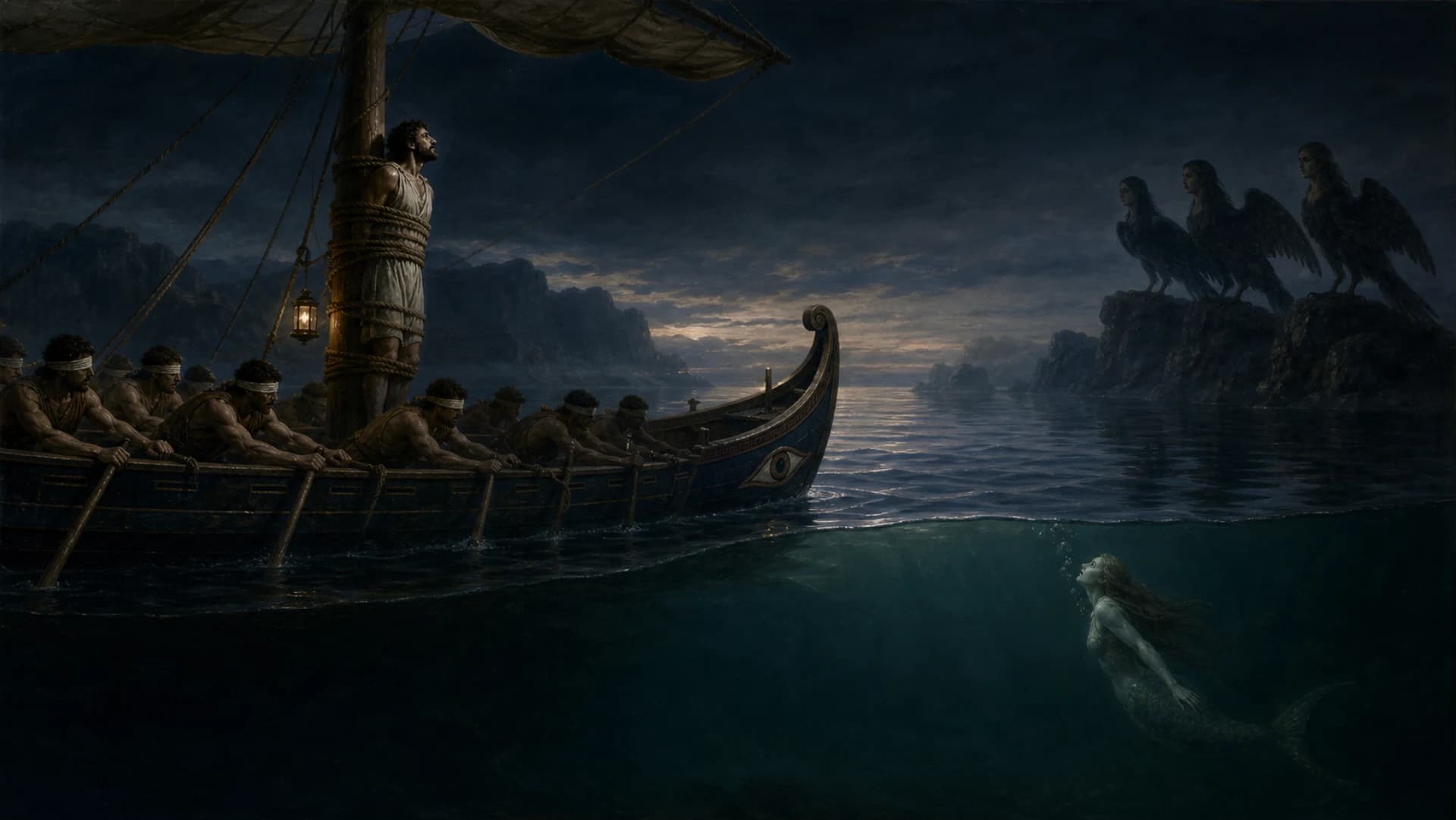
01Sirens and mermaids: one steals a course with song, one gives her song to the shore
From the bodiless fatal song in the Odyssey and the bird-bodied Siren of Greek art to the medieval fish tail, Columbus's three surface sightings and Andersen's tongueless Little Mermaid: two traditions meet through the price of a voice.
Continue along the route ↗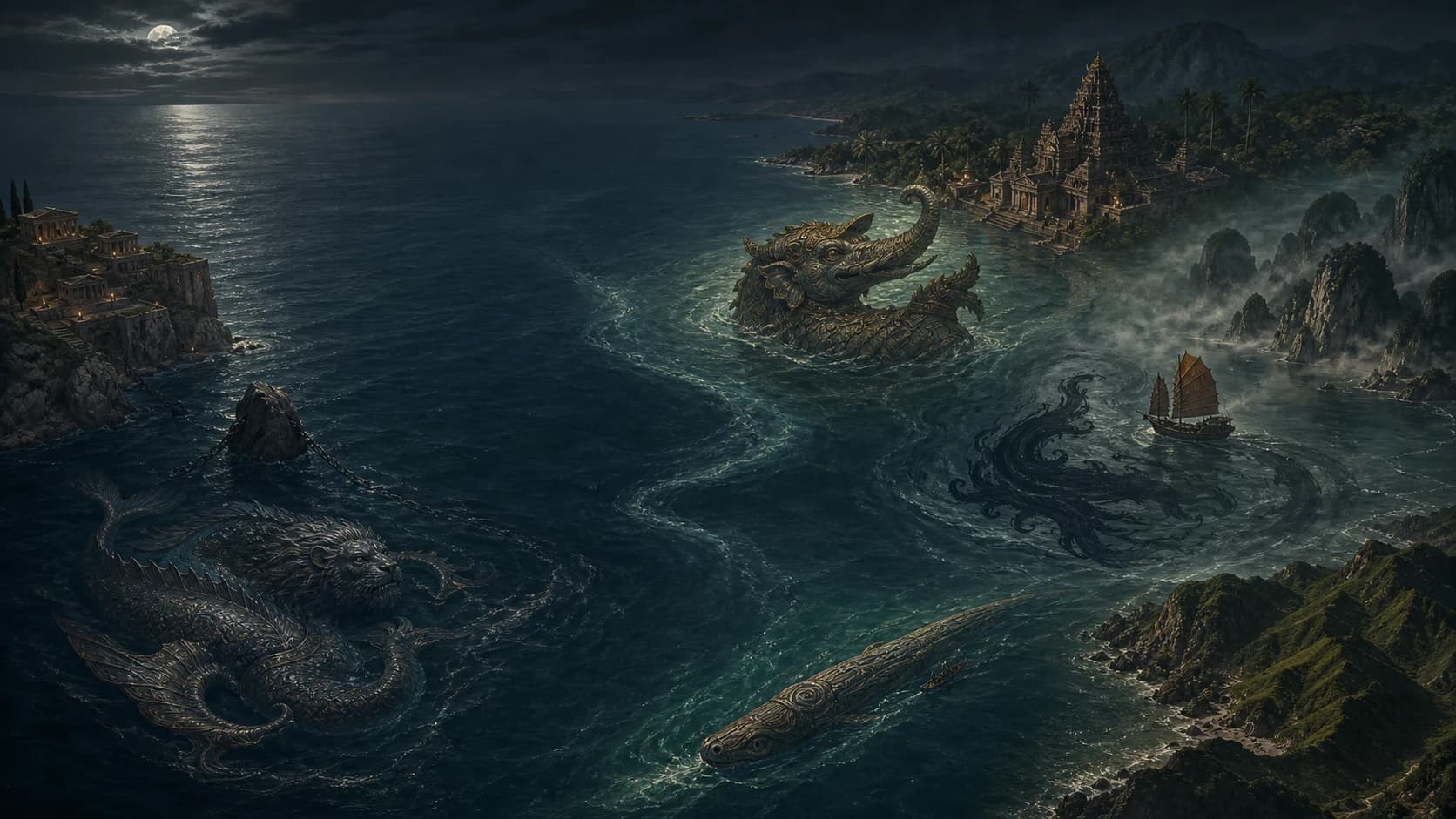 02
02Sea monsters of the world: every coast gives deep water a different verb
From the Greek ketos that consumes a sacrifice and the Indian makara that carries a water deity to China's Album of Sea Oddities, Hokusai, Māori taniwha and Mami Wata across the African Atlantic: monsters that demand, guard, guide and bestow.
Continue along the route ↗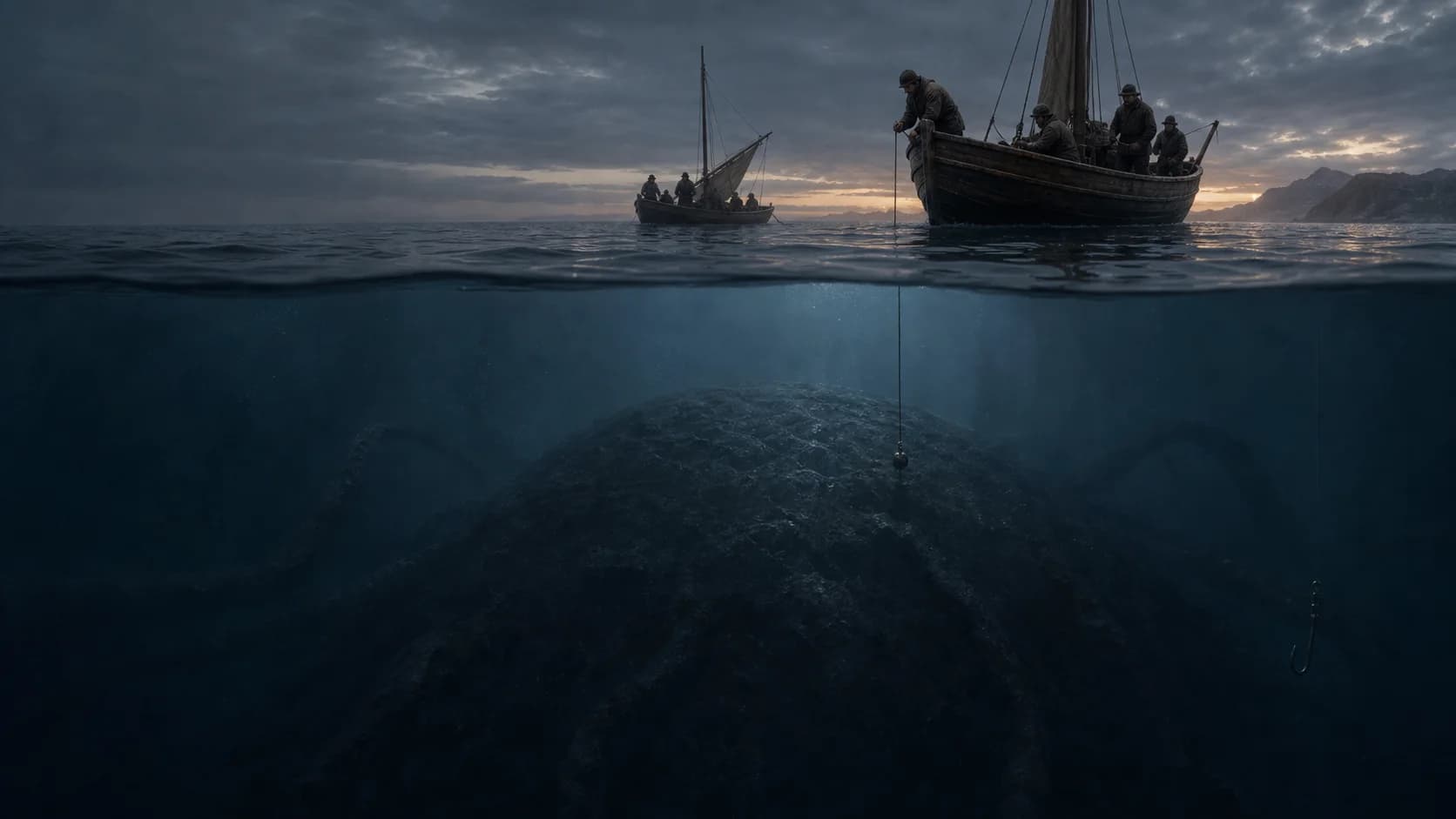 03
03Kraken and Leviathan: the seabed rises, the fishhook fails
From the hafgufa of The King’s Mirror and Pontoppidan’s sounding lead to Job’s fishhook, Montfort’s octopus and Tennyson’s sleeping deep: how Kraken and Leviathan became two different measures of the epic sea.
Continue along the route ↗