 leviathan
BEFORE THE TAIL, DANGER WAS A VOICE.
Homer gives his Sirens no fish tails—and no faces. He stills the wind and lets a song promise every secret of Troy. Greek artists later give that voice a woman's head and a raptor's body; medieval manuscripts bring wings and tails together. In 1837 Andersen reverses the current: the Little Mermaid surrenders her tongue for legs. Odysseus can hear but cannot move; she can move but cannot speak. The traditions meet in the price of a voice.
HOW A VOICE CROSSES WATER, GROWS A BODY, AND ENDS IN SILENCE.
The sea falls still before the song crosses the rail
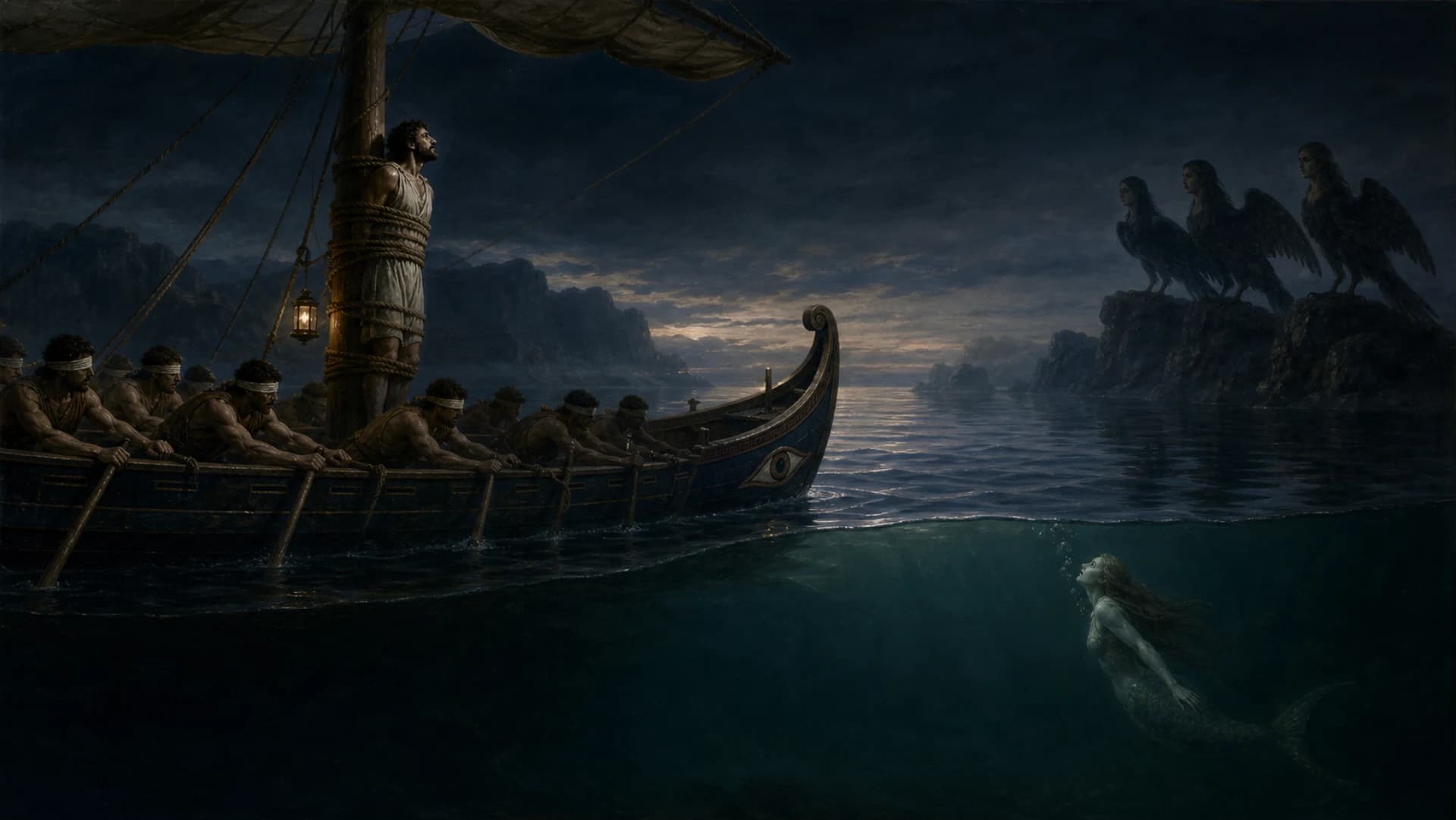
Book 12 of the Odyssey makes the danger almost weightless. As the ship nears the Sirens' island, the fair wind suddenly ceases and a god lulls the waves to sleep. The crew furls the sail, takes the oars and whitens the grey water with polished fir. Only when the vessel enters the reach of a human shout does the song begin. No immense body breaks the surface. The whole sea simply makes room for a voice.
That calm establishes the Sirens' scale. They need not pursue the ship or splinter its hull. The sailors must abandon their own course. The creature remains on its island while sound crosses the water, passes through discipline and homesickness, and reaches what each listener guards least securely. Tails, mirrors and flowing hair will later cover the scene, but the oldest power still inhabits this windless channel.
They promise not love, but everything that can be known after Troy
HOMER · ODYSSEY XII · 184–191PERSEUS ↗ Come, renowned Odysseus, great glory of the Achaeans. Stay your ship and hear our voice. Whoever listens leaves delighted—and knowing more.ANCIENT GREEK SOURCEδεῦρ᾽ ἄγ᾽ ἰών, πολύαιν᾽ Ὀδυσεῦ, μέγα κῦδος Ἀχαιῶν,
νῆα κατάστησον, ἵνα νωιτέρην ὄπ᾽ ἀκούσῃς.
… ἀλλ᾽ ὅ γε τερψάμενος νεῖται καὶ πλείονα εἰδώς.
The Sirens hail Odysseus as the great glory of the Achaeans and ask him to stop. Their bait then reveals its edge. Everyone who hears them, they claim, leaves delighted and knowing more. They know every suffering endured by Greek and Trojan under the gods at Troy; they know all that comes to pass on the fertile earth. For a man who survived by intelligence and spent ten years looking for his homeward route, omniscience is a more exact temptation than beauty.
The song turns his life into a battlefield he can look back upon whole. If he lands, he may learn the complete meaning of what he left at Troy—and lose every future, like the bones on the meadow whose flesh has not finished rotting. The Sirens offer an epic without an ending: the hero may hear his glory sung forever, while wife and child wait forever for him to bring the story home.
Wax closes every ear; rope preserves one man's hearing
Circe's solution reads like exact shipboard procedure. Odysseus cuts a great round cake of beeswax, works it warm with his palms and the sun, and seals each companion's ears. They bind his hands and feet, stand him upright in the mast-step and secure the rope ends to the mast. He alone keeps his hearing, and he alone gives up the power to act.
When the song reaches him, he commands release with his brows. Perimedes and Eurylochus do not argue with their captain; they rise, add more bonds and pull them tighter. The heroic act lies in that earlier self-knowledge. Odysseus admits that the future man who hears the song will betray the present order, and entrusts survival to those unable to hear his plea. Only beyond the song do wax and rope come away, and the restraint reveal itself as the thing that saved him.
Greek vessels give the unseen voice a woman's head and a raptor's body
Homer leaves a meadow, bones and sound, but no anatomy. Greek artists of the sixth century BCE filled that space from another visual tradition: a human head joined to a bird, wings extended, clawed feet gripping the edge of an object. A mid-sixth-century bowl at The Met carries Sirens with female faces and avian bodies around its rim. Other Archaic Sirens are bearded; their gender has not yet settled into one form.
By the fifth century BCE, the beard disappears and the Siren becomes more consistently female. She also enters funerary art, tearing her hair or beating her breast for the dead. Birds move between earth and sky, while song belongs to lament. To an ancient viewer the Siren could therefore carry both a predator's talons and a mourner's gesture. This body is not an illustration of Homer's lines. It is visual culture's separate answer to their disembodied voice.
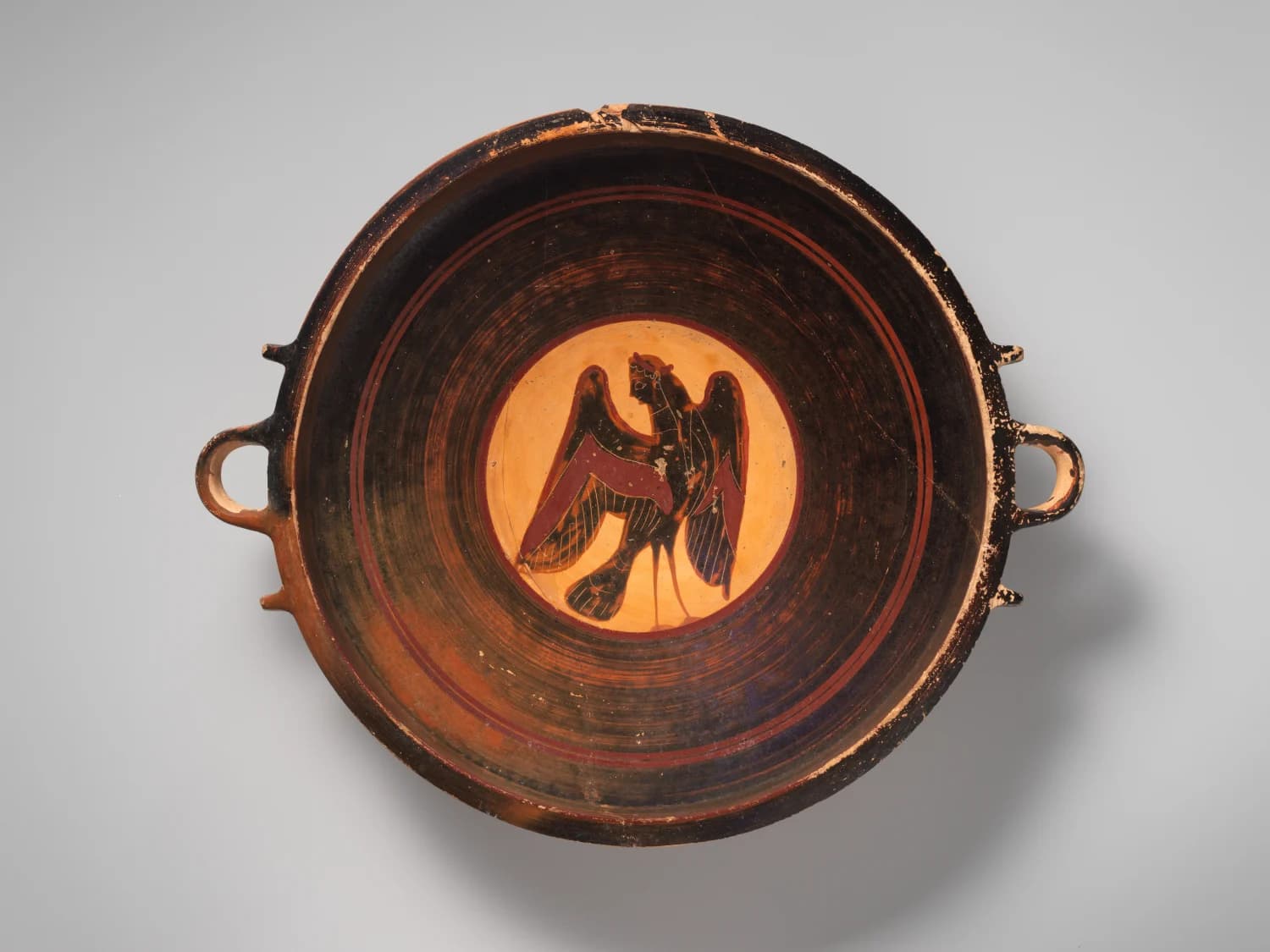
Greek terracotta lekane, mid-sixth century BCE. Sirens circle the vessel without a single fish tail.
THE MET · OPEN ACCESS ↗The Argo keeps its ears open, and Orpheus drives another song across the water
Book 4 of the Argonautica preserves another passage. Near Anthemoessa, the Sirens pour out a lily-like voice and the heroes prepare to cast hawsers ashore. Orpheus raises his Thracian lyre at once. A rapid, rippling melody fills their ears, overmasters the women's song, and lets west wind and following wave carry the Argo away.
Here silence does not defeat song; one song escorts a ship through another. The victory remains incomplete. Butes leaps from his rowing bench into the dark surge and swims toward the island. Aphrodite snatches him from the eddies and settles him in Sicily. Homer saves a crew through deafness and binding; Apollonius calls on music, wind and divine mercy. The Sirens appear greater for it: even with the finest singer on earth aboard, the heroes nearly lose a man.
On a medieval page, bird wing and fish tail meet over the same water
Medieval bestiaries inherit the fatal song and repeatedly redraw the lower body. The Worksop Bestiary, made about 1185–1210, gives three Sirens a composite anatomy of woman, bird and fish: wings remain, tails have appeared, and one holds the comb often associated with a mermaid. In the early fourteenth-century Queen Mary Psalter, the junction is explicit. One bird-bodied Siren and one fish-tailed Siren attack the sleeping men of a ship together.
No single year changes bird into fish. Talons, wings, one or two tails, mirrors, combs and instruments combine for centuries, while Latin names and European vernacular water-women draw closer in translation. The familiar fish-tailed Siren grows through copying, explanation and repainting. She inherits the danger of Greek song and the body of northern and European female water beings, like two currents converging in the margin of a parchment sea.
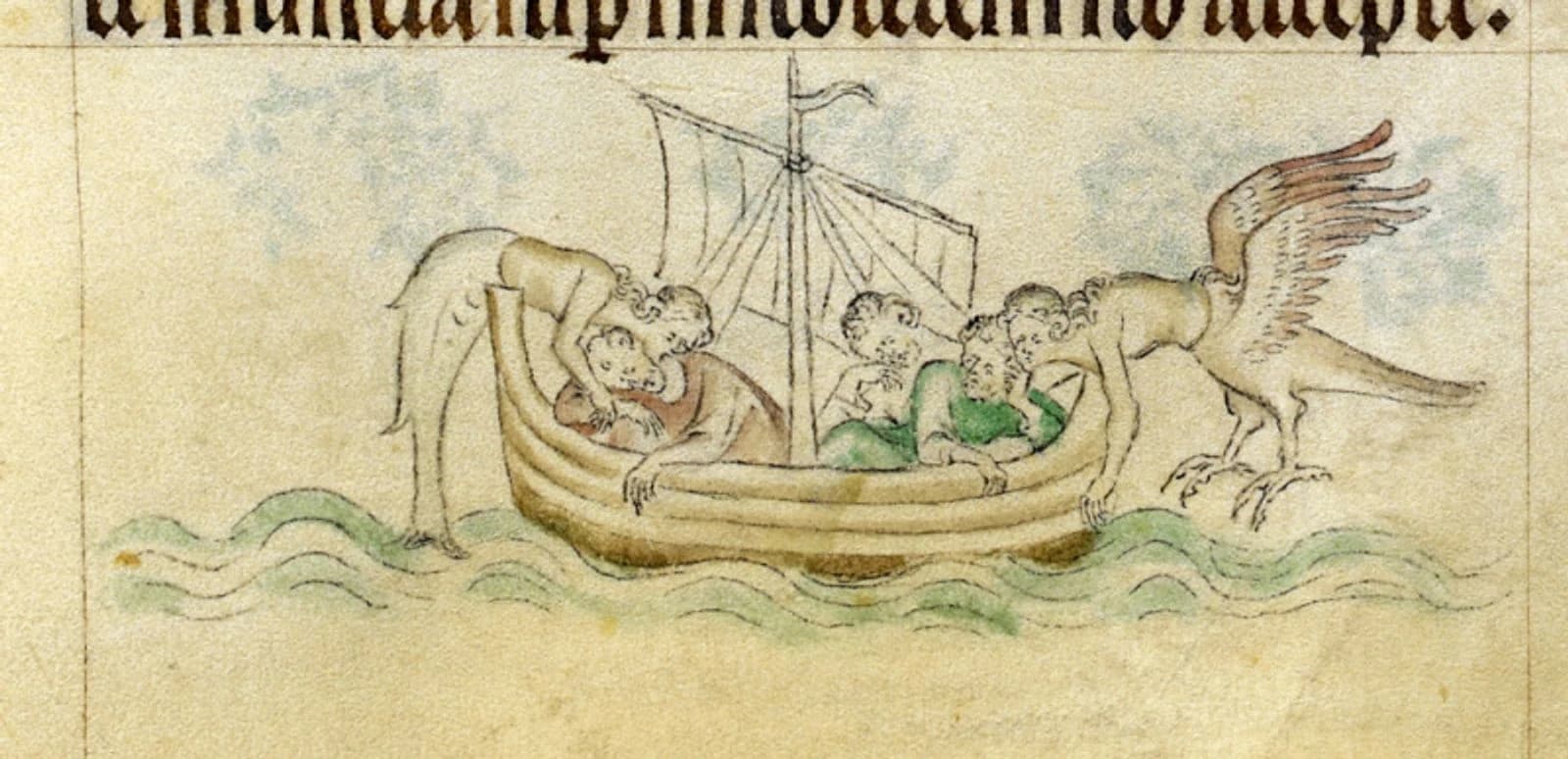
Bird-bodied and fish-tailed Sirens appear together. Convergence is more truthful than a neat evolutionary line.
BRITISH LIBRARY ↗In 1493 Columbus sees three faces rise from the water
DIARIO · 9 ENERO 1493INSTITUTO GEOGRÁFICO NACIONAL ↗ The previous day, near the Rio del Oro, the Admiral saw three Sirens rise high from the sea. They were not as beautiful as painted, though their faces were human in some degree.SPANISH SOURCEEl día pasado… dixo que vido tres serenas que salieron bien alto de la mar, pero no eran tan hermosas como las pintan, que en alguna manera tenían forma de hombre en la cara.
The journal abstract for 9 January 1493 reports that on the preceding day, near the Rio del Oro, Columbus saw three ‘sirens’ rise high from the sea. They were not as beautiful as painted, though their faces were human to some degree; he said he had seen others on the Guinea coast. Columbus's original log is lost. The words survive through Bartolomé de las Casas's abridgement of an earlier copy, giving the sighting both precision and the tide-marks of transmission.
Editors have long identified these animals as manatees. A manatee can raise and turn its head; its forelimbs contain finger-like bones, and the position of the female's mammary glands invites a human comparison at distance. Modern taxonomy still places manatees and dugongs in the order Sirenia. Yet the encounter deserves more than a joke about bad eyesight. Sailors reached unfamiliar waters carrying available names, and a remote body entered the outline of one. Natural history and legend surfaced together, each presenting half a recognisable face.
In 1837 Andersen makes a mermaid surrender the loveliest voice beneath the sea
H. C. ANDERSEN · DEN LILLE HAVFRUE · 1837H. C. ANDERSEN CENTRE ↗ You have the loveliest voice on the ocean floor. You must give it to me. For my potion, I will take the finest thing you possess.DANISH SOURCEDu har den deiligste Stemme af alle hernede paa Havets Bund… den Stemme skal du give mig. Det Bedste du eier vil jeg have for min kostelige Drik!
Andersen's Little Mermaid first appeared on 7 April 1837. After saving the prince, she seeks more than his love: she longs for the soul that survives a human death. The sea witch will turn her tail into legs, but warns that every step will feel like treading on blades. If the prince marries another, her heart will break the following morning and she will become sea foam. The potion requires one more price—the most beautiful voice on the ocean floor.
The witch tells her to extend her tongue and cuts it off. Now she can astonish the court by dancing, while pain passes through every footfall. She saved the prince and knows who actually found him on the shore, yet cannot tell him her name or deed. The Sirens' voices take a sailor from his return. Andersen's mermaid gives away her voice to reach the land. Her tail no longer identifies a body that traps mariners. It marks a home she has chosen to leave.
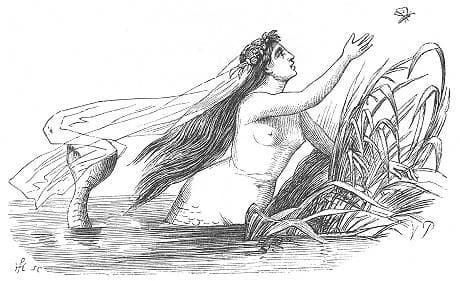
No pose of maritime predation—only someone in the sea looking toward land.
PUBLIC DOMAIN ↗The knife falls into the sea; she will become foam before reclaiming her tail
H. C. ANDERSEN · THE KNIFE / THE FOAMFULL TEXT ↗ She flung the knife far out into the waves; the water gleamed red where it fell. She looked once more at the Prince, then leapt from the ship into the sea.DANISH SOURCE… hun kastede Kniven langt ud i Bølgerne, de skinnede røde, hvor den faldt… endnu engang saae hun med halvbrustne Blik paa Prindsen, styrtede sig fra Skibet ned i Havet.
After the prince marries, the Little Mermaid's sisters cut off their hair to buy a knife from the witch. If she drives it into the prince before sunrise and lets his warm blood fall on her feet, the legs will join into a tail. She can descend and live another three hundred years. Dawn pales as she enters the tent and hears the sleeping prince call his new bride by name.
The blade trembles in her hand, then flies over the rail into the reddening water. She kisses the prince, leaps and dissolves into foam. The tale does not end with disappearance. Morning light warms the foam and she rises among the daughters of the air, able to work toward an immortal soul through good deeds. Andersen reserves the grandest instant for a renunciation no one witnesses. She surrendered voice for legs; now she surrenders her body for another person's life. The sea does not restore her old form. It sends her toward a higher and longer voyage.
One stands bound to a mast; one stands silent on a deck
Put the stories aboard one imagined ship and their difference shines more brightly than the tail. Odysseus possesses a name, martial fame and a commanding voice. To hear the Sirens, he lets rope remove his movement. The Little Mermaid possesses the finest song under the sea. To walk beside the prince, she lets a knife remove her voice. One hears but cannot move; the other moves but cannot speak. Each yields part of the body's authority to cross the narrowest channel of desire.
Here lies the shared epic height of Siren and mermaid. A sea-song can contain knowledge, glory, love, soul and homecoming, until a traveller will exchange course, body or life to possess it. Odysseus trusts companions to tighten the knots and carries what he heard back into the human world. The Little Mermaid casts the knife into the sea and makes her silence travel farther than song. The mast rises over the waves; foam climbs into morning light. Across millennia, the two traditions meet before one question: when the sea calls, what can you leave behind and still continue forward?
After the song is gone
01Do the Sirens in the Odyssey have fish tails?+
The Odyssey gives no description of their appearance. Greek visual art normally presents them as human-headed birds; the fish tail becomes widespread through the medieval convergence of Siren imagery with European female water beings.
02What do the Sirens offer Odysseus?+
They promise delight and greater knowledge. In particular they claim to know all the suffering of Greeks and Trojans at Troy, and everything that happens on the fertile earth.
03Why does Odysseus have himself tied up?+
He wants to hear the song and knows he will then order the crew to land. Their ears are sealed with wax, so they cannot hear his plea; the ropes preserve his hearing while preventing him from changing course.
04How does Orpheus take the Argo past the Sirens?+
He plays a rapid melody on his lyre and fills the heroes' ears with a stronger song. Butes still jumps overboard and is rescued by Aphrodite.
05When did bird Sirens turn into mermaids?+
There is no single conversion date. Medieval images combine talons, wings and one or two fish tails over several centuries, while names and motifs from different water-woman traditions converge.
06Did Columbus really record mermaids?+
The abstract of his log for 9 January 1493 says he had seen three Sirens the previous day and found them less beautiful than paintings. The original log is lost; the surviving account comes through Las Casas. The animals are generally identified as manatees.
07Why does Andersen's Little Mermaid give up her voice?+
The sea witch demands her tongue and voice as payment for the potion. The mermaid accepts in order to gain legs and pursue the prince's love and an immortal soul.
08Does Andersen's original mermaid simply become foam?+
Her body becomes foam after she jumps into the sea, but she then rises among the daughters of the air. She does not receive a soul immediately; she gains a path toward one through good deeds.
Follow the voice back to every source
- 01The Odyssey, Book 12 — Greek text and A. T. Murray translationPerseus Digital Library · Tufts University
- 02Argonautica, Book IV, lines 885–922Theoi Classical Texts Library · R. C. Seaton translation
- 03The Sirens: Bird-Women and Fatal SongsThe Metropolitan Museum of Art · Dangerous Beauty
- 04Terracotta lekane with bird-bodied sirens, mid-6th century BCEThe Metropolitan Museum of Art · Open Access
- 05Greek hydriai and funerary sirensThe Metropolitan Museum of Art
- 06Mourning siren from a grave monumentThe British Museum
- 07Worksop Bestiary, MS M.81, fols. 16v–17rThe Morgan Library & Museum
- 08Mermaids, sirens and Alexander the Great — Queen Mary PsalterThe British Library
- 09The Journal of Christopher Columbus, 9 January 1493Hakluyt Society edition · Internet Archive mirror
- 10Mermaid or Manatee?Smithsonian Institution
- 11From Mermaids to Manatees: the Myth and the RealitySmithsonian Ocean
- 12Den lille Havfrue (1837) — voice and sea-witch passagesH. C. Andersen Centre · University of Southern Denmark
- 13The Little Mermaid — Jean Hersholt translationH. C. Andersen Centre · University of Southern Denmark
- 14Manuscript of Den lille HavfrueH. C. Andersen Centre · University of Southern Denmark
- 15Den lille Havfrue, first edition and publication historyH. C. Andersen Centre · Bibliography
- 16The Little Mermaid — Vilhelm Pedersen illustrationWikimedia Commons · Public domain
Related signals
Along the same route
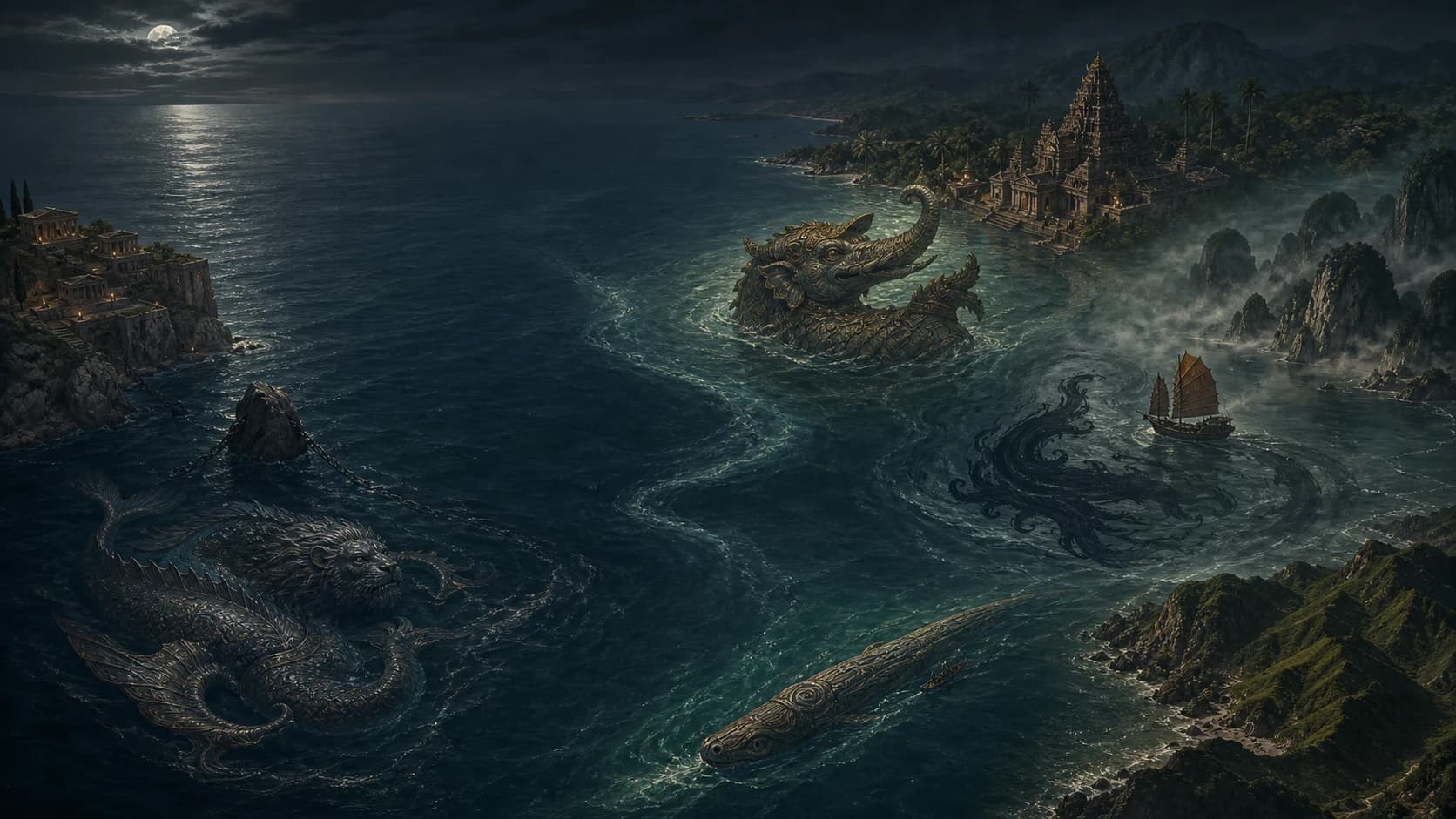 01
01Sea monsters of the world: every coast gives deep water a different verb
From the Greek ketos that consumes a sacrifice and the Indian makara that carries a water deity to China's Album of Sea Oddities, Hokusai, Māori taniwha and Mami Wata across the African Atlantic: monsters that demand, guard, guide and bestow.
Continue along the route ↗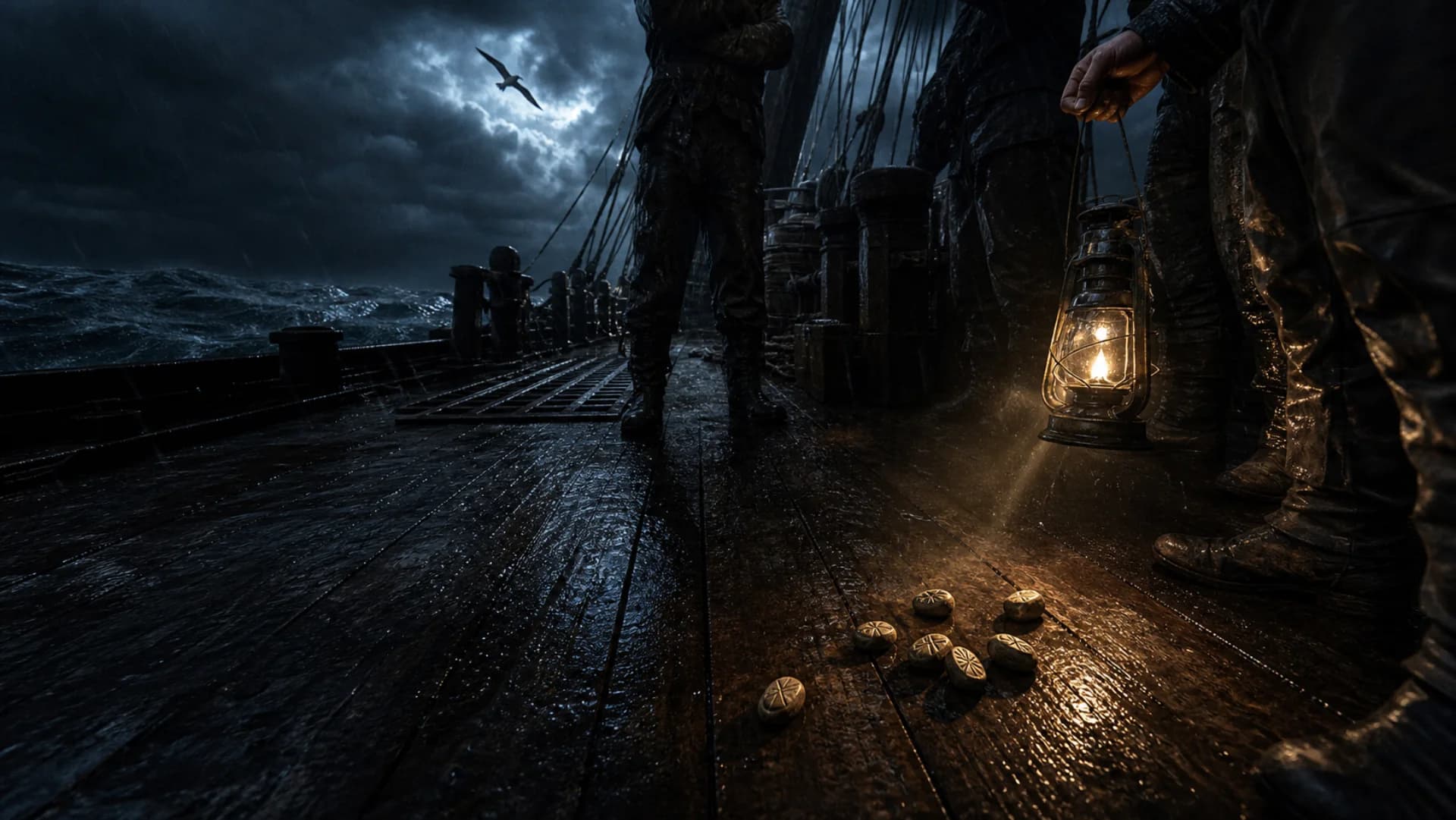 02
02Curses at sea: when the storm demands a name
From Jonah's lot and the cattle of Helios to the shot fired in 1719 and the albatross hung around a mariner's neck: how omen, transgression, name and disaster became a verdict at sea.
Continue along the route ↗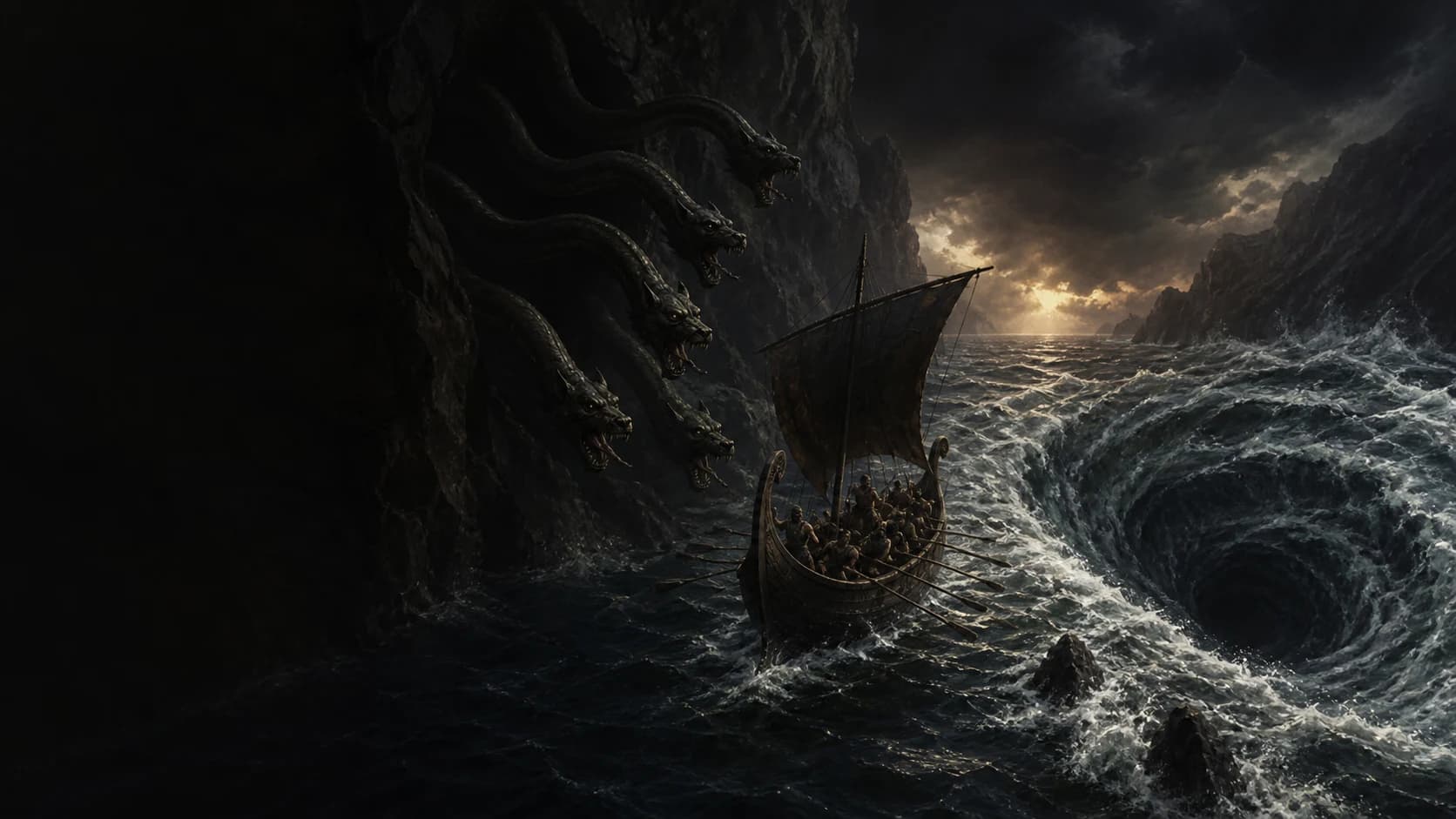 03
03Scylla and Charybdis: six men, or the whole ship
From the six sailors taken during the first passage in Odyssey 12 to Odysseus hanging from a fig tree on the second: this is not a balanced dilemma but a channel that charges a price.
Continue along the route ↗