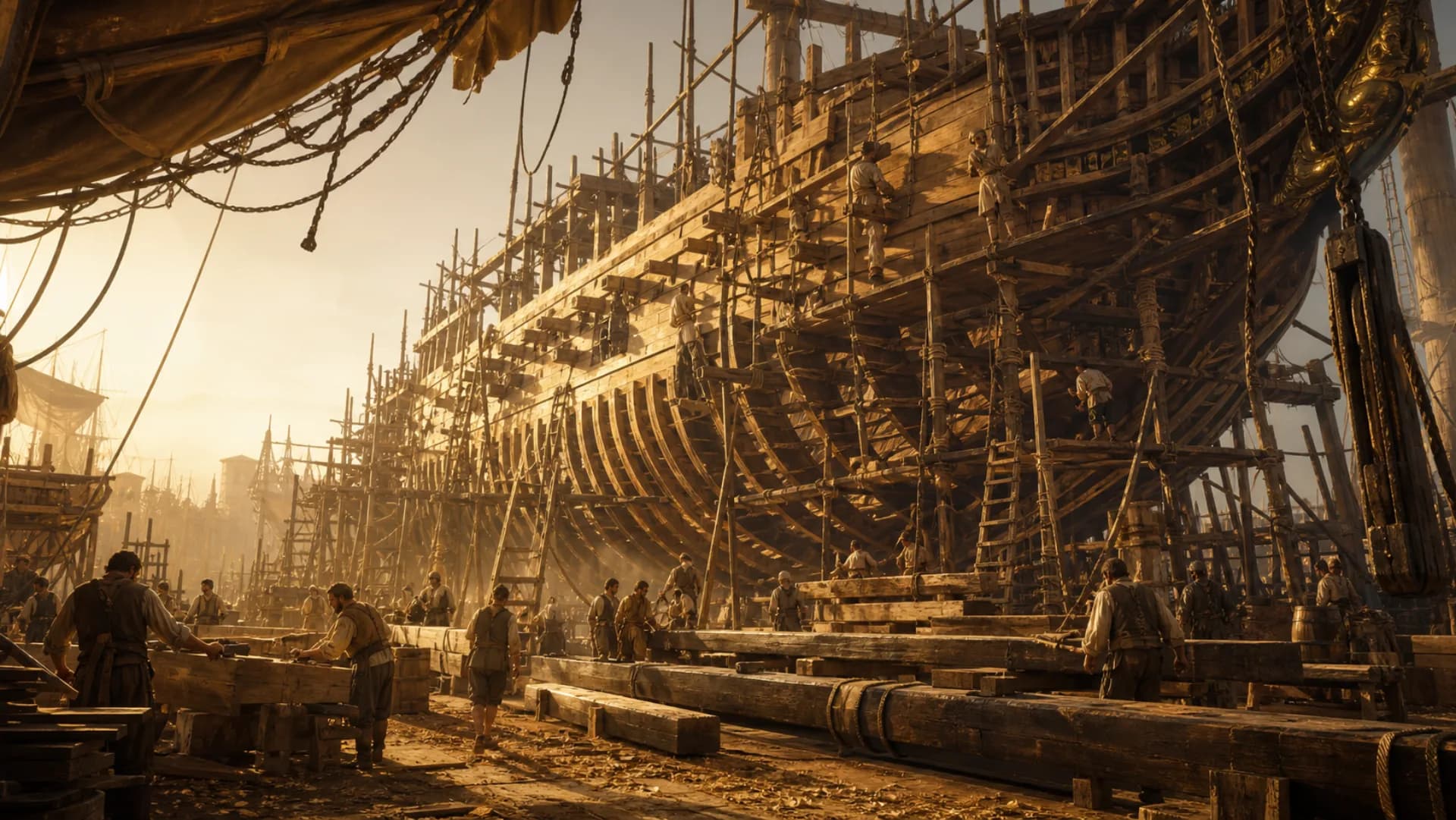
 ship structure
An old harbor photograph reveals only three masts and a row of yards
A barque is defined by the rig carried on its last mast
In the English rig classification that became stable in the nineteenth century, a barque or bark has at least three masts. All forward masts are square-rigged and only the aftermost mast is fore-and-aft rigged. On a three-master, the foremast and mainmast carry transverse yards and tiers of square sails, while the mizzen carries a spanker or other fore-and-aft sail. A four- or five-masted barque follows the same rule: square rig continues through the penultimate mast and changes only at the last one.
Square-rigged describes sails carried from yards set broadly across the ship; it does not require geometrically square sail outlines. Fore-and-aft sails work broadly along the vessel's centreline. Jibs ahead of the foremast and staysails between masts can coexist with both systems, so counting rectangular-looking patches in a photograph is unreliable. A Royal Museums Greenwich merchant-barque model of about 1880 and Luce's seamanship textbook both identify the three-masted barque by square fore and main masts with a fore-and-aft mizzen.
Neighbouring rigs are eliminated one mast at a time
A full-rigged ship has at least three masts and square rig on every mast; a barque replaces the square rig of only the last mast with fore-and-aft rig. A barquentine places square rig on the foremast alone, with main, mizzen and any further masts fore-and-aft rigged. A brig has only two masts and square rig on both, so mast count already excludes it. A schooner is primarily fore-and-aft rigged on two or more masts, although a topsail schooner can carry some square sails forward. One visible yard therefore does not automatically make a barquentine.
The National Park Service Guidelines for Recording Historic Ships presents full-rigged ship, bark and barkentine as separate sail-plan diagrams and notes that barks could have four or five masts. Its Great Lakes study also warns that historical registration and everyday usage confused bark with barkentine and brigantine. A defensible identification combines a complete sail plan, mast and spar structure, and a record from the relevant date. A distant photograph with sails furled may support a probable classification, but not always a certain one.
The fore-and-aft aftermast removed part of the square-sail workload
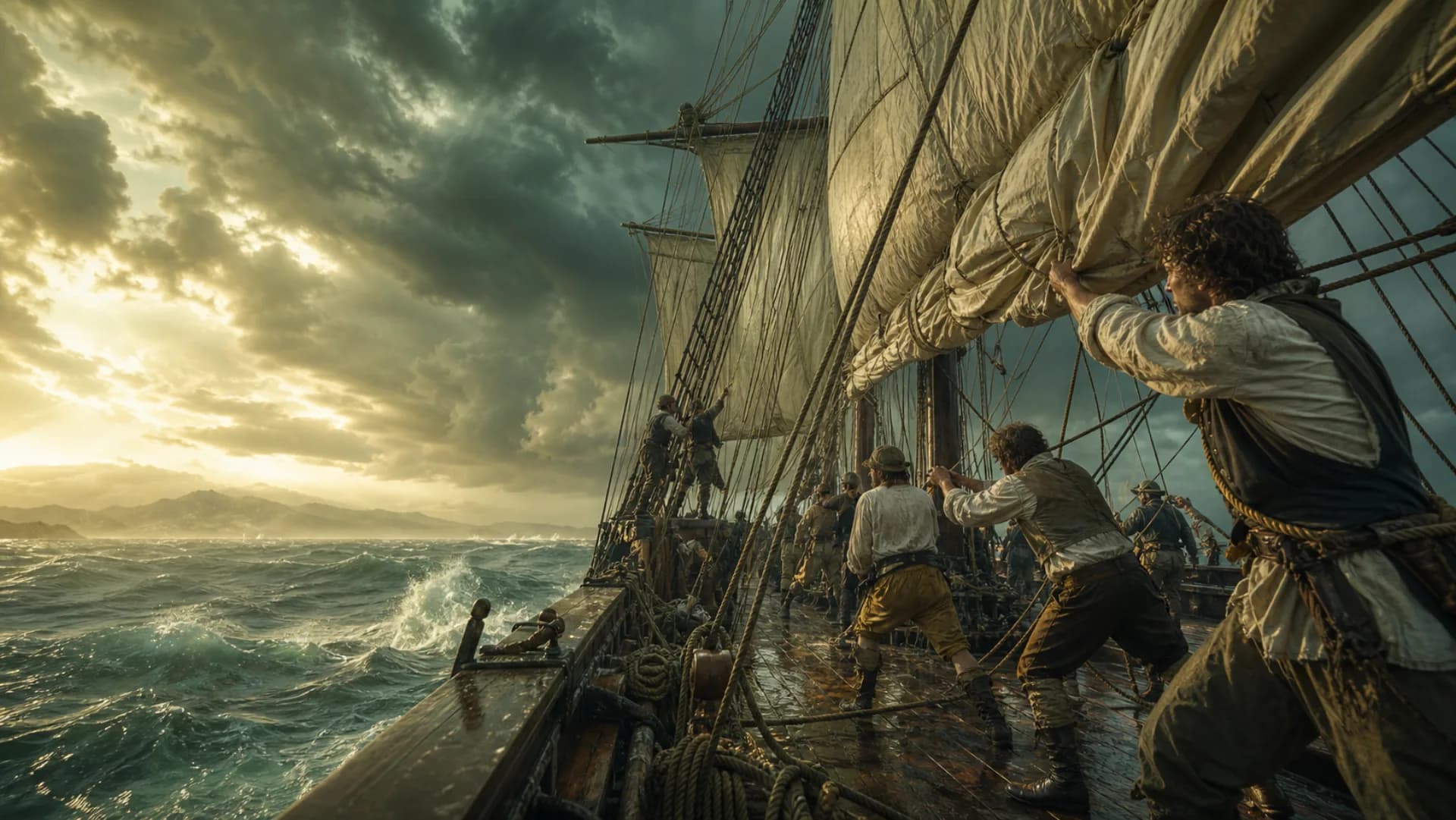
Square yards have to be braced to the wind, while reefing and furling often puts several people aloft along a yard. Replacing the aftermost square-sail suite with fore-and-aft sails removes one set of labour-intensive yards, sails and running rigging. The after sail can still help balance yaw and steering. The New Bedford Whaling Museum notes that the bark rig became popular among mid-nineteenth-century whalers because it needed fewer hands to work the sails when much of the crew was away in the whaleboats.
Fewer hands is a comparison with a similarly sized and equipped full-rigged ship, not a claim that a large barque could be handled casually by a handful of people. Manning depended on dimensions, sail area, route, watch system, machinery and safety practice. Nor does rig name alone determine speed, windward angle or cargo capacity. Hull form, displacement, stability, sail-area distribution and sea conditions all matter. The barque was an operational compromise, not a universal performance ranking above every ship or schooner.
An early bark may name a hull form or a small vessel instead
Applying the mature rig definition directly to sixteenth-, seventeenth- or eighteenth-century documents creates an anachronism. Lloyd's Register Foundation explains that merchant vessels in the mid-eighteenth century were still commonly classified by hull type. Bark was one of the labels recorded by surveyors in the 1764 Register of Ships, while rig became a more dominant identifier during the nineteenth century. British spelling increasingly favored barque; American records often retained bark. In a nineteenth-century technical context, the spellings commonly name the same rig.
The Qatar Digital Library's guide to nautical terminology in India Office Records also notes that barque or bark could be used for a small vessel from the seventeenth century onward. An early appearance of the word may therefore say nothing conclusive about the aftermost mast. Historical descriptions such as cat-built bark for Cook's Endeavour should not be turned into a nineteenth-century barque solely from that word. Start with the document's own period and administrative vocabulary, then add images, repair accounts and rigging inventories.
ELISSA shows that hull identity and rig classification can change separately
The iron merchant vessel ELISSA, built in 1877, supplies a documented three-masted example. Her U.S. National Historic Landmark documentation describes crossed yards on the fore and main with gaff rig on the mizzen. As restored, nineteen sails include a course, lower and upper topsails, topgallant and royal on each square-rigged mast; the mizzen has a gaff topsail and spanker. Jibs and several staysails fill the spaces ahead and between. Those fore-and-aft staysails do not turn her into a schooner because the principal mast-by-mast distribution remains barque rig.
The same hull received an engine and was reduced to barkentine rig in 1918 when square sails on the mainmast were replaced by a gaff mainsail. Later reductions produced a simpler schooner arrangement and eventually a motor vessel. The 1977–1982 restoration returned her to the original barque configuration, and the Galveston Historical Foundation now presents her as the 1877 iron barque ELISSA. One continuous vessel can therefore receive several valid rig labels at different dates; barque is not a biological species permanently fixed to the hull.
Archive identification starts with date, mast count and the aftermost mast
When reading a ship image or plan, establish its date before counting masts from bow to stern. Mark each mast that carries a characteristic suite of transverse yards, courses and upper square sails, then inspect the principal sails of the aftermost mast. Square rig only forward suggests barquentine; square rig on every mast suggests a full-rigged ship; square rig on multiple forward masts with only the last fore-and-aft fits the mature barque definition. A damaged, dismasted or temporary jury-rigged vessel deserves an explicitly uncertain result.
Record rig, hull, trade and date in separate fields. Wood, iron and steel describe material. Clipper or bluff-bowed can describe hull form or performance intent. Whaler, cargo carrier and training ship describe service. Barque describes the sail-and-spar arrangement, and all of these labels may truthfully occur in one complete description. Citing the registry year, conversion period and observed rig state gives another researcher a path to reproduce the identification, which is more useful than forcing a precise ship type from one blurred patch of canvas.
Questions
Continue exploring this subject
What is a barque sailing ship?
A barque has three or more masts, square rig on every mast except the last, and fore-and-aft rig on the aftermost mast. American sources often spell the word bark.
What is the difference between a barque and a barquentine?
A barque is square-rigged on all but its last mast. A barquentine is square-rigged only on the foremast, with every following mast fore-and-aft rigged.
Does a barque always have three masts?
No. Three-masted examples are common, but four- and five-masted barques existed. The defining rule still leaves only the final mast fore-and-aft rigged.
Are bark and barque different rigs?
Usually not in nineteenth-century and later technical usage: bark is common American spelling and barque common British spelling. Earlier bark can also be a general vessel or hull term.
Why can a barque carry staysails without becoming a schooner?
Classification follows the principal rig on each mast. Jibs and staysails are normal additions and do not by themselves replace the square-rigged fore and main masts that define a three-masted barque.
Sources
Continue the research
- Cargo vessel; Barque, circa 1880Royal Museums Greenwich
- Text-Book of Seamanship: Types of vessels and rigsHistoric Naval Ships Association
- Guidelines for Recording Historic Ships, Third EditionU.S. National Park Service
- Great Lakes Sailing Vessels: Associated Property TypesU.S. National Park Service
- Vessels and Terminology: BarksNew Bedford Whaling Museum
- Research guide: Eighteenth- and nineteenth-century rigsLloyd's Register Foundation
- Nautical Terminology in the IOR Files: European Ships in the Age of SailQatar Digital Library
- ELISSA National Historic Landmark documentationU.S. National Park Service
- 1877 Tall Ship ELISSAGalveston Historical Foundation
 04
04 05
05