INPUT
→Assess
Separate wound, fracture, tooth, infection sign and ordinary disease.
A real Age of Sail career dossier · 13
Barber-Surgeon · Chirurgeon
A practitioner who treats maritime injury with recognized manual skill and a finite chest while barbering and surgery separate around him.
Barber-surgeon names a profession and institution specific to certain places and periods, not every Age of Sail medical officer. London's barbers and surgeons united as the Company of Barber-Surgeons in 1540. A trained surgeon could go to sea to treat illness, wounds, fracture and dental trouble and keep a medical chest. The Mary Rose surgeon had a seven-year apprenticeship and examination behind him, while an assistant may have done routine hair cutting. London formally separated the occupations in 1745, after which calling every British naval surgeon a barber-surgeon becomes increasingly misleading.
Information arrives, judgment forms, and work passes on through a complete watch.
Separate wound, fracture, tooth, infection sign and ordinary disease.
Choose station, assign assistance and draw finite instrument and dressing.
Clean, dress, splint, extract, compound medicine or operate when necessary.
Review change, replenish the chest and explain voyage health risk to command.
The Mary Rose case joins a trained surgeon, extensive chest, cramped cabin and assistant division.
The East India Company selected surgeons and standardized chests, supply and printed sea guidance.
Institutional separation made naval surgeon increasingly an independent office.
Read hemorrhage and tissue damage, clean, dress, splint and operate when required.
Handle diseased teeth, abscess, skin complaint and daily instrumental cases.
Identify, preserve, prepare and replenish medicine, dressing and instrument.
Build trust through master, examination, case and voyage experience and judge change.
Institutions, experience, patronage, and opportunity shaped each person’s route.
Learn instrument, medicine and patient care under a master.
London's system granted standing after long apprenticeship and peer scrutiny.
Take more independent cases through chest and voyage experience.
After 1745 the British path increasingly belonged to the separate surgical profession.
Barber-surgeon best describes guild traditions in parts of late medieval and early modern Europe and practitioners in or beside combined barbering and surgical work. Titles and qualifications differed among cities, states, armies, navies and merchant services. A sixteenth-century London institution cannot simply be projected onto a seventeenth-century Dutch merchantman or a nineteenth-century British warship.
This dossier concentrates on English maritime examples from the Tudor period to the mid-eighteenth century. A vessel principally needed practical skill with trauma, dental trouble, ordinary disease, drugs and instruments. Shaving did not itself qualify someone for difficult surgery, while membership in a combined company did not prove that every surgeon cut the whole crew's hair each day.
The Royal College of Surgeons records that statute united London's barbers and surgeons in 1540 as the Company of Barber-Surgeons. The city company enrolled members, organized apprentices, examined entrants and governed occupational standing. Barbers initially held senior institutional weight, while surgeons increasingly pressed for independence as hospital work, anatomy teaching and professional reputation developed.
Union was first an arrangement of governance, training and credential, not a checklist made by adding every job together. A member enrolled and regulated in London might practise elsewhere; other ports and countries had their own systems. One universal barber-surgeon licence would erase the useful friction of whether a guild, owner, army or navy recognized a person's credential.
RCS records describe a typical seven-year apprenticeship followed by examination before the Court of Examiners; Mary Rose interpretation gives its surgeon the same apprenticeship and examination background. Apprentices learned with a master to identify instruments and medicines and handle wound, fracture, tooth and patient before peers judged whether they could practise independently.
That path was neither a modern medical degree nor a European licensing standard. Other practitioners learned through armies, hospitals, local guilds, family shops or assistant service at sea. A credible dossier records place of training, master, company freedom and sea experience separately instead of flattening them into one medical level.
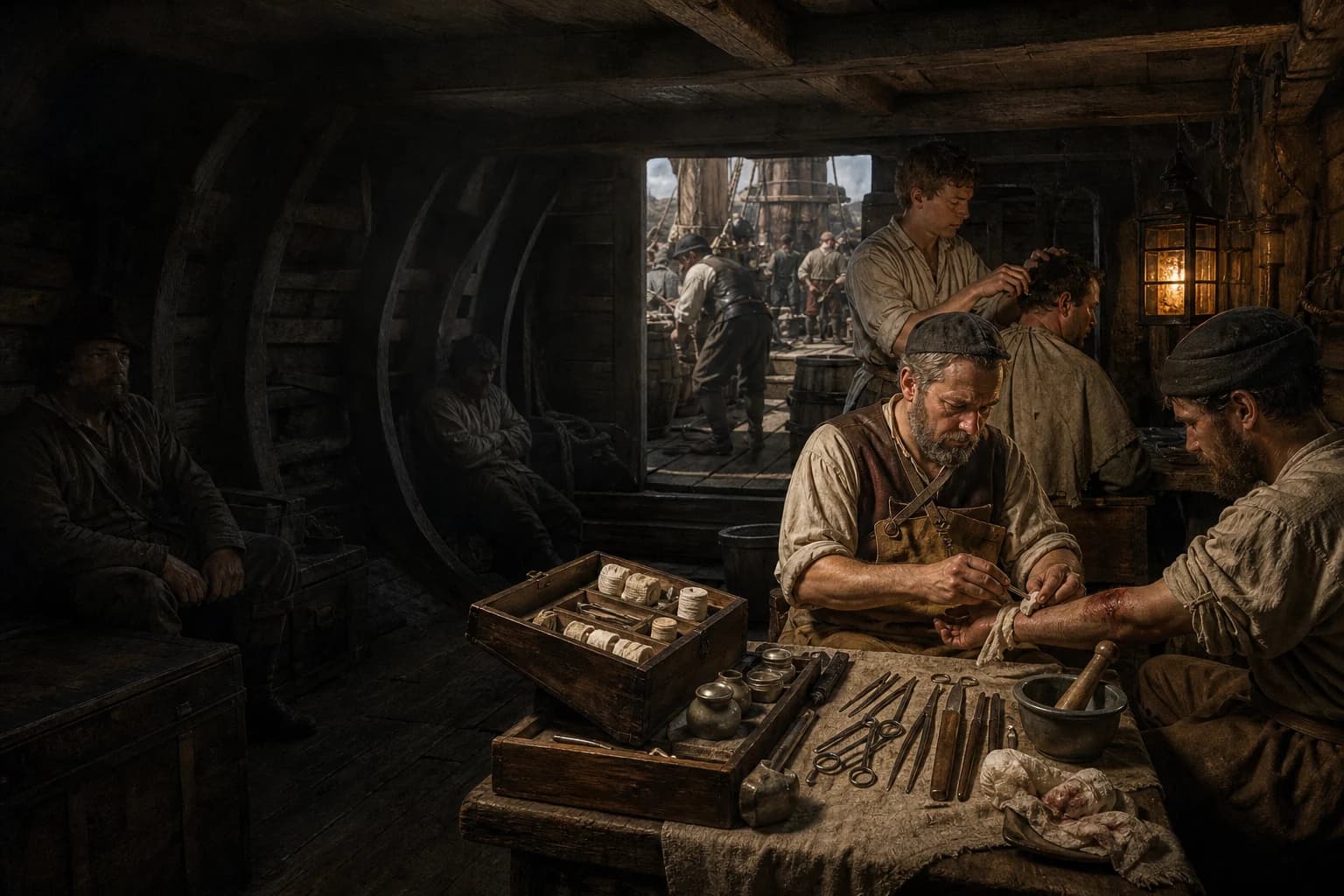
The Mary Rose, lost in 1545, supplies unusually rich material evidence. Its surgeon possessed a chest containing instruments, ointment vessels, syringes, spatulas, dental forceps and other equipment, while his belongings indicate a man above ordinary labouring status. His private cabin was too small and dark for every treatment, so difficult cases were probably handled in a more open part of the lower deck.
The assemblage also contained razors and barbering equipment, but Mary Rose interpretation suggests that an assistant probably handled basic washing and hair cutting. That division is more persuasive than the popular one-man caricature: the trained hand assessed and treated, an assistant prepared tools, attended patients and took elementary work, and space and injury determined the treatment station.
An early surgeon faced cuts from rope, block, fall and blade, set or splinted fractures, treated abscess and skin complaint, pulled diseased teeth, and attended fever, flux and passage-long debility. Only catastrophic damage might lead to amputation. In Joseph Atkins's account of a 1711 Royal Navy case, renewed bleeding led the surgeon to tighten a tourniquet again and use a heated cautery; this is one documented naval operation, not a universal barber-surgeon sequence. Hemorrhage control, cleaning, dressing, splinting and watching recovery filled more ordinary practice.
Knowledge remained constrained by humoral theory, limited pharmacology and the pre-germ world. Without modern anaesthesia, antibiotics or an aseptic theatre, pain, shock, infection and gangrene could defeat a technically completed operation. Capacity should therefore emerge from judgment, instruments, dressings, clean water, assistance, room and the patient's strength—not a magical healing statistic.
John Woodall was a freeman of the Barber-Surgeons' Company and became the East India Company's first Surgeon-General in 1613. He treated company dockworkers but also selected surgical personnel and equipped and supplied surgeons' chests for outward ships. An oceanic corporation required a repeatable medical supply and staffing system, not one heroic healer.
Woodall's The Surgeon's Mate, published in 1617, described the chest's arrangement, instruments, medicines and uses and addressed gunshot, gangrene, plague and scurvy at sea. His observation of citrus value against scurvy did not instantly create modern nutrition policy. Print, supply and voyage experience advanced together while cost, older theory and execution slowed adoption.
A large warship or company vessel could carry a surgeon, mate or assistant and divide examination, instrument preparation, patient attendance and elementary barbering. A small merchant vessel might carry only a chest and a hand with some experience, without any qualified surgeon. A captain could order sanitation or decide to seek a port but did not thereby acquire surgical competence.
Physician, apothecary, surgeon, barber and attendant overlapped differently across societies while retaining distinctions. University physicians leaned toward learned physic and status, apothecaries toward preparation of drugs, and surgeons toward manual treatment; limited manpower nevertheless forced overlap at sea. That is a contextual compromise, not evidence the professions were always identical.
As surgical teaching, hospital practice and professional identity grew, London's surgeons sought departure from the united company. An Act of Parliament separated them in 1745. Their new Company of Surgeons gained authority to examine and approve practitioners for army and navy. This was an important London and British transition, not a switch that ended every combined practice worldwide on one day.
The National Archives places later Royal Navy surgeons in formal officer records and notes that they were warrant officers before 1843. That administrative continuity shows surgery established as a distinct naval office. Barber-surgeon therefore fits an early tradition and transition, but should not replace ship's surgeon across the full Age of Sail.
Income might combine navy or company salary, merchant-voyage contract, private patient fees, a shore shop or hospital office. Whether the practitioner supplied instruments and drugs and recovered their cost materially changed earnings. The Mary Rose surgeon's belongings suggest relative standing but cannot generate a pay table for every fleet.
A path could run from apprenticeship through examination and company freedom into a warship, merchant voyage, East India Company, hospital or shore practice; an assistant might gain enough practice for independent appointment. Reputation grew from surviving cases, a dependable chest and recognized credential, and fell through death, shortage, disputed qualification and failed treatment.
career.barber-surgeon
No. It was a place- and period-bound guild and occupational tradition. Surgery and treatment were the trained practitioner's core work; an assistant might do basic barbering, and later naval surgeons held independent office.
No. Guild union did not give every member equal surgical competence. Apprenticeship, examination, master and experience mattered, while local rules also set boundaries.
Yes, the assemblage includes razors and barbering objects, but the museum suggests an assistant may have performed routine washing and hair cutting. They do not show surgery was secondary.
No. Cleaning and dressing wounds, splinting fractures, dental extraction, abscesses, fever and ordinary attendance were more routine. Amputation answered some unsalvageable limb injuries.
The Company of Barber-Surgeons generally used a seven-year apprenticeship and examination. That describes London and should not be treated as a universal European qualification.
London's surgeons separated from the barbers in 1745 and built an independent company with army and navy examination powers. Naval surgeon increasingly named its own profession and office.