INPUT
→Coordinate
Clear worship, class, sick visit and burial windows with command and watch.
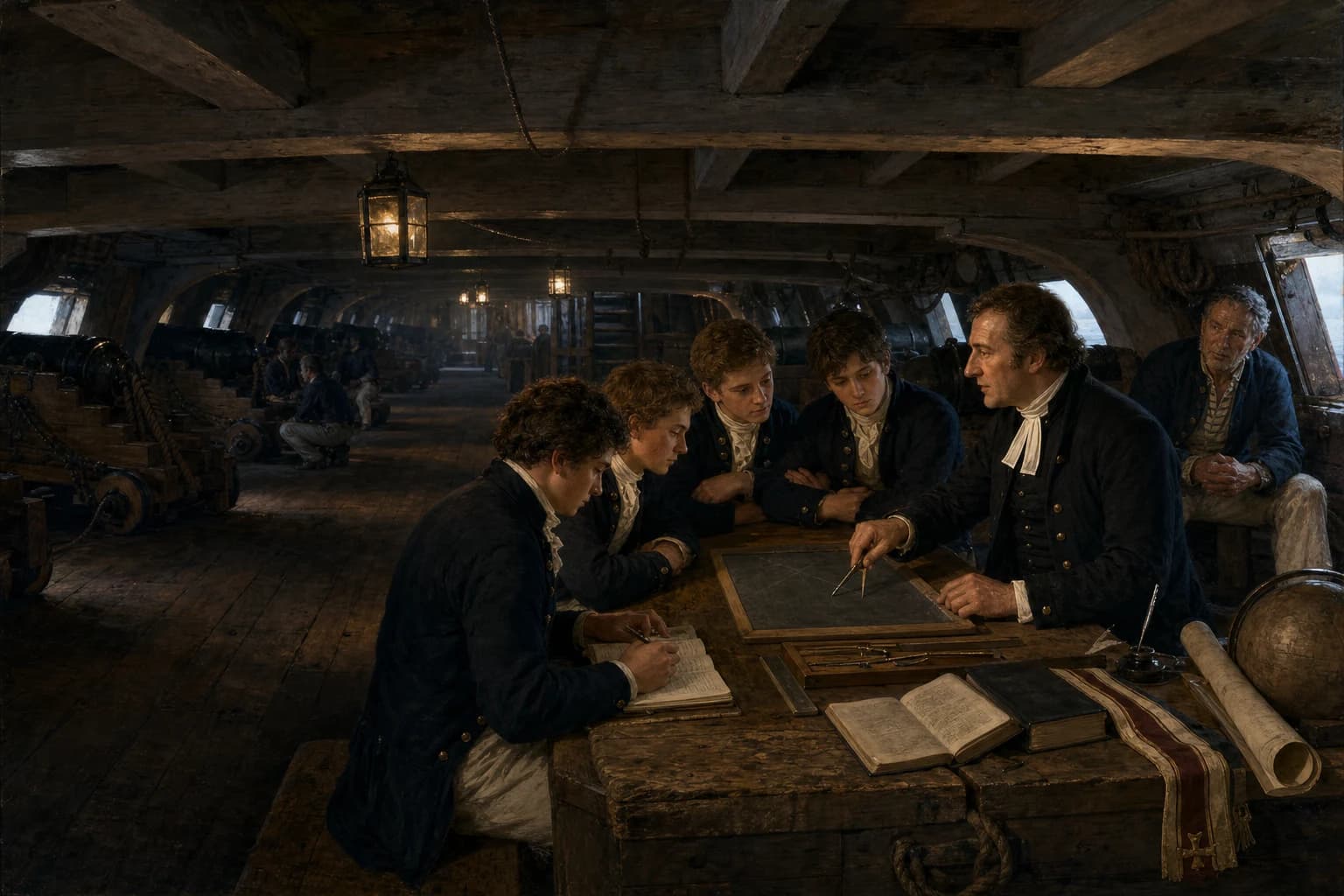
A real Age of Sail career dossier · 11
Naval Chaplain · Ship’s Chaplain
A figure without ship command who links ranks through rite, teaching, language and one-to-one trust.
An Age of Sail naval chaplain conducted appointed worship and funerals, visited the sick and offered pastoral support. In the early United States Navy he also served formally as a teacher of writing, arithmetic and navigation to midshipmen and boys, and could act as flagship secretary or interpreter. He did not hold the captain's disciplinary power, and not every ship carried one. Qualification, denomination, status and practical influence varied by service, date, captain and operational demand.
Information arrives, judgment forms, and work passes on through a complete watch.
Clear worship, class, sick visit and burial windows with command and watch.
Arrange service text, lesson, instrument, list and individual need.
Conduct, teach, visit or translate across rank within operational limits.
Record only what is required, protect confidence and follow grief and learning.
Most likely to carry a formal chaplain and add language, secretarial or squadron work.
Often lacked a chaplain and covered worship, education or last care only informally.
Qualification, audience and status depended on established church, denominational policy and mission.
Fit worship and burial into windows allowed by weather, watch and readiness.
Teach writing, arithmetic, journal and navigation foundations through interrupted study.
Hear grief, fear and conflict while preserving confidence across rank.
When qualified, handle foreign text, translation, secrecy and correspondence.
Institutions, experience, patronage, and opportunity shaped each person’s route.
Denomination and service decided whether ordination was required.
Learning, conduct, recommendation and sea fitness supported appointment.
Combine rite, education and care inside limited space and command constraints.
Sea-going language, teaching and administration opened several shore paths.
English monarchs ordered chaplains into warships in the seventeenth century, yet evidence assembled by Royal Museums Greenwich shows lasting shortfall. In 1815 one critic put the total below one clergyman for every five ships of the line and said appointments were effectively confined to that class. Small warships, merchantmen and temporary armed vessels commonly lacked a dedicated chaplain.
Religious systems at sea were not interchangeable. Formal Royal Navy chaplaincy remained exclusively Anglican for centuries, with equal status for Catholic and other provision far beyond the sailing era. The early United States Navy used a different appointment logic. Chaplain is therefore a working category whose documents may instead say priest, minister, schoolmaster or missionary outside a naval establishment.
United States regulations of 1814 ordered the chaplain to read prayers at stated periods. British sea instructions of 1806 required divine service and sermon on Sundays, but only when ship duty or weather did not absolutely prevent it. A working deck was cleared and the company mustered rather than a permanent church appearing aboard.
Watch, sail evolution, chase, storm, sickness and readiness interrupted the ideal timetable. RMG cites an 1802 chaplain who complained that daily ship duty did not allow the prescribed daily ceremony. Chaplain coordinated time, place, muster and order with captain and first lieutenant; he prepared the service but could not stop dangerous shiphandling for a sermon.
The 1814 rules required funeral ceremonies for those dying in service aboard the chaplain's vessel and, by command, for a person from another public ship. Earlier British and American duty descriptions likewise joined burial of the dead with prayer and visiting the sick. Preparation, timing, muster and disposal needed many hands and command approval rather than chaplain alone.
Disease, accident and battle could make deaths consecutive on a long cruise. Ceremony acknowledged a person and helped those returning to watch understand the loss; enemy contact or heavy weather could shorten it. Officers, purser and clerk handled death record, effects, wages and notice. The chaplain centered rite and care for the living.
The Constitution Museum says education mattered more than religious zeal to early U.S. selection: most chaplains were college educated while few were ordained ministers. The 1814 regulations formally made chaplain a schoolmaster teaching midshipmen and volunteers writing, arithmetic, navigation and whatever else contributed to proficiency.
Other youths could be taught by captain's order. Lessons fitted around watch and duty, using slate, journal, chart, arithmetic and navigation tools rather than a shore term. U.S. naval history notes no standard curriculum, sometimes-voluntary attendance and commanders who wanted young officers elsewhere. A written duty did not guarantee a daily class.
A chaplain could teach writing and arithmetic with navigation in an officer's education; the sailing master bore professional responsibility for route, position, chart, log and safe navigation. A separate schoolmaster, when carried, could take systematic instruction. Explaining a calculation did not create authority in fog or dangerous pilotage.
Teaching helped a young midshipman turn observation into recorded and checkable judgment, write a journal, read orders and prepare for greater office. Literacy made the chaplain a knowledge node, not an expert in every maritime trade. Navigation in a syllabus must remain distinct from navigating the ship.
Eighteenth-century descriptions told the chaplain to visit and comfort the sick. RMG observes that chaplains could meet officers and ratings privately across rank, seeing fear, grief, family anxiety and conflict before many others. Trust accumulated through conduct; it did not arrive automatically with appointment.
He did not diagnose in place of the surgeon. British accounts even note that visiting the sick could depend on the surgeon's goodwill, while contagion, crowding, treatment and rest constrained entry. Chaplain addressed meaning and distress, surgeon disease and wound, captain shipwide action—each without swallowing another office.
A duty description expected the chaplain to model religion, morality and virtue and discourage vice. Worship, conversation and admonition might address drink, fighting, gambling, profanity or despair, but did not make him court-martial, master-at-arms or captain. Sacred office alone did not authorize irons, flogging or reversal of sentence.
The position without direct coercion was both fragile and useful. A chaplain too visibly reporting every private concern to the wardroom lost lower-deck confidence; one confronting every order could lose captain-provided time and space. Professional judgment meant choosing public and private channels and making advice heard without disguising it as command.
The Constitution Museum says a squadron flagship chaplain often served the commodore as secretary. A precise British example is HMS Victory's Alexander John Scott. Fluent in French, Spanish and Italian, he handled foreign correspondence, intercepted papers, translation and private secretarial work for Nelson beside his formal chaplaincy.
Personal ability and flagship demand produced such combinations; they were not standard duties of every chaplain. They show how accurate writing, language, secrecy and cultural interpretation could affect diplomacy, intelligence and orders. A game should split learning into teaching, language, clerical accuracy and pastoral trust instead of one universal intelligence score.
The National Archives includes pre-1843 chaplains among warrant-officer records; RMG notes their first appearance in the Navy List in 1814 and commission appointments from 1844. Earlier British chaplains complained of undefined position, little working space and awkward status. Those later changes cannot be projected backward onto every seventeenth-century ship.
For one early U.S. example, the Constitution Museum gives forty dollars per month and two rations and says most chaplains served a year or less. Entry might combine university or theological education, ordination, languages, recommendation and public appointment differently. Departure could lead to parish, school, administration or translation rather than a ladder toward military command.
career.naval-chaplain
No. British orders repeatedly called for them, but actual numbers stayed low and concentrated in ships of the line and flagships. Small warships, merchants and temporary armed vessels often had none.
No. He could conduct funerals, visit the sick and offer counsel; early U.S. chaplains also taught writing, arithmetic and navigation, and flagship chaplains might serve as secretary or interpreter.
It depended on the service. The Constitution Museum says many early U.S. chaplains were college educated but not ordained, while Royal Navy chaplaincy remained tied to Anglican clergy.
Not by sacred office alone. He could admonish or advise command, but confinement, flogging, court martial and orders belonged to the captain and naval disciplinary system.
No. The chaplain could teach writing, arithmetic and navigation foundations; the sailing master bore operational responsibility for route, position, log and safe navigation.
University or theological education, ordination, teaching and language skill, recommendation and naval appointment entered in different combinations by country and date. No single route covered the era.