INPUT
→Receive
Hear task, place, deadline and reporting hand exactly.
A real Age of Sail career dossier · 12
Cabin Boy · Ship’s Boy · Boy
The newcomer who enters the sea system through its smallest jobs and trades accuracy, endurance and visible skill for harder assignments.
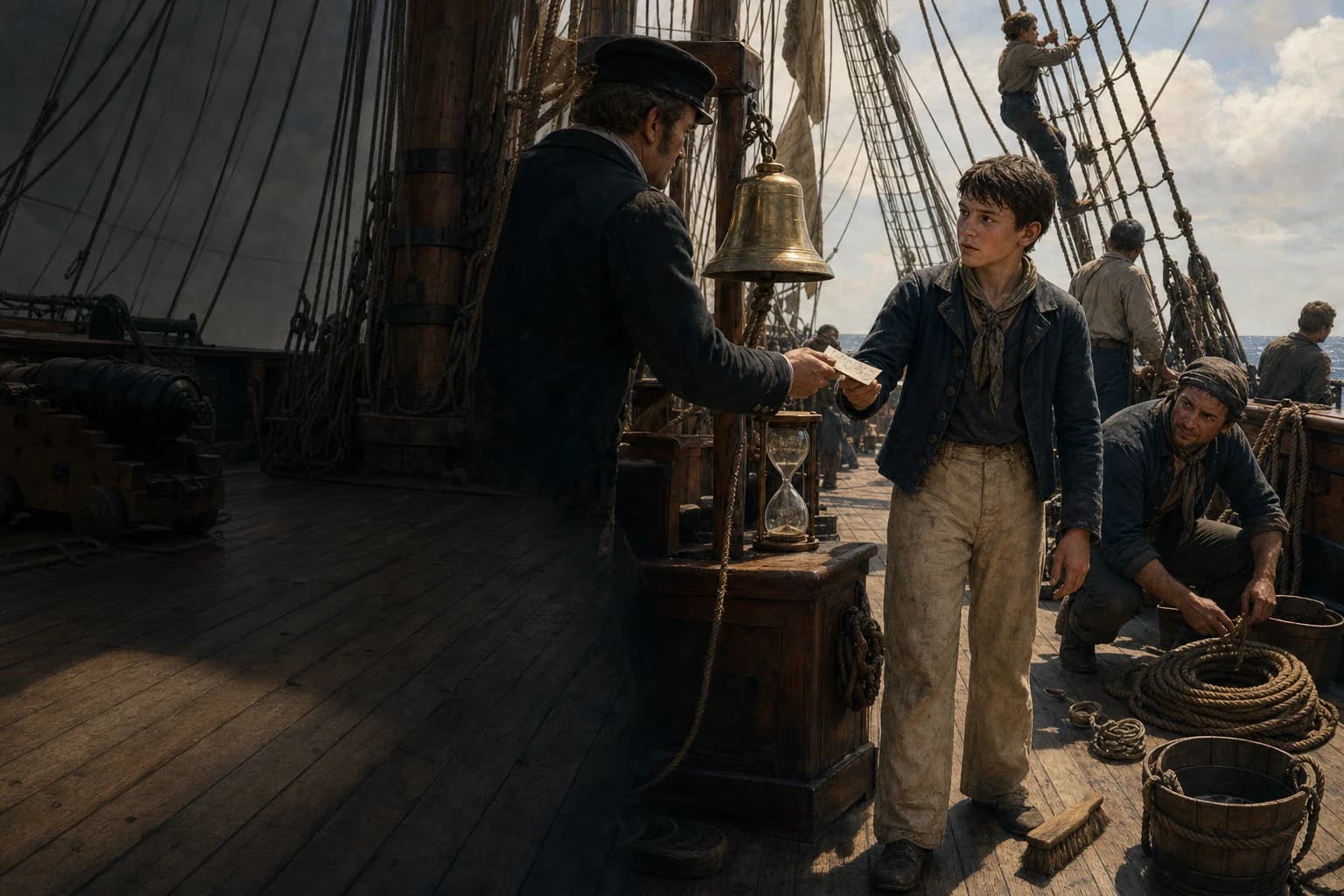
An Age of Sail cabin or ship's boy was commonly an inexperienced teenager who swept, ran messages, watched the glass and bell, coiled rigging, served officers and learned knots and sails through work. Some passed powder or shot in battle. The name was not one age certificate: Boy in the early U.S. Navy was first an experience rating and could include adults. Cabin boy, merchant apprentice and midshipman carried different status, contracts and prospects.
Information arrives, judgment forms, and work passes on through a complete watch.
Hear task, place, deadline and reporting hand exactly.
Clean, carry, strike, serve or complete elementary rope work.
Accept inspection by an experienced seaman and redo faulty work.
Convert reliability into harder duty, higher rating or specialist branch.
Boy was a low rating allocated to messages, bell, maintenance, light sails or battle relay.
Cabin boy, master's boy, ship's boy or apprentice carried very different contract and training.
Some youths embarked as midshipmen through a separate appointment and social route.
Keep the original words, find the recipient, choose a safe route and confirm delivery.
Watch and turn the glass and strike the bell correctly through routine.
Recognize common lines and coil, knot, splice and assist with light sails.
Follow safety command and sequence on wet, rolling, high and crowded surfaces.
Institutions, experience, patronage, and opportunity shaped each person’s route.
Age, experience, family and contract did not form one gate.
Build trust through message, bell, knot, cleaning and light sails.
Demonstrated ability opened deck, rigging, gun and craft branches.
Education, patronage, appointment and chance controlled movement across rank.
Comparative seventeenth-century merchant research finds Dutch cabin watchers commonly aged thirteen to sixteen, attending captain and officers and sometimes learning toward officer work; the English master's boy or ship's boy was not necessarily a formally recognized office. Cabin boy could describe location and service as much as a standard rank.
Boy was clearer as a low U.S. naval rating. The Constitution Museum stresses experience rather than age: most were mid- to late-teen novices, probably on a first cruise, but an adult without sea experience could receive the rating. This dossier uses cabin boy as searchable shorthand while retaining the source term for each institution.
A seafaring family might place a son with a known master; merchants needed cheap novices; wartime navies needed manpower; a youth might seek wages, ration or escape from shore hardship. Britain's Marine Society trained poor children from thirteen for the king's ships, showing charity, labour discipline and military recruitment overlapping.
That was not automatically free adventure. Guardian, parish, sponsor or owner might decide for the youth, and unequal power raised risk of withheld pay, violence and inability to leave. Central British merchant-apprentice records begin mainly in 1824, usually with four- or five-year indenture to a master. That later form must not be projected unchanged into the sixteenth century.
A Constitution Boy might sweep and scrub, slush masts, coil running rigging after evolutions, work around the galley or serve an officer. Low-status labour joined hygiene, line safety, cabin routine and the next sail evolution. A foul coil was not merely untidy when an emergency demanded the rope run free.
Some were classed among idlers, men outside the ordinary two-watch rotation, but the term did not mean idle. They followed special duties and turned out when all hands were called. Small merchants might combine cabin, meal, cleaning and deck assistance in one youth; a frigate could distribute novices by department.
Time at sea was divided with a sandglass and announced by bell. U.S. naval history records a ship's boy watching and turning the glass when it ran out. A missed turn or wrong bell could disturb watch, speed measurement, meal and relief. High frequency and easy supervision made the task basic while its consequences trained reliability.
USS Independence orders of 1815 selected three smart boys in each watch for quarterdeck messages and to call midshipmen from below; an orderly near the captain's door carried his orders. The runner did not decide content, but had to find the right person, repeat exactly, take a safe short route and report completion.
The Constitution Museum calls Boys apprentice seamen. Coiling taught knots and splices; some went aloft to loose or furl light sails. Experienced hands demonstrated, corrected and increased difficulty. Deck competence did not yet mean independent work at night, in storm or high above the yards.
Progress belonged to observable skills: recognizing lines, following orders, balancing, securing, reading routine and reaching the right station at all hands. Ordinary or able seaman was the direct path for most. Literacy, mathematics, patronage and social position affected entry to specialist or officer tracks.
A master's or cabin boy cleaned space, carried food, tended clothes, ran errands and waited on command. Proximity to captain or wardroom exposed a youth to charts, papers and officer conversation and might earn recommendation. Nearness to power did not give power or guarantee instruction.
Private service competed with ship duty and made appraisal depend heavily on one officer. Abuse, overwork, humiliation and favoritism were hard to challenge in a closed vessel. A career model needs mentor, departmental training, contract protection and abuse risk separately rather than a guaranteed promotion for serving a good captain.
A Constitution quarter bill from late 1812 assigned powder passing to eleven Boys, eight ordinary seamen, two able seamen and four hands of uncertain rate; an 1814 bill again mixed ratings. Some youths took pass boxes from a hatch to their gun, but boys did not monopolize the duty.
A human chain moved cartridges from magazine through scuttles and levels, avoiding chaos on ladders. A boy collected a full pass box for his section, delivered it and returned the empty while shot, smoke, darkness, splinters and explosion surrounded him. The nickname hides the formal quarter bill, segmented relay and adult participation.
In the Constitution Museum's 1812 U.S. example, Boys earned roughly six to ten dollars monthly at the bottom of the hierarchy. Wage, ration and slop charge must stay tied to service and date. Merchant youths might receive monthly, voyage or indenture terms, sometimes with benefit controlled by guardian or master.
Fall from aloft, recoiling rope, cold and wet, deficiency, disease, violent discipline and battle did not spare a young hand. Small size helped in some spaces but reduced strength, warmth and self-protection. History should neither reduce boys to passive victims nor call actual harm character-building adventure.
Reliable cleaning, message, bell and rope work could bring a higher seaman rating and then deck, boatswain, gun, carpenter or other specialist track. Independence orders promised consideration in advancement and indulgence for alacrity and good conduct, making daily report and superior judgment consequential.
Midshipman was a separate officer-training status involving literacy, mathematics, recommendation, social resource and appointment. A few cabin watchers learning toward office do not prove every boy could captain a ship. Completing merchant indenture established employability, not command. A credible tree permits growth, transfer, escape, injury and long lower-deck service.
career.cabin-boy
Many were about twelve to sixteen or in their mid- to late teens, but no single age applied. Boy in the early U.S. Navy was an experience rating and could include an adult novice.
No. Cabin and ship's boys performed service and novice seamanship; midshipman was an officer-training appointment with different education, patronage and status.
No. Some passed powder or shot, but Constitution bills assign the chain to ordinary and able seamen too, while many boys held messenger and other stations.
Some U.S. Boys were idlers outside the normal two-watch rotation, yet worked assigned routines and turned out at all hands and battle. Other services arranged them differently.
Through corrected work in cleaning, coiling, knots, light sails, bell and messages, taking harder tasks as competence became visible. Formal schooling depended on vessel and service.
No. Progress to ordinary or able seaman was more direct. Officer entry also required education, recommendation, appointment, capital or opportunity behind strong social barriers.